
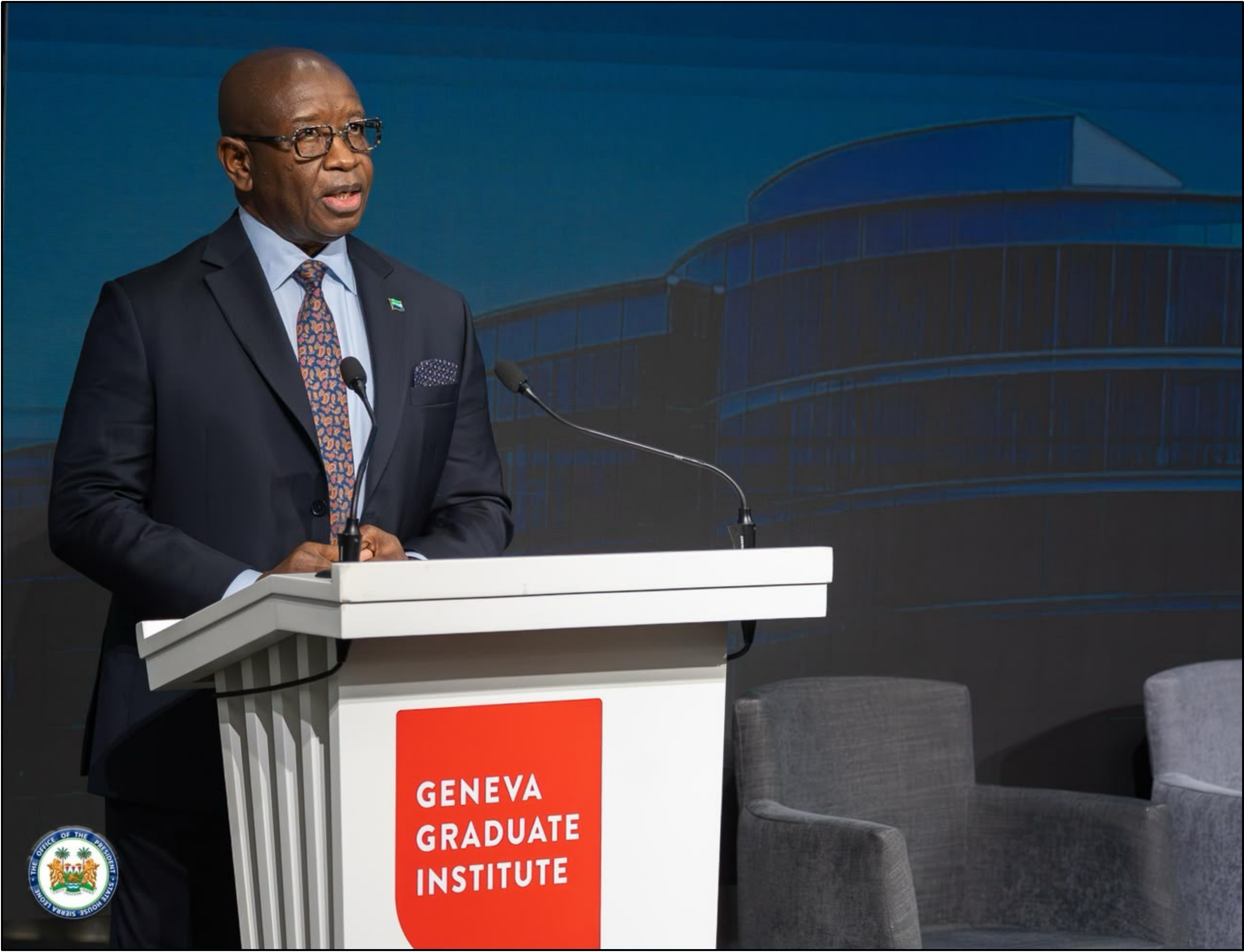
Dr Julius Maada Bio
GENEVA, Switzerland, October 2026 – Sierra Leone’s President, Dr Julius Maada Bio, has outlined five priorities for building lasting peace in Africa, saying peace is not only about ending conflict, but also about tackling the conditions that allow it to take root.
President Bio gave the keynote lecture “Building Lasting Peace in Africa: The Catalytic Role of ECOWAS” at the Geneva Graduate Institute as part of the institution’s Director’s Global Leadership Series. He called for stronger democratic institutions, preventive diplomacy, enhanced regional cooperation, people-centred security and assured financing of African-led peace operations.
Peace starts with the absence of war. It doesn’t promise anything,” he said.
Drawing on his experience as a former soldier, Sierra Leone’s post-war recovery and his stint as immediate past Chairman of the ECOWAS Authority, Bio reflected on the country’s transformation from receiving international peacekeeping assistance to contributing to peacekeeping efforts elsewhere.
Regional and international partners can help create the conditions for peace, but cannot secure it by itself, he said. But he also argued that sustained peace requires national ownership, justice, and effective institutions that serve the public and earn its confidence.
“One of my priorities is to prevent conflicts from escalating,” he stressed. Bio proposed a Regional Prevention Compact that would set agreed-upon early-warning triggers and automatically launch mediation when signs of crisis emerge. He said early intervention could help settle disputes before they escalate into wider conflicts.
He also called for strengthening democratic institutions and more accountable governance. He said peaceful transfers of power and public confidence in institutions were key to avoiding instability. He cited Sierra Leone’s peaceful transitions of power in 2007 and 2018, and called on policymakers to broaden their vision of peacebuilding. The success should be judged not by the wars ended, but by the wars prevented.
On regional cooperation, Bio promoted what he termed “cooperative sovereignty”, meaning West African countries should work together to face common security threats instead of acting individually. He emphasised the need for dialogue with Burkina Faso, Mali and Niger. Still, he admitted that ECOWAS has to learn from its mistakes and prove its value through tangible benefits for the people.
Bio also stressed that security efforts should target people. He called for more investment in opportunities for young people, warning that it is difficult to sustain peace when people experience insecurity, injustice and economic exclusion. “Creating opportunities for young people is part of addressing the circumstances that can lead to conflict,” he said.
He also emphasised the need for sustainable funding to African-led peace operations. He also reiterated Sierra Leone’s support for reform of the United Nations Security Council, arguing that Africa should have a more equitable voice in decisions affecting peace and security worldwide.
“The best results of peacebuilding are the wars that never started, the elections that never were contested, the youth that found jobs, not guns,” Bio said.
In concluding his remarks, the President said: Last peace is not to be measured merely by the absence of gunfire. It should also be measured by whether we give people – especially young people – the security, opportunities and confidence to build a better future.
