
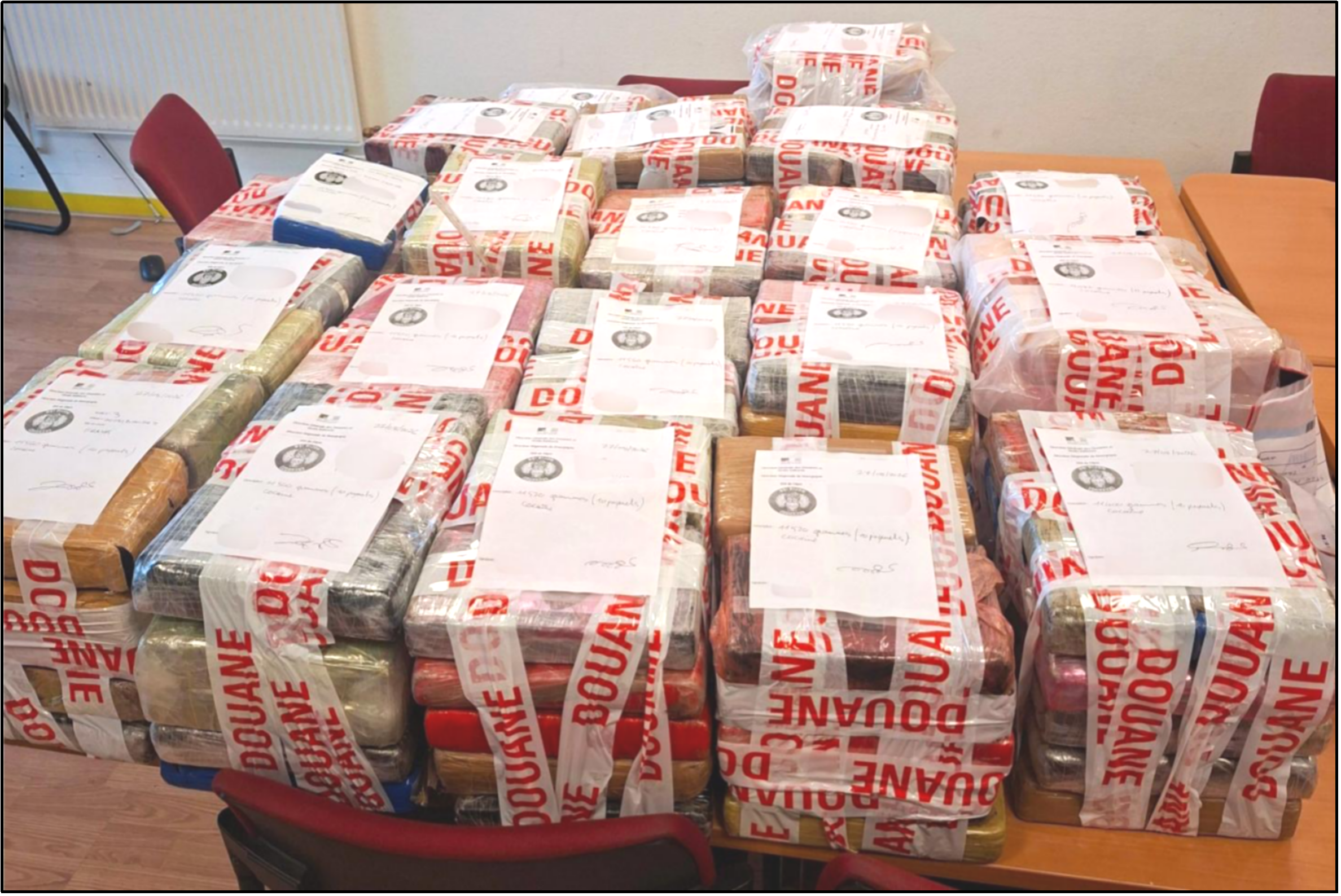
French customs officers in the port of Dunkirk conducted an intelligence-led search Sunday night that led to the seizure of a large quantity of cocaine on a cargo ship bound for Antwerp after coming from Ghana. Dutch and Belgian media reports and information passed to French investigators indicate that some of the loot is connected to the criminal organisation of Dutch fugitive drugs boss Jos Leijdekkers, aka “Bolle Jos.”
Authorities said the inspection in Dunkirk was not routine, but based on specific intelligence. The consignment, weighing thousands of kilos, was to be delivered to a business address in Dordrecht, officials told Belgian newspaper HLN. Dutch and French investigators are now trying to determine who owned the shipment, how it was distributed, and whether it links to Leijdekkers’ organisation.
Jos Leijdekkers has been on the run for years and is believed to be hiding in Sierra Leone. Europol and the Netherlands have placed him on their most-wanted lists, and the district court in Rotterdam sentenced him to 24 years in prison in absentia. The conviction was for a series of narcotics offences, including six cocaine shipments of nearly 7,000 kilograms, and other offences. The reward for information leading to his arrest is 200,000 euros and is being offered by Europol and the Dutch authorities.
The Dunkirk interception is the latest of a series of major cocaine seizures in France in recent weeks, some of which have been linked to the Netherlands or involved vehicles bearing Dutch license plates. On 3 September, customs officers at the Galaure rest area on the A7 in Drôme arrested a Dutchman in his forties after discovering 347 kilograms of cocaine concealed in a truck. Authorities estimated the street value of the seizure at around 13 million euros.
Other recent cases include an incident on July 17 in Dijon when customs officers became suspicious of a Spanish driver sleeping in a truck with Dutch plates.
The driver continued on his way before the vehicle was stopped and searched at the La Loyère rest area, where investigators found more than 165 kilograms of cocaine hidden in the air conditioning system of the truck.
Another major bust occurred in Dijon on 27 August. Customs stopped a truck with Dutch plates that had more than 231 kilograms of cocaine hidden in a ventilation compartment.
The paperwork was for the declared cargo, Spanish sparkling wine, but the driver’s behaviour and the low value declared led to a full search during which drugs were found in the cab, investigators said. Investigators put the street value of the load at just under 6.8 million euros.
Meanwhile, gendarmes in the Pyrenees-Orientales, during a raid Friday and Saturday, stopped a convoy of three vehicles, seizing nearly a ton of cocaine allegedly imported from Spain.
The operation turned violent when the driver of a high-powered vehicle intentionally rammed a police car, injuring two officers. Authorities detained a man from Paris, one of the convoy’s drivers.
Other late summer seizures included the check on the A71 at Bourges on August 17, when a British-registered truck was found to be carrying 109 kilos of cocaine concealed in a refrigerated compartment, and an earlier stop in the same area where 243 kilos were found in another vehicle.
French customs and police say the recent surge in seizures is due to increased intelligence sharing and inspections targeting ports, highways and rest stops. Investigations into the Dunkirk seizure remain ongoing, and French and Dutch authorities are expected to coordinate further inquiries to identify the recipients, handlers, and ties to larger trafficking networks, including any direct links to Leijdekkers’ organisation.
