
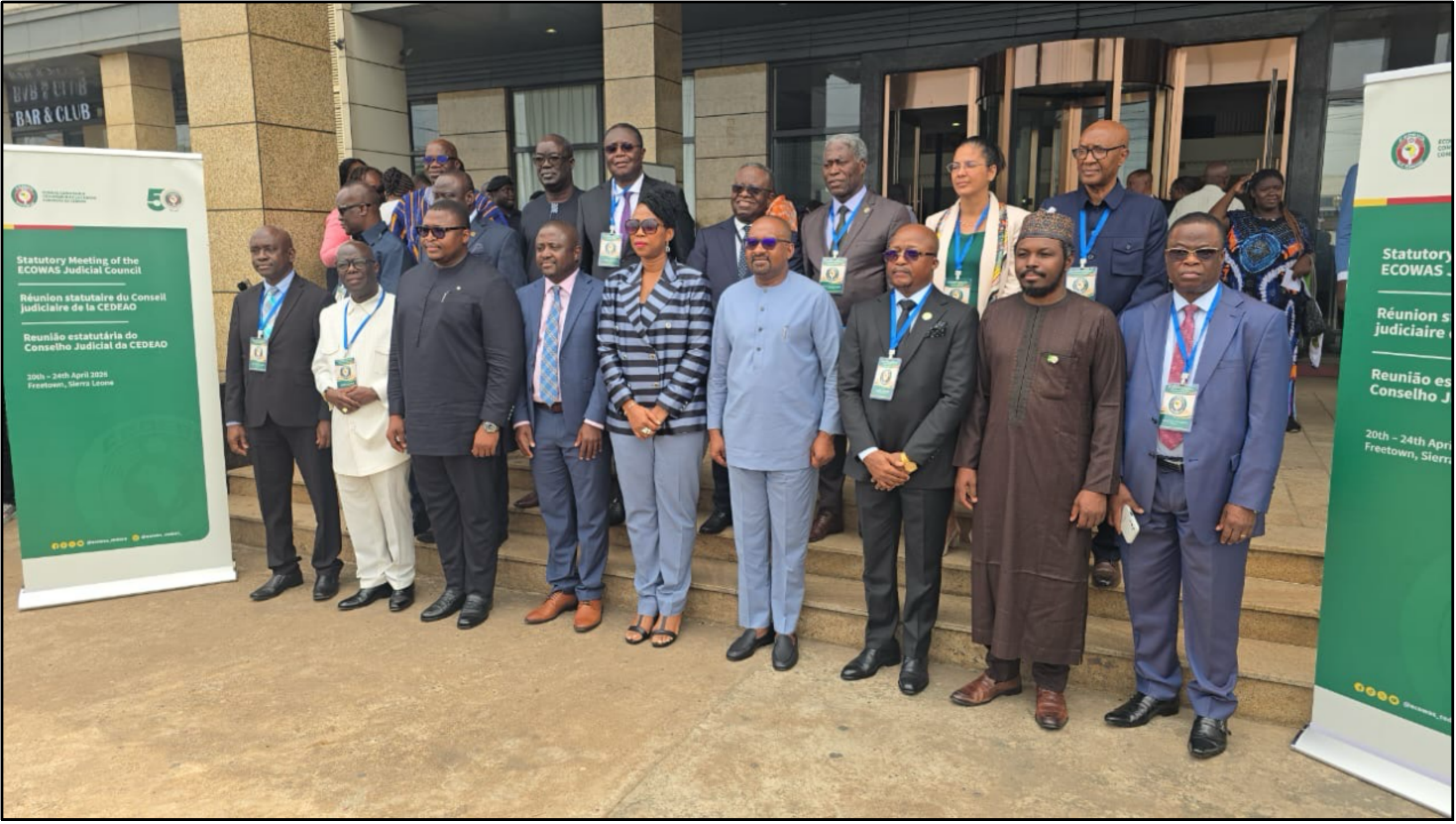
Freetown — Sierra Leone’s Attorney General and Minister of Justice, Alpha Sesay Esq., has called for increased judicial collaboration across West Africa, claiming that coordinated regional justice mechanisms are critical to advancing human rights, the rule of law, and economic integration within ECOWAS.
Speaking at the ECOWAS Judicial Council’s Statutory Meeting in Freetown, Mr Sesay stated that the gathering occurred at a critical juncture in Sierra Leone’s legal evolution. “You have arrived at a time when Sierra Leone is experiencing a transformative legal renaissance,” he told judges, legal officers, and regional delegates, framing the meeting as both timely and significant for the country and the region.
The Attorney General outlined several significant reforms implemented by President Julius Maada Bio’s administration, including the Criminal Procedure Act of 2024, the abolition of the death penalty, new progressive gender laws, the criminalisation of child marriage, and ongoing efforts to review and update the constitution. “Our direction is clear: to move away from justice for the few and toward justice for all,” he said, describing the measures as part of a deliberate shift toward a more inclusive and rights-based national legal order.
While recognising Sierra Leone’s domestic accomplishments, Alpha Sesay emphasised that national systems cannot function in isolation in an era of cross-border crime, security challenges, and frequent political transitions. He portrayed the ECOWAS Judicial Council as a critical institution for ensuring coherence and trust in regional adjudication, as well as reinforcing the authority and effectiveness of the ECOWAS Community Court of Justice.
“Through its oversight, the people of West Africa can maintain confidence in regional adjudication as a shield against injustice and a safeguard for human rights,” he told the assembly, emphasising the Council’s responsibility to preserve public trust in regional legal remedies.
Mr Sesay stated that greater judicial cooperation would help create a predictable legal environment that attracts investment and allows for reliable cross-border enforcement of judgments—foundations he described as critical to regional prosperity. “When we strengthen judicial cooperation, we do more than advance legal theory; we build the legal infrastructure for regional prosperity,” he said, connecting legal reform to larger economic outcomes.
He requested that participants prioritise three interconnected goals: harmonisation of laws and procedures across member states, improved access to justice through the use of technology, and strong safeguards for judicial independence. “Let us strengthen the safeguards that protect judicial independence, ensuring that our courts are long-lasting symbols of impartiality and truth,” he urged.
In his closing remarks, the Attorney General reminded delegates that the resolutions reached in Freetown would have far-reaching consequences for more than 400 million people across the ECOWAS region, emphasising the Judicial Council’s critical role in shaping a fairer, more integrated, and resilient justice system for West Africa.
