
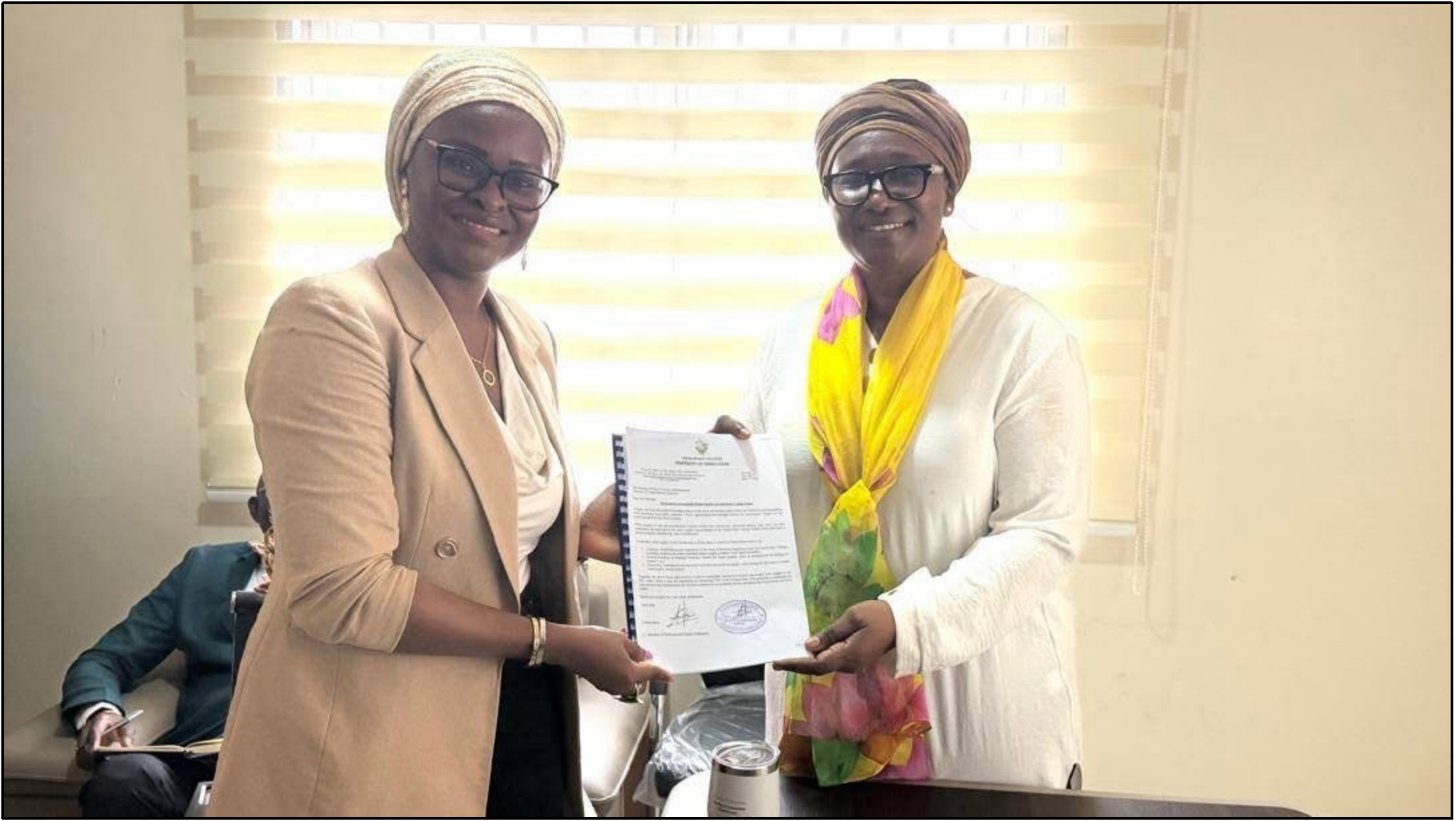
In preparation for the university’s Bicentenary celebrations in early 2027, the Ministries of Water Resources and Sanitation (MWRS) and Technical and Higher Education (MTHE) have pledged a concerted government-led effort, in collaboration with the leadership of Fourah Bay College (FBC), to address the university’s long-standing water supply problems.
The Minister of Technical and Higher Education, Dr Haja Ramatulai Wurie, led a delegation from Fourah Bay College on a courtesy visit to the Ministry of Water Resources and Sanitation with the Minister, Dr Sao-Kpato Hannah Isatta Macarthy. The meeting focused on practical, sustainable measures to provide a reliable year-round water supply for students, faculty, staff and residents of the campus community.
Dr Wurie outlined the university’s plan for an integrated water supply plan, which involves the rehabilitation of the existing Babadorie Dam, the drilling of strategically located boreholes across the campus, and the construction of water storage systems to harvest and store rainfall for use during the dry season. “The combined interventions will create redundancy and resilience to ensure uninterrupted water access to the university and adjoining communities,” she said.
“We cannot have an institution that has stood for two centuries still struggling with something as fundamental as water supply,” said Dr Wurie, characterising the project as an opportunity to solve a long-standing infrastructure shortfall once and for all, with the 200th anniversary approaching.
Minister Macarthy welcomed the delegation and reiterated the Ministry of Water Resources and Sanitation’s commitment to supporting a sustainable cross-government solution. Fourah Bay College is a national institution, she pointed out, and its water problems should not be solved piecemeal, but through coordinated action by the ministries and agencies concerned.
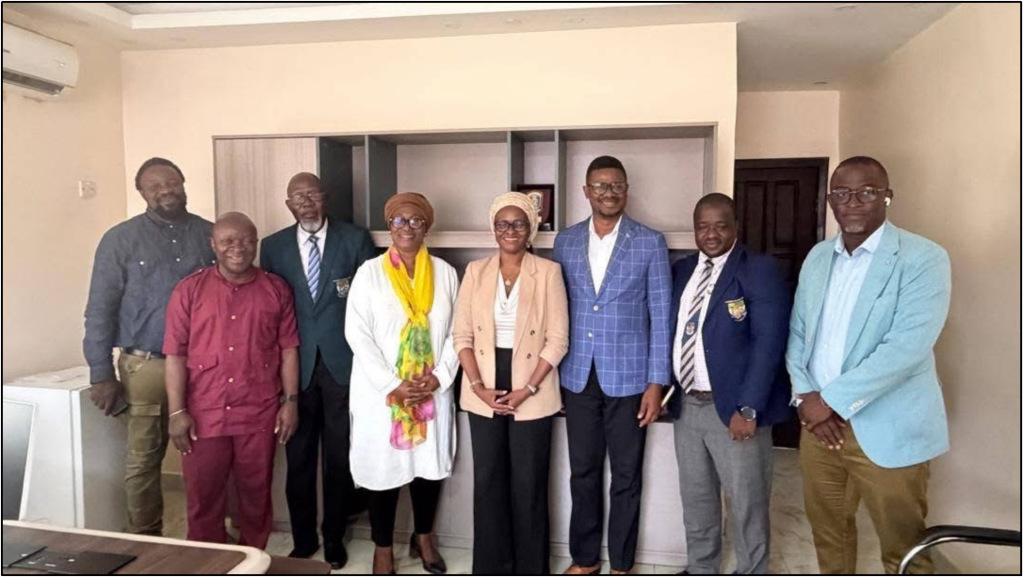
The Minister proposed that MWRS should work together with the Ministry of Finance to mobilise the necessary resources via one of its implementing agencies, and to give the Fourah Bay College initiative priority status within the Ministry’s portfolio of university projects related to the Bicentenary. She said that the benefits of better water infrastructure would extend beyond the student body, offering improved access for campus staff and their families, as well as other residents within the campus perimeter.
“We can champion this as a ministry,” said Dr McCarthy. “We just have to be intentional to collaborate with our colleagues at the Ministry of Finance so that this will be one of our priority projects.” She said the proposed interventions are in line with the Government’s wider objectives to improve water security through investments in sustainable infrastructure and institutional cooperation.
The two ministries agreed on a series of next steps to take the proposal forward in a structured and accountable way. These include a comprehensive technical review of the university’s proposal by the Ministry of Water Resources and Sanitation, drafting of formal communication to the Ministry of Finance to solicit funding and implementation support, and convening an inter-ministerial meeting. The meeting will bring together MWRS, MTHE, the Ministry of Finance, Fourah Bay College and relevant technical agencies to finalise arrangements for implementation, define modalities for financing and set timelines.
The ministries also committed to regular coordination meetings during the development and implementation of the project, and to utilise engineering expertise from Fourah Bay College, in the design and supervision phases. The approach is intended to ensure that technical decisions are responsive to local campus conditions, and that project oversight is informed by institutional knowledge.
The assurances were welcomed by representatives of Fourah Bay College who described the initiative as a historic opportunity to tackle what has been a perennial problem for generations. Lecturer Patrick Walker, the college’s Asset Chairman, said the water supply problem had been going on for almost 200 years and congratulated the move to decisive action.
“This has been a recurring challenge for almost 200 years,” Walker said. “We are making tangible efforts to resolve it today. And generations to come will know that we did what many of us could not do before.
The proposed interventions, which include rehabilitation of the Babadorie Dam, drilling of boreholes and installation of rainwater harvesting and storage infrastructure, are aimed at providing both immediate relief and long-term water security. If implemented as planned, the project would be a case study in cross-ministerial collaboration to tackle a critical infrastructure gap at one of Sierra Leone’s most venerable higher education institutions on the cusp of its landmark anniversary.
