
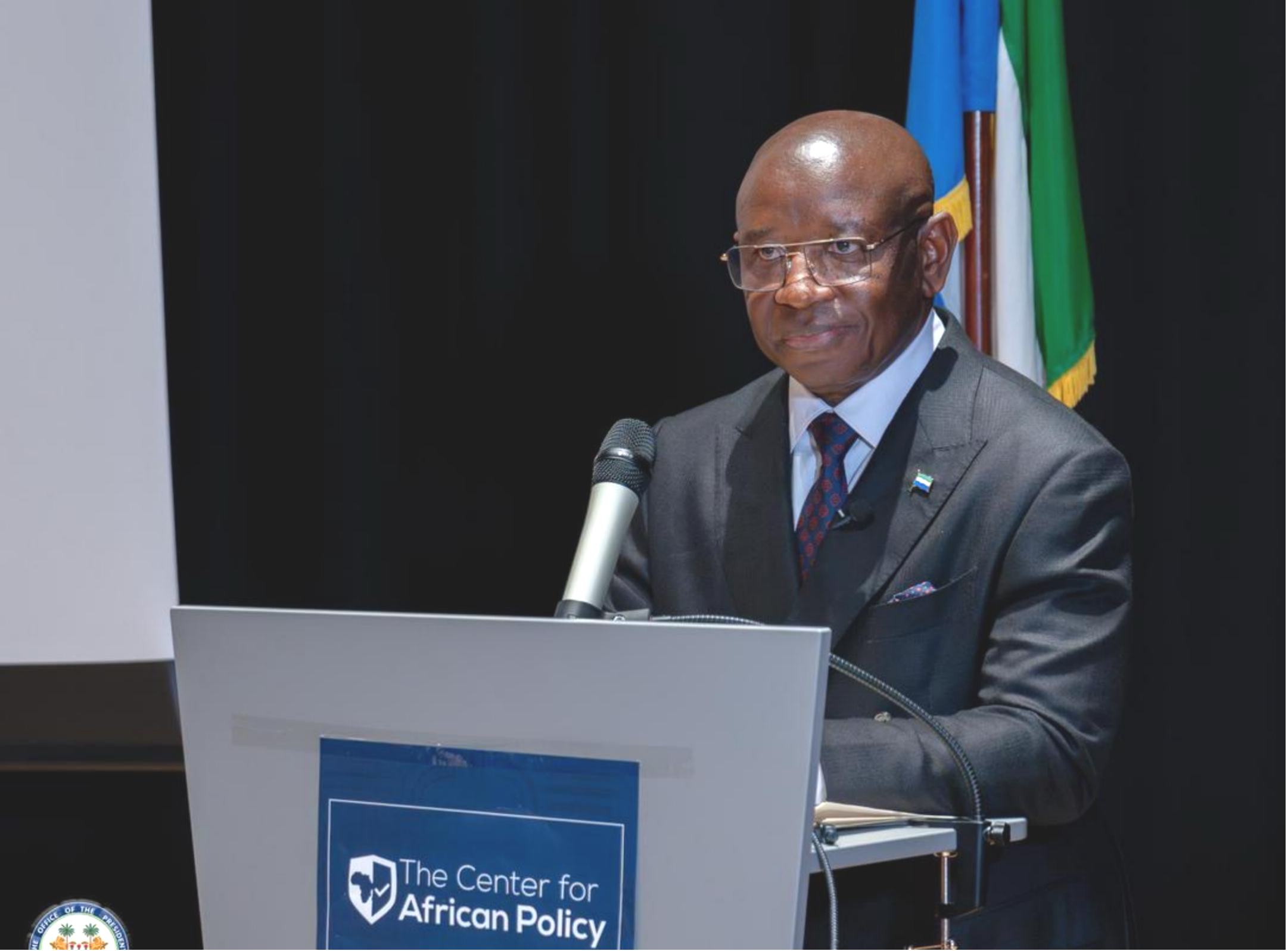
His Excellency Dr Julius Maada Bio, President of Sierra Leone and current Chairman of the ECOWAS Authority of Heads of State and Government, delivered a reflective and impassioned lecture at the University of Oxford, urging African leaders, institutions, and citizens to defend constitutional democracy in the face of growing coups and electoral uncertainty across West Africa. President Bio delivered remarks to a group of postgraduate students, faculty, diplomats, and academics as part of the Oxford Postgraduate Distinguished Lecture Series, with the theme “Defending Constitutional Democracy in an Era of Growing Coups and Electoral Uncertainty in West Africa.”
President Bio warned in a measured address that blended personal testimony with institutional analysis that the region’s constitutional order is under threat from several interconnected pressures. He listed a number of threats, including a wave of military takeovers, dwindling trust in public institutions, deteriorating economic conditions, escalating insecurity, and rising political instability. “Constitutional democracy is under pressure across our region,” he told the audience, noting that West Africa has seen successive coups in Mali, Guinea, Burkina Faso, Niger, and Guinea-Bissau since 2020, putting regional mechanisms for preventing and responding to unconstitutional changes of government to the test.
President Bio, citing his dual role as Sierra Leone’s head of state and ECOWAS chairman, argued that the most dangerous threat to democratic systems is not limited to the soldier who suspends a constitution. He also warned that the gradual erosion of public trust in democratic institutions is dangerous. “The greatest threat to constitutional democracy in West Africa is not only the soldier who violates the Constitution,” he stated. “It is also the gradual erosion of public trust that causes citizens to question whether constitutional systems can continue to protect, represent, and improve their lives.” According to his analysis, democratic decline often begins imperceptibly with weakened accountability, tolerated excesses, and the normalisation of constitutional compromises; if not addressed, such deterioration creates opportunities for unconstitutional actors to exploit public frustration.
President Bio used the Oxford podium to openly discuss his own political development and the lessons it has taught him about legitimacy and governance. He admitted that his first rise to power was through military rule, and that more than two decades later, he returned to national leadership through the ballot box. “I first came to power under military rule,” he stated. “Twenty-two years later, I reclaimed leadership through the ballot box rather than by force. I discovered that the most difficult aspect of leadership is refusing to assume power. It limits it.” That personal arc influenced his belief that constitutional legitimacy must take precedence over force as the foundation for political authority.
In reference to Sierra Leone’s own experience, President Bio defended his government’s commitment to resolving disputes and grievances through legal and constitutional channels rather than through violence. He cited ongoing domestic reforms to boost democratic credibility, such as the formation of a Tripartite Steering Committee and a package of electoral reform measures aimed at rebuilding public trust in institutions and the integrity of the vote.
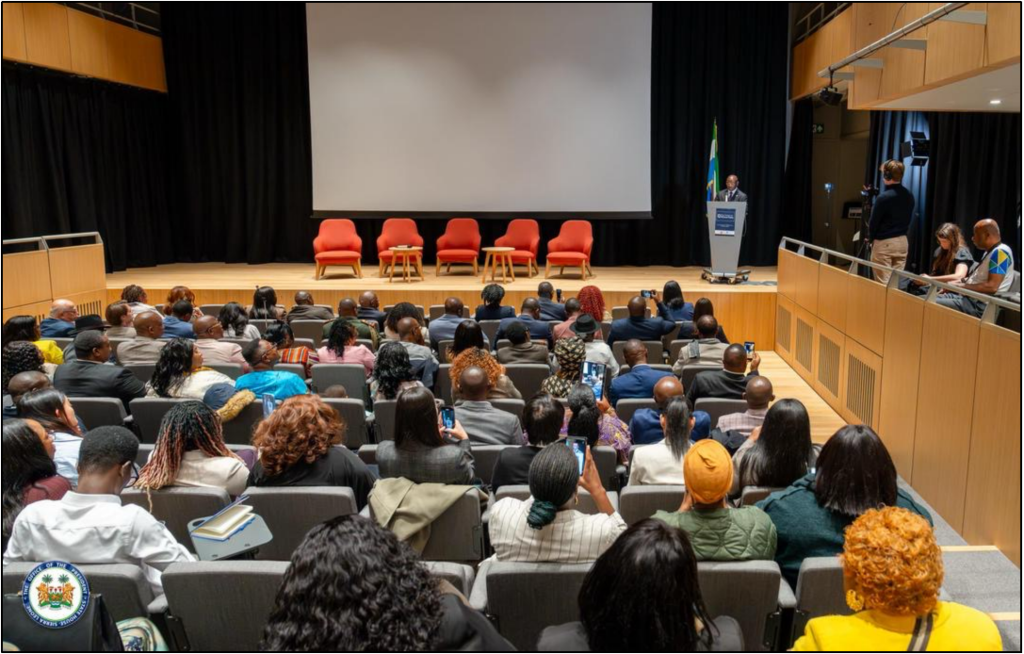
Speaking as ECOWAS chair, the President reaffirmed his opposition to unconstitutional power grabs and warned that democratically elected governments bear responsibility for the survival of the democratic system. “Military coups are wrong,” he asserted. “However, if constitutional governments fail to govern responsibly, the likelihood of unconstitutional intervention increases.” He urged ECOWAS and other regional actors to look beyond crisis response and invest in preventive diplomacy, clearer governance benchmarks, and proactive measures to detect and reverse democratic backsliding before it reaches a critical point.
Addressing the assembled scholars and young Africans, President Bio emphasised that the ultimate responsibility for defending constitutional order lies with people and institutions, not with abstract documents. “Constitutions do not enforce themselves.” Institutions do not protect themselves. “People do,” he said, urging political elites, judges, election managers, civil society, and voters to renew their commitment to integrity, leadership, and civic responsibilities.
Finally, he cautioned against leaving a cynical legacy for future generations, arguing that constitutional legitimacy is the only long-term foundation for peace, stability, and national progress. “Our generation must ensure that no African child grows up believing that the gun is a quicker way to power than the ballot,” he concluded.
President Bio delivered his lecture against the backdrop of regional instability, combining self-reflection with policy prescriptions: strengthen institutions, rebuild public trust, hold leaders accountable, and prioritise preventive regional engagement. His message sought to reframe the debate on West Africa’s democratic resilience by focusing on the quiet deterioration of public trust as well as the headline-grabbing violence of coups, and by urging leaders, institutions, and citizens to work together to defend constitutional democracy.
