
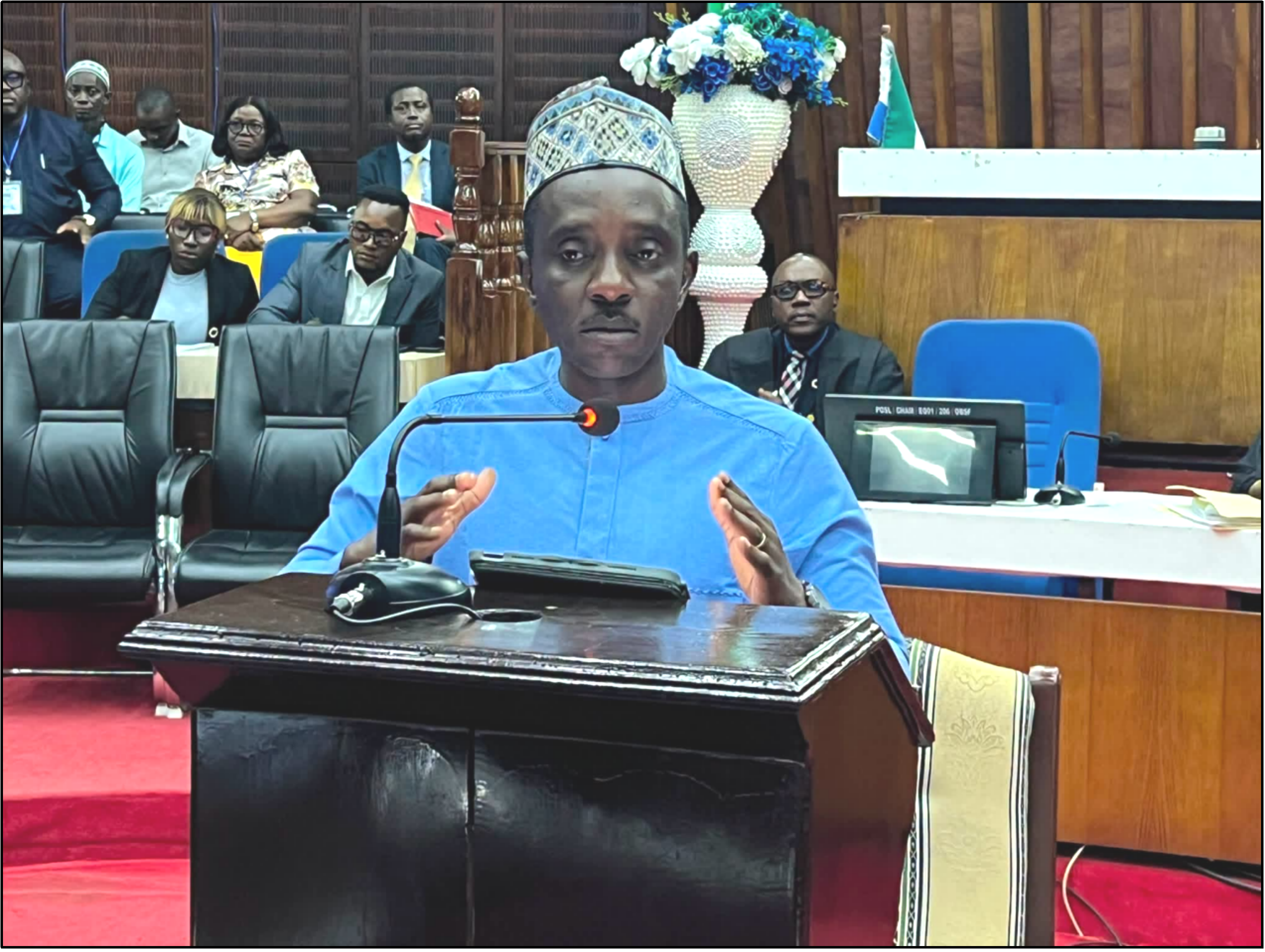
Chernor Bah, Minister of Information and Civic EducationParliament approved a $5 million Public-Private Partnership (PPP) agreement between the Ministry of Information and Civic Education (MoICE) and Diming Yimo Printing Group to modernise the Government Printing Department. Cabinet also endorsed reforms in mining, maritime development, and digital governance. The announcements were made by Hon. Chernor Bah, Minister of Information and Civic Education, during the Government’s weekly press briefing on Tuesday, July 14, 2026, where he presented Cabinet conclusions and updates on national initiatives.
On March 24, 2026, a 10-year Build-Operate-Transfer (BOT) agreement was signed to modernise the Government Printing Department, which has been in operation for over 200 years. Minister Bah informed Parliament that the $5 million investment requires no direct financial contribution from the government. At the end of the contract, Sierra Leone will take ownership of the upgraded facility and its assets.
Members of Parliament who participated in the debate welcomed the anticipated increase in printing capacity, as well as the emphasis on training and upskilling local employees. They also emphasised the importance of strong oversight mechanisms to protect sensitive government documents and insisted that Ministries, Departments, and Agencies (MDAs) follow rules that direct official printing work through the modernised facility.
In addition to the printing press ratification, Cabinet approved several important reforms aimed at improving resource management, maritime capacity, and digital sovereignty. Cabinet approved a new, transparent framework for managing Tonkolili North iron ore licences, which will be administered by the National Minerals Agency. The executive also approved the formation of the Sierra Leone Ocean Shipping Company Ltd, a joint venture between the Sierra Leone Mining and Maritime Development Company (SLMMDMC) and China’s Zhejiang Xiehai Group, as a step toward improving domestic maritime capabilities.
Cabinet’s National Open Source Software First Policy aims to reduce software procurement costs, improve data security, and strengthen digital sovereignty by prioritising open-source solutions in government systems.
Minister Bah promised citizens that the government would closely monitor the implementation of these initiatives to ensure accountability, efficiency, and tangible national benefit.
