
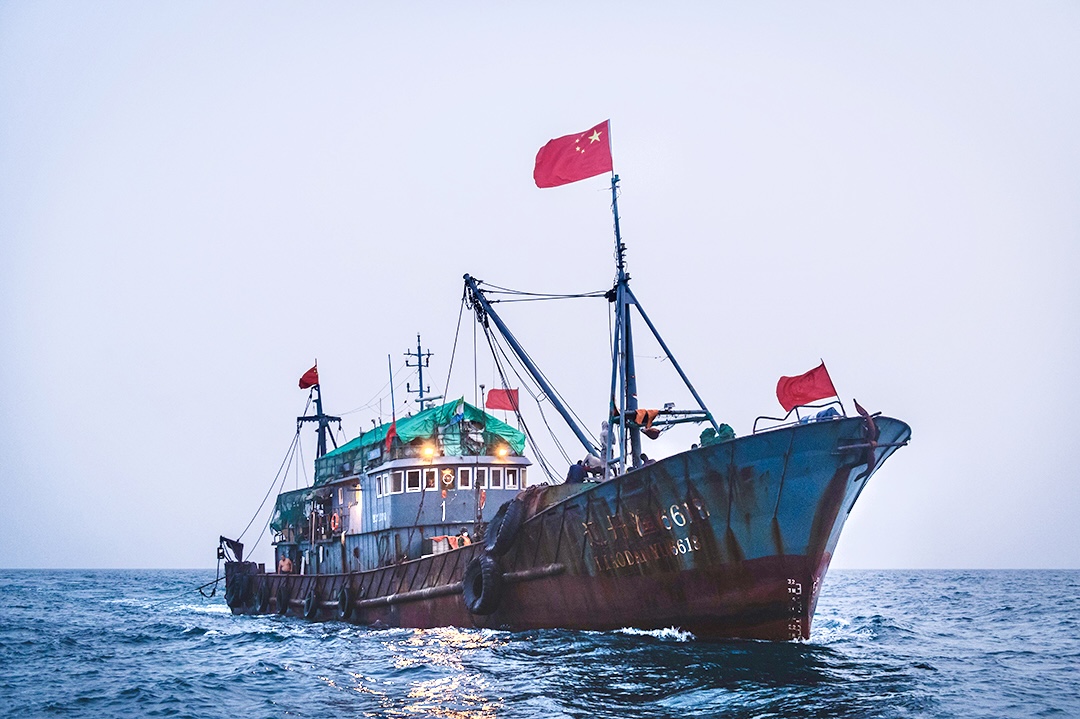
Artisanal fishermen in Sierra Leone are accusing foreign industrial trawlers linked to China’s distant-water fleet of repeatedly breaching coastal fishing limits, destroying gear, and reducing local catches, creating a crisis for livelihoods and marine environments across West Africa. “We put our nets in during the night and come back to shore,” said fisherman Musa Gassimo on Sherbro Island, about 110 kilometres (68 miles) south of Freetown.
“At night, the trawlers came and [intentionally] cut the lines.” A new net, he added, could cost about $250 to replace, a heavy burden for families who depend on daily catches. At Tombo Harbour outside Freetown, Thomas Turay, president of Sierra Leone’s Fishermen’s Union, pointed to several industrial trawlers on the horizon, just outside the exclusive economic zone. “There is too much illegal fishing,” Turay told the BBC.
“We own the sea but foreign trawlers come at night and breach the seven-mile exclusion zone, coming right into the shore. Turay said the incursions had caused a 40% drop in the average catch of local fishers in recent years. These drops reflect larger regional losses due to illegal, unreported and unregulated (IUU) fishing. Sierra Leone estimates that illegal fishing costs it some $50 million a year. West Africa as a whole, long identified as a global hotbed of IUU activity, loses up to $9.4 billion annually. Illegal fishing, for example, has led to the loss of more than 300,000 jobs in the region, including artisanal and traditional fisheries, according to seven African environmental experts writing in a policy brief published in October 2025 by the China Global South Initiative. Environmental and enforcement reports cite distant-water fleets for harmful and illegal practices.
The IUU Fishing Risk Index consistently puts Chinese vessels among the worst offenders. Investigations and NGO reports indicate that many of these vessels also bottom trawl, dragging heavy nets along the seafloor and indiscriminately capturing juvenile fish and other marine life, destroying habitats and undermining the future productivity of fisheries. Chinese bottom trawlers catch some 2.35 million tonnes of fish a year, worth some $5 billion, and accounting for half of China’s distant-water catch, the Environmental Justice Foundation said.
The suspects are accused of illegal fishing with explosives, illegal fishing gear, turning off vessel transponders to avoid monitoring, operating under “false flags” or “flags of convenience,” and illegal transshipments at sea, known as “saiko.” According to the Lansing Institute, more than half of all false flag registrations in the world are in African jurisdictions. Observers also cite shell companies being used to hide ownership and frustrate enforcement and prosecution. Fishermen and civil society leaders say corruption worsens the problem. “The government officials are scared to help the local fishermen,” Turay told the BBC. “I know that a person who runs this illegal business has the money to pay and bribe. Allegations of collusion and weak enforcement are common across the region, where historically monitoring capacity has been limited.
The Sierra Leone fisheries ministry does not agree with some of the fishermen’s claims of gaps in enforcement. International vessels operating in Sierra Leonean waters must carry transponders that track their movements and government inspectors carry out regular checks, Sheku Sei, director of the Ministry of Fisheries, told the BBC. “While some illegal fishers elsewhere turn off transponders to avoid detection, this is not the case in Sierra Leone,” Sei said.
Improvements are being made to monitoring and enforcement by the government. Authorities say they have invested in at least six patrol boats for the inshore waters and radio equipment, electronic tablets and Android phones that will help monitor and control the fisheries sector. The ministry has also been focusing on tax evasion in the maritime sector as part of a broader crackdown on illegal activity.
But regional experts say stronger, coordinated action is needed to halt the losses and bring back sustainable fisheries. The China Global South Initiative policy brief recommends harsher penalties on companies engaged with illegal trawlers, updating policies on fisheries and water resources, and investing in naval and coast guard capabilities. The authors suggest the creation of local, real-time monitoring systems using satellite data and automatic identification systems, along with public, anonymous reporting channels for civilians to report illegal activity. The steps are intended to democratize oversight and cut reliance on a handful of officials who could be corrupt.
Local fishermen such as Turay and Gassimo eagerly await the changes. “The sea belongs to us,” said Turay. “If we don’t do anything, our kids won’t have any fish to eat.”
