

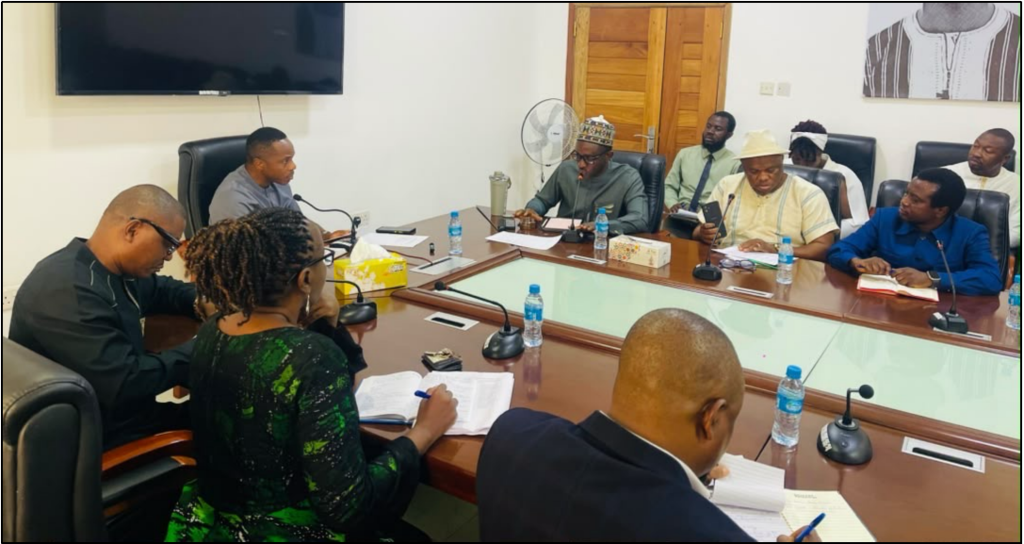
State Avenue, State House, Freetown, Monday, September 14, 2026 — The Chief Minister, Dr David Moinina Sengeh, on Monday convened a high-level Strategic Delivery Clinic with the Ministry of Information and Civic Education (MoICE) and its agencies to review progress, identify implementation gaps and improve coordination in support of the Government’s Big Five Game Changers and the Medium-Term National Development Plan 2024–2030.
The clinic provided a forum for ministers, senior ministry officials, and agency representatives to showcase ongoing and planned programs, assess delivery timelines, and align institutional responsibilities with measurable outcomes. The engagement was deliberately framed to translate policy commitments into real outcomes through tighter performance management across the mandate areas of the Ministry
In his opening remarks, the Chief Minister congratulated MoICE’s work so far and stressed the importance of effective public communication, civic education and reliable public information to enhance citizen participation and improve government program delivery. “It is vital to strengthen these systems so that they can achieve the national development priorities and maintain the public trust, he said.
Chief Director of MoICE, Alimamy Lahai Kamara, outlined the Ministry’s legislative, policy and institutional reform agenda. Priority bills and regulations in the pipeline include the Records Management and Archives Bill, the Data Protection Bill, and the Street Signage Regulation, which is with the Attorney General’s Office. Policy reviews are also ongoing for the Sierra Leone Broadcasting Corporation (SLBC), Sierra Leone News Agency (SLENA) and the Government Printing Department. Proposed amendments to the SLBC, National Commission for Civic Education and Development (NaCCED) and the Independent Media Commission (IMC) Acts are ready and awaiting submission to the Law Officers’ Department.
MoICE has launched an ambitious program to improve research on public perception and civic participation. Planned activities include nationwide surveys on the Constitutional Amendment Bill, re-districting and Presidential deliverables, community meetings, school and university outreach campaigns, and targeted social media engagement. The ministry is working on a National Civic Education Policy. It plans to partner with development partners like UNDP on data protection initiatives and UNFPA on civic engagement activities in relation to the upcoming Population and Housing Census.
The ministry also emphasised institutional development and infrastructure development. Plans are underway to refurbish the Miatta Civic Centre and construct a National Archives and Records Centre. The Ministry of Finance has provided seed funding for the latter. The ministry said it is developing training programs for records management professionals to sustain the digitisation work, which has started with technical support from UCLA and participation from students of Fourah Bay College.
On the media and communications front, MoICE reaffirmed its commitment to ongoing content creation, including radio and television programming, media appearances, and regular Daily Mail publications. The ministry has a target of producing 240 radio and television programs and has produced two editions of its quarterly newsletter. Among the ministry’s strategic proposals was establishing an SLBC Public Broadcasting Fund and forming a Movie Makers Council to promote the creative sector; MoICE staff will be trained on digital media in November 2026 to build in-house competencies.
Also, we reviewed stakeholder engagement plans. The ministry outlined a schedule of engagements with Ministries, Departments, and Agencies (MDAs), local councils, and civil society organisations and announced an Information Commissions Conference for September 2026. Capacity-building programs on election reporting and related coverage for journalists and civil society are also envisaged to strengthen responsible media practices.
The Strategic Delivery Clinic is part of the Chief Minister’s effort to improve cross-government coordination, remove delivery bottlenecks, and turn ministerial commitments into tangible outcomes for citizens. For MoICE, the clinic underscored priorities related to public communication, civic engagement, strengthening media institutions, information management, and access to reliable government information- areas the government identifies as crucial for cultivating an informed citizenry and promoting the national development agenda.
