
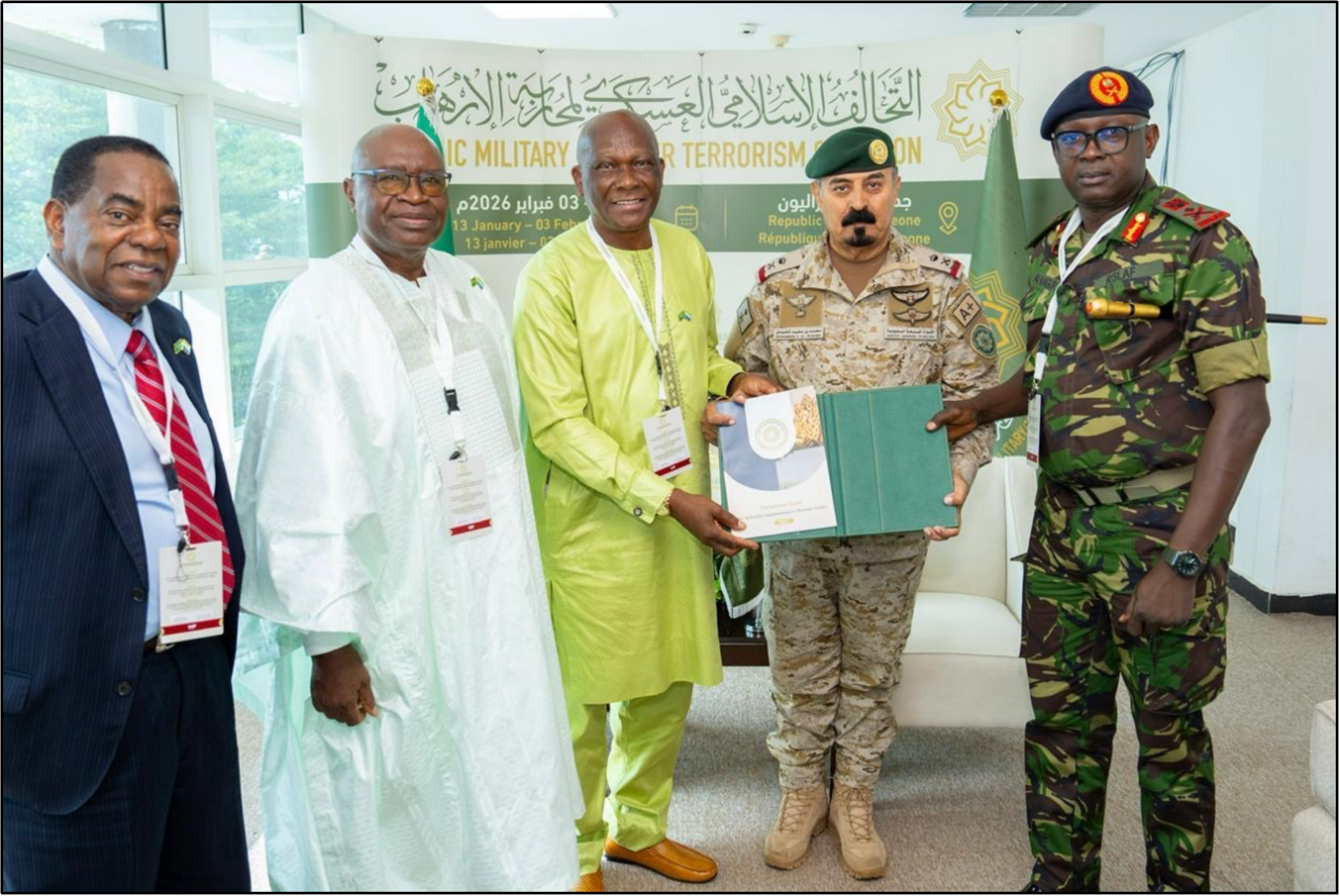
Freetown, January 2026 — Sierra Leone and the Islamic Military Counter Terrorism Coalition (IMCTC) signed a Memorandum of Understanding (MOU) on Tuesday and launched an IMCTC strategic initiative at the Freetown International Conference Centre (Bintumani). The agreement and accompanying programme are intended to strengthen West Africa’s capacity to prevent and respond to terrorism, with a focus on training, intelligence cooperation, and counter-terrorist financing measures.
The MOU, signed by Sierra Leone’s security sector’s Chief of Defence Staff Lieutenant General Amara Idara Bangura and the IMCTC’s Major General Mohammed bin Saeed Al-Moghedi, establishes a multifaceted partnership. It intends to train Sierra Leone’s defence personnel, who will then be equipped to train religious leaders, such as Imams and Pastors, in combating extremist ideologies. The initiative prioritises developing national expertise in anti-money laundering to disrupt terrorist financing networks and improve regional security.
The National Security Coordinator in the Office of National Security (ONS), Abdulai Caulker, welcomed the IMCTC delegation and described the launch as a significant milestone in Sierra Leone’s counter-terrorism efforts. He emphasised the importance of intelligence-driven cooperation and ongoing strategic partnerships for collective security. Caulker also praised President Julius Maada Bio’s leadership in strengthening alliances with IMCTC member states and regional security arrangements.
Morie Lengor, Minister of Internal Affairs, warned that terrorism and violent extremism are still major threats in Sub-Saharan Africa, especially in the volatile Sahel region, during his keynote address. Lengor emphasised the importance of multilateral cooperation in preventing the spread of these threats and praised the IMCTC’s initiative to provide professional training to Sierra Leone’s security forces.
The Secretary-General of the IMCTC, Major General Mohammed bin Saeed Al-Moghedi, thanked the host for their hospitality and emphasised the coalition’s reasons for engaging in West Africa.. “Terrorism is a global phenomenon that requires cross-border cooperation to protect communities,” he said, emphasising the importance of integrated partnerships over fragmented efforts in countering terrorism. Al-Moghedi stated that the Kingdom of Saudi Arabia supports the initiative and that the IMCTC’s role is to improve coordination and capacity among partner countries.
Mohammed Barrie, Sierra Leone’s ambassador to the Kingdom of Saudi Arabia, provided historical context for the IMCTC, recalling its establishment in December 2015 under Crown Prince Mohammed bin Salman Al Saud’s auspices. He explained that the coalition’s dual goals are to combat extremist ideologies and dispel myths that link Islam and terrorism, as well as to promote unity among Islamic countries. Ambassador Barrie prioritized Sierra Leone’s collaboration with the IMCTC, including capacity building for security forces, establishing a counter-terrorism center in Freetown, research collaboration, information sharing, and countering extremist narratives through public diplomacy.
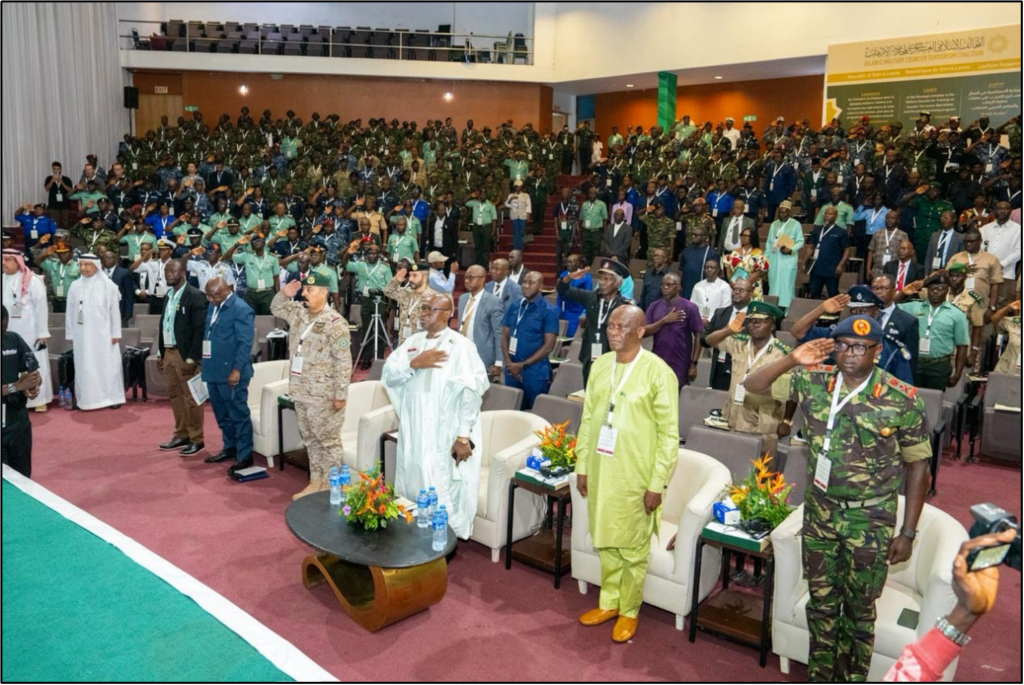
On behalf of the Minister of Defence and Commander-in-Chief, H.E. Brigadier (Rtd.) Julius Maada Bio, Colonel (Rtd.) Muana Brima Massaquoi expressed gratitude to King Salman bin Abdulaziz Al Saud and the Crown Prince and Prime Minister of Saudi Arabia for their support for the IMCTC. He reaffirmed the Ministry of Defence’s commitment to treating terrorism as a transnational threat that necessitates collective action, shared responsibility, and long-term partnership. He praised the three-week training for selected Sierra Leone security forces members.
The three-week training program will initially focus on neutralising unexploded ordnance and improvised explosive devices (IEDs) through identification, towing, and safe disposal procedures. The final week of the course will focus on counter-terrorism operations, including training in detecting and responding to explosive threats in realistic scenarios involving people, vehicles, buildings, and open areas. The training is intended to improve Sierra Leone’s forces’ operational readiness and capability to respond to explosive threats and terrorist incidents.
The partnership aims to achieve governance and capacity-building objectives, in addition to operational training. The MOU aims to strengthen Sierra Leone’s ability to disrupt terrorist funding and build resilience against extremist groups expanding from the Sahel into West Africa by developing anti-money laundering expertise and promoting inter-agency coordination.
The IMCTC’s agenda in Sierra Leone reflects a broader regional concern about the spillover of instability and extremist activity from the Sahel. Officials emphasised the importance of intelligence sharing, research collaboration, and public diplomacy in combating radicalisation and building community resilience. Ambassador Barrie’s proposed initiatives, including a counter-terrorism centre in Freetown, improved research partnerships, and public messaging campaigns, indicate a desire to combine tactical capacity building with strategic community-oriented approaches.
At the event’s conclusion, Lieutenant General Amara Idara Bangura, Chief of Defence Staff, delivered a vote of thanks, emphasising Sierra Leone’s commitment to the partnership and ongoing cooperation with IMCTC member states. The MOU and the launch of the strategic initiative mark a new phase in Sierra Leone’s engagement with international partners in the fight against evolving terrorist threats and strengthening national and regional security.
