
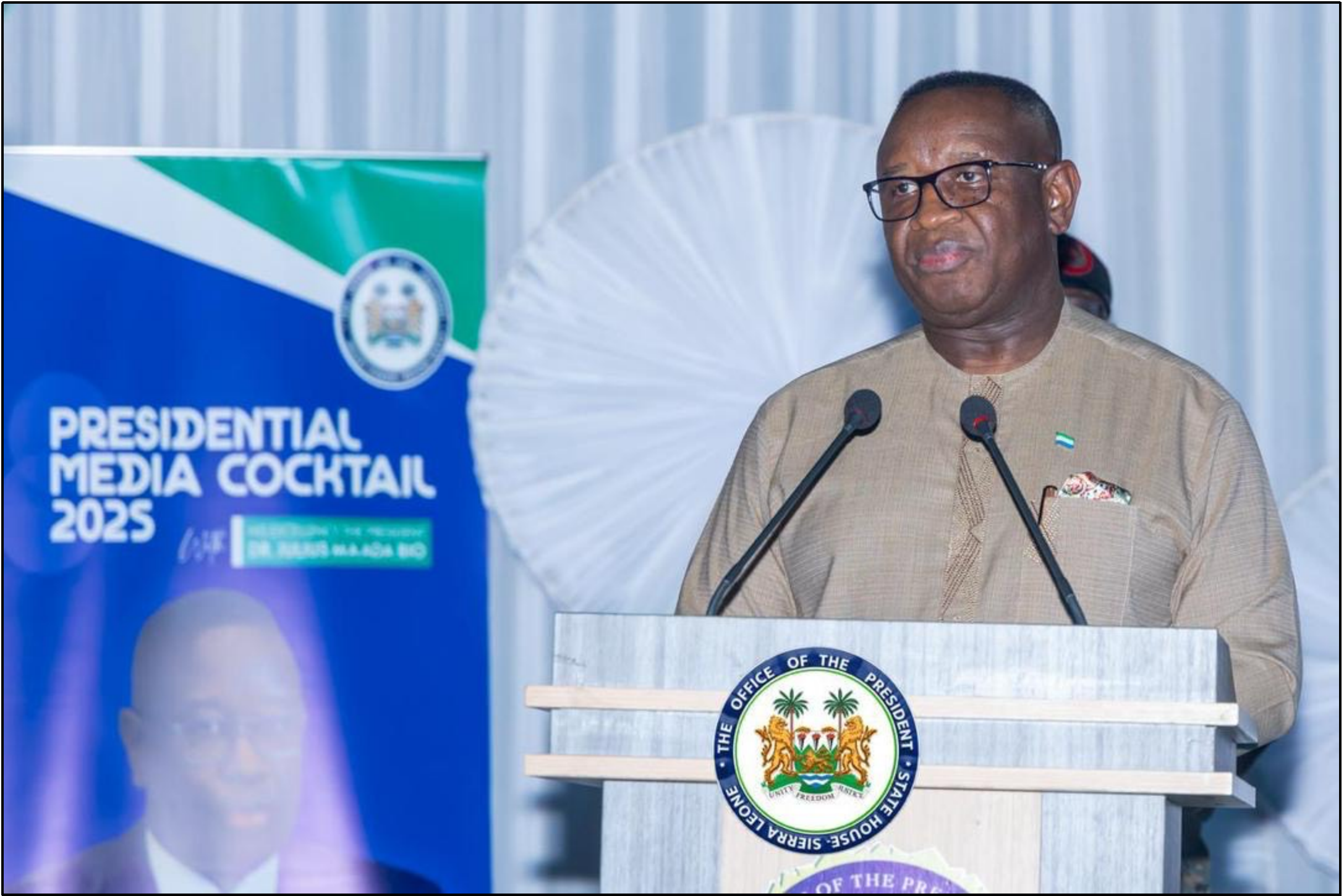
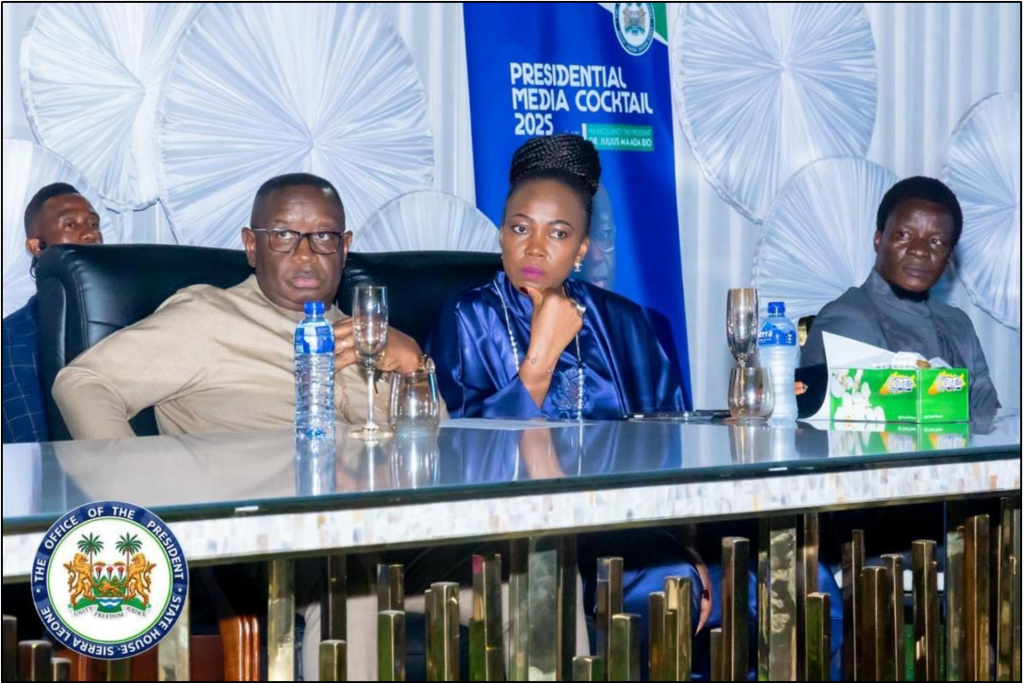
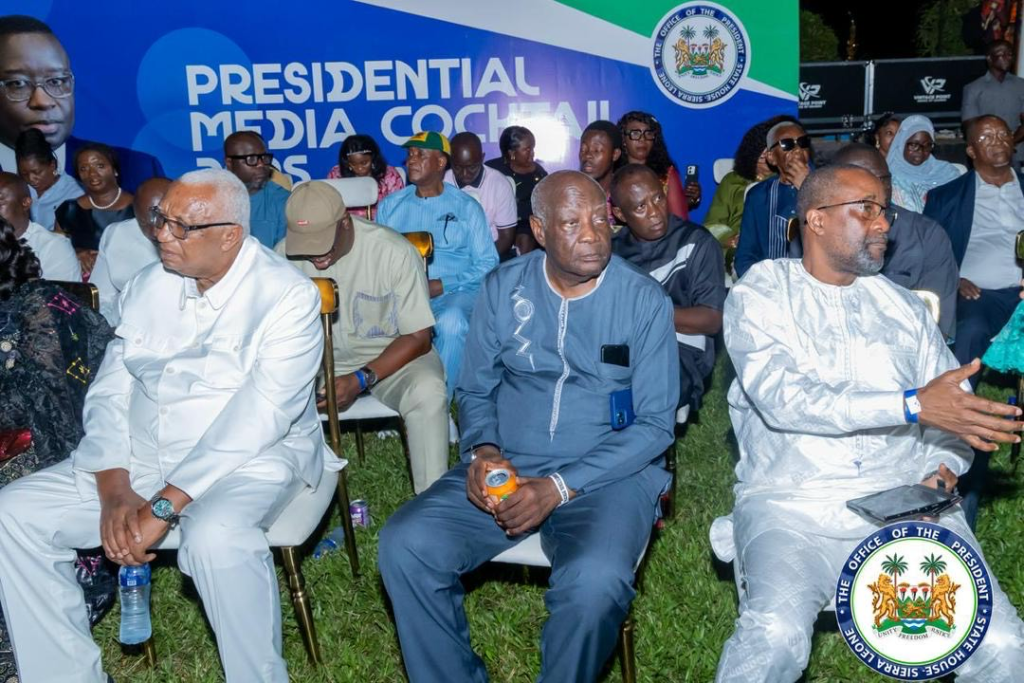
President Dr Julius Maada Bio has announced a significant increase in government support for the Sierra Leone Association of Journalists (SLAJ), bringing the annual subvention to NLe 2.7 million as part of a larger initiative to strengthen independent journalism and modernise the country’s information ecosystem. The announcement was made at the seventh Presidential Media Cocktail at the State House, which was attended by media executives, editors, and representatives from national media associations.
President Bio described the move as a clear demonstration of his administration’s commitment to media sustainability, stating that the press remains “a fundamental pillar of democracy” and emphasising the importance of a free and empowered media for transparency, accountability, and informed civic engagement. “For SLAJ, Christmas gift always comes early,” he joked, claiming that the decision addresses critics who have questioned the government’s contributions to media development.
The new allocation represents a significant increase in government support compared to previous disbursements. President Bio recalled that in 2020, the government allocated Le 200 million (old Leones) to media causes, and he stated that the current increase is the result of deliberate reforms aimed at strengthening media institutions, improving professional reporting, and encouraging public-interest journalism.
Highlighting progress since 2018, the President cited impressive gains in press freedom. Sierra Leone has risen more than 25 places in the World Press Freedom Index since 2017, he claims, and will be ranked 56th globally in 2025, one of the fastest improvements ever recorded. He attributed the rise to several reforms, including the repeal of criminal libel laws, stronger journalist protections, capacity-building initiatives, and more constructive engagement between government and media stakeholders.
Among the major policy announcements made at the event was the approval of the country’s first National Information and Media Policy, which will establish standards for digital media governance, responsible use of artificial intelligence, and broader modernisation of the information ecosystem. This year, President Bio also announced Sierra Leone’s 95 per cent Freedom of Information compliance score, describing information access as “the lifeblood of a vibrant democracy.” To build on those gains, he announced that the Right to Access Information Commission would be reconstituted as a more powerful Access to Information Authority, with increased enforcement powers and sanctions to ensure compliance.
The President reaffirmed his support for the recently established National Fund for Public Interest Media, noting that the fund had already made its first grants to 14 media outlets. He praised the Media Reform Coordinating Group for spearheading the initiative and emphasised government-sponsored training programs that have given over 500 journalists and information officers skills in fact-checking, digital literacy, and ethical reporting.
President Bio linked media independence to Sierra Leone’s rising international profile, citing the country’s presidency of the UN Security Council, election as Chairman of ECOWAS, and endorsement of the USD 2.2 billion Mission 300 Energy Compact as examples of Sierra Leone’s stronger voice on the global stage. “These achievements demonstrate our respected voice in global affairs,” he said, urging journalists to report on the country’s progress “with pride and accuracy.”
Despite the positive assessment, the President acknowledged that the media sector continues to face significant challenges. Financial constraints, rapid technological change, and the spread of misinformation were identified as risks to public trust and media viability. To address these issues, he identified government priorities such as increasing media entrepreneurship, promoting media literacy, strengthening legal and physical protection for journalists, improving institutional collaboration, and deepening civic education nationwide.
President Bio also announced plans to modernise national media institutions. He announced partnerships to reform the Sierra Leone Broadcasting Corporation, as well as efforts to revive legacy agencies such as the Sierra Leone News Agency, the Government Printing Department, and the Government Daily Mail. In a related development, the Cabinet has approved a National Records and Archives Policy, and a new Records and Archives Bill is being drafted to modernise records management practices that, in some cases, date back to 1964.
In conclusion, the President emphasised that the relationship between the government and the press should be based on trust, mutual respect, and shared democratic values. He urged journalists to uphold truth and accountability, using the following metaphor: “A President without a strong media is like Freetown without Cotton Tree, missing its heart, identity, and voice.” The address emphasised a commitment to ongoing collaboration between state institutions and media organisations to ensure the sustainability and innovation of Sierra Leone’s press.
