
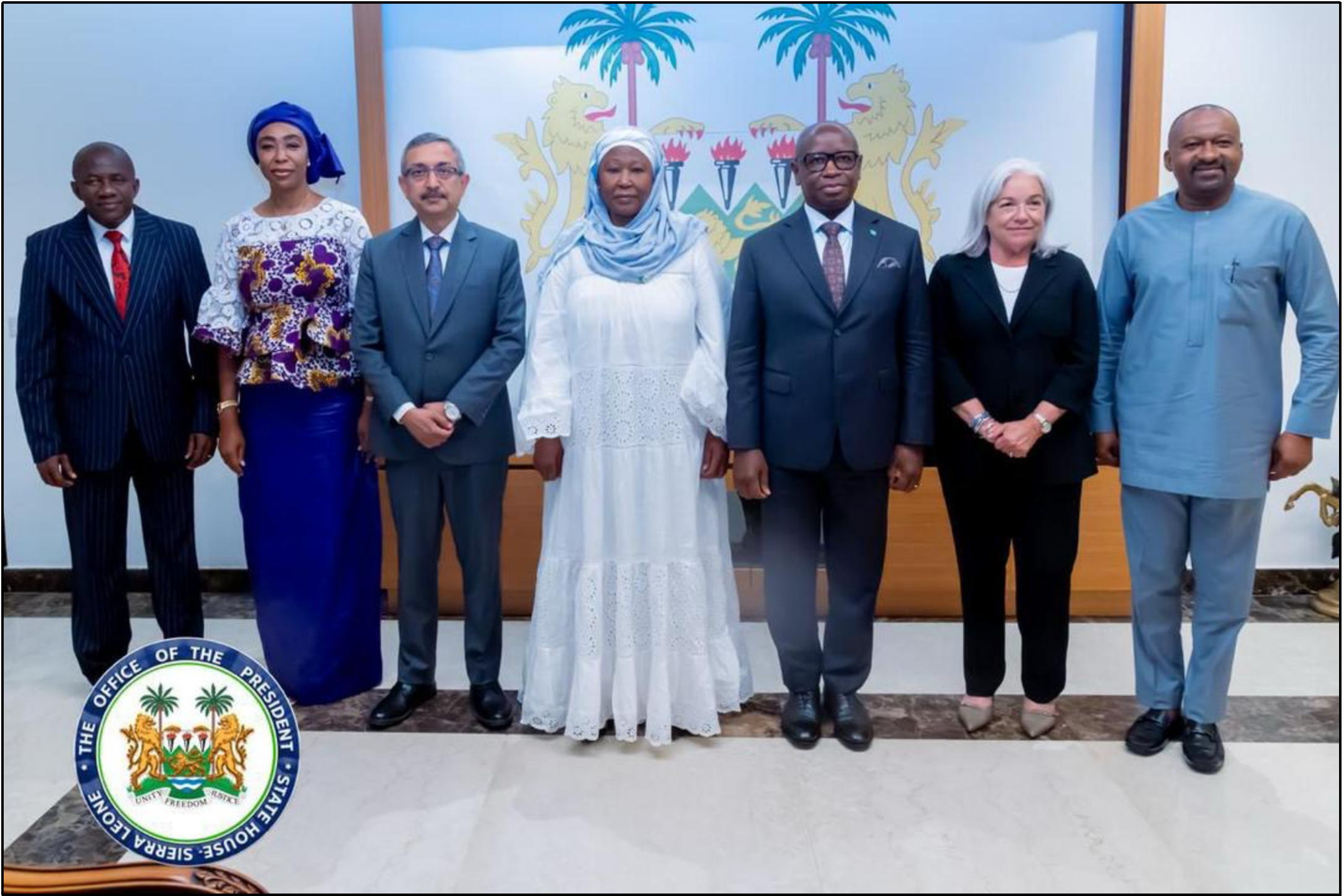
Freetown, April, 2026 — A delegation of international moral guarantors overseeing the Agreement for National Unity between the Government of Sierra Leone and the opposition All People’s Congress (APC) paid a courtesy call on His Excellency President Dr Julius Maada Bio today, praising his leadership in advancing peace, dialogue, and democratic stability domestically and across the ECOWAS region. Rev. Shodankeh Johnson, Board Chairman of the Independent Commission for Peace and National Cohesion, explained that the guarantors were in the country to assess progress toward implementing the Unity Agreement and to follow up on recommendations from the Tripartite Committee.
The visit is part of ongoing monitoring and support efforts aimed at maintaining momentum for consensus measures agreed upon by the government, opposition, and international partners. Vice President Dr Mohamed Juldeh Jalloh, who led the government delegation to recent meetings with guarantors and APC representatives, briefed President Bio on the results of those discussions. Dr Jalloh reported on progress made thus far and assured the visiting guarantors of the government’s continued commitment to constructive engagement and the thorough implementation of agreed-upon actions.
Mrs Fatoumata Jallow-Tambajang, former Vice-President of The Gambia, reiterated the delegation’s mandate to evaluate implementation progress and promote ongoing dialogue between parties. She praised President Bio for facilitating engagement as well as his broader contributions to West African peace and stability, particularly through his participation in ECOWAS initiatives. “We require leaders like you in Africa. Mrs Jallow-Tambajang expressed gratitude to President Bio for facilitating dialogue and engagement, highlighting key areas of agreement from recent consultations with the APC.
In response to the delegation, President Bio thanked the guarantors for their ongoing cooperation and reaffirmed his administration’s unwavering commitment to peace, national cohesion, and democratic governance. Reflecting on his leadership style, he stated, “I have always viewed Sierra Leone not through a political lens, but through a development and peace lens,” emphasising his view of national priorities as stability and progress rather than partisan advantage.
President Bio reiterated that the electoral reform process was guided by transparency and inclusivity, with international partners serving as neutral facilitators to help stakeholders reach an agreement. He reiterated his support for proportional representation, describing it as a mechanism for improving fairness and broadening political inclusion throughout the country’s electoral system.
The President highlighted reforms achieved during his tenure, citing the abolition of the death penalty and the repeal of the seditious libel law as concrete steps taken to strengthen democratic governance and human rights protections. He urged Sierra Leoneans to carry their tradition of religious tolerance into politics and to work across party lines to maintain national unity.
President Bio concluded by reiterating his vision of transforming Sierra Leone into an “oasis of peace” and promising to continue working with domestic stakeholders and international guarantors to ensure the Agreement for National Unity’s long-term implementation. The visit emphasised international interest in Sierra Leone’s reconciliation efforts and the President’s role in promoting inclusive governance.
