
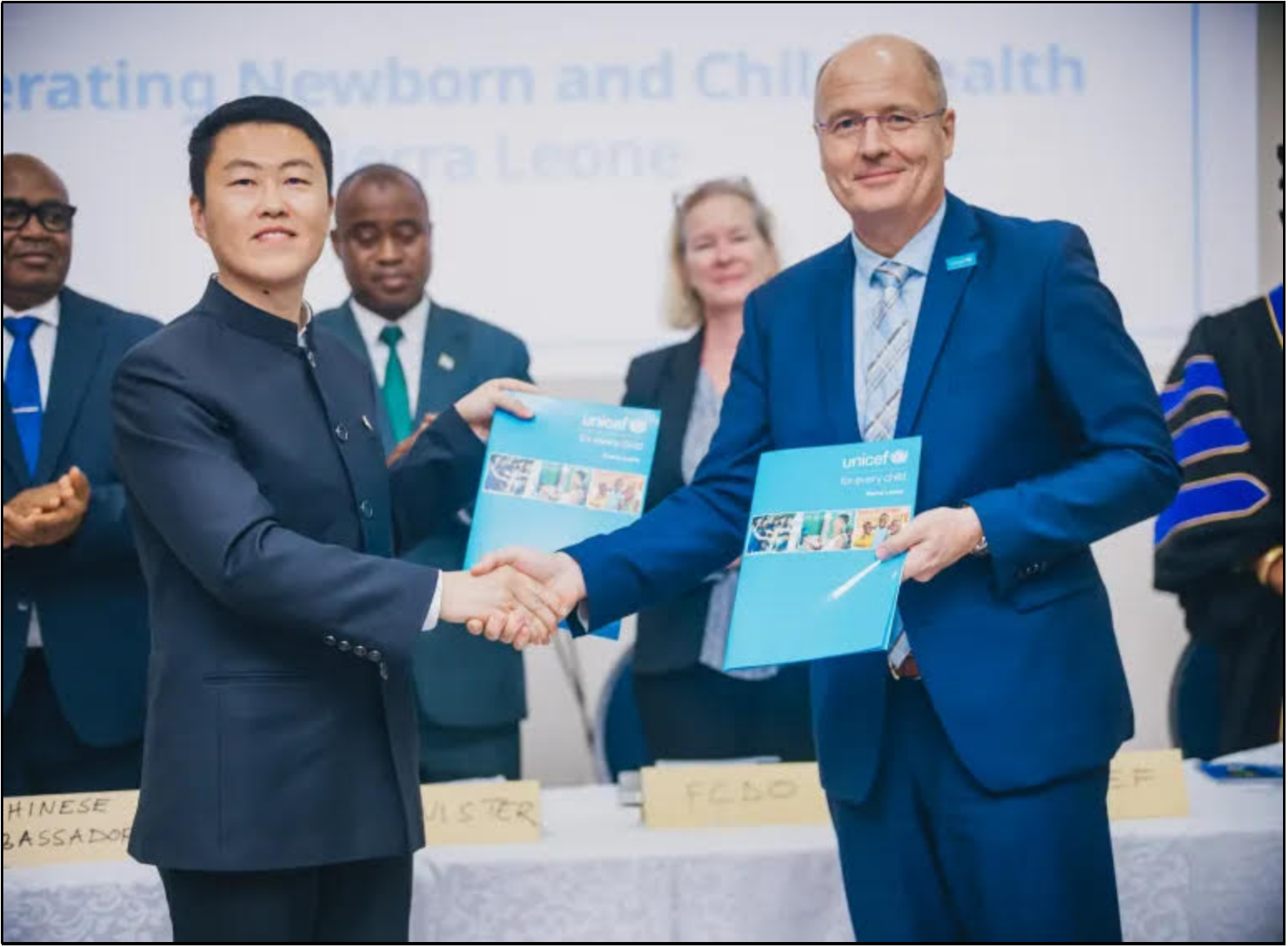
UNICEF Representative, Rudolf Schwenk, and the Chinese Rep exchange partnership agreement at the official launch of a Strategic Health Partnership to Accelerate Newborn and Child Survival in Sierra Leone.
The Chinese government, through the China International Development Cooperation Agency (CIDCA), announced a comprehensive partnership with Sierra Leone’s Ministry of Health and UNICEF to improve newborn and child health services throughout the country. The “Accelerating Newborn and Child Health in Sierra Leone for Improved Survival and Well-being” program aims to address care gaps that contribute to preventable deaths among newborns and young children.
Sierra Leone has made progress in child survival in recent years, but infant and young child mortality remains unacceptably high. Pneumonia, malaria, and diarrhoeal diseases remain the leading causes of death in children, with complications during the neonatal period accounting for a sizable proportion of early deaths. The initiative aims to address these persistent threats by strengthening frontline health services, increasing access to quality care in underserved communities, and strengthening the systems that underpin efficient service delivery.
The program, which is funded by China’s Global Development and South-South Cooperation Fund, is expected to directly benefit nearly 400,000 children while indirectly reaching more than 1.1 million people by strengthening more resilient health systems across the country. Practical, on-the-ground interventions are central to the effort: the program will provide nearly 1,000 health workers and community health workers with improved skills and tools for providing quality child and newborn care; upgrade more than 80 health facilities with essential medicines and medical equipment; and install reliable solar power to ensure uninterrupted services in areas where electricity supply is unreliable.
Aside from physical upgrades and clinical training, the program focuses heavily on system strengthening. Improvements to health information systems and referral pathways are planned to ensure that care continues beyond the first point of contact. Improved data collection, reporting, and referral mechanisms will help to reduce diagnostic and transfer delays, ensuring that sick newborns and children receive timely, appropriate care when it is most critical.
The launch included the introduction of the fourth cohort of the Post-Basic Certificate in Neonatal Nursing program. This specialised training component highlights the initiative’s emphasis on investing in people: by developing a more capable neonatal nursing workforce, the program aims to improve survival and outcomes during the most vulnerable first days and weeks of life.
The Sierra Leone launch puts into action a UNICEF-CIDCA agreement signed in Beijing in November 2025. The programme is fully integrated into UNICEF Sierra Leone’s 2025-2030 Country Programme, which is aligned with national health priorities and the SDGs. Partners describe the collaboration as a shared commitment to ensuring every child survives and thrives by empowering health workers at both the community and facility levels, upgrading critical infrastructure, and making practical improvements that translate into better care for families across the country.
