
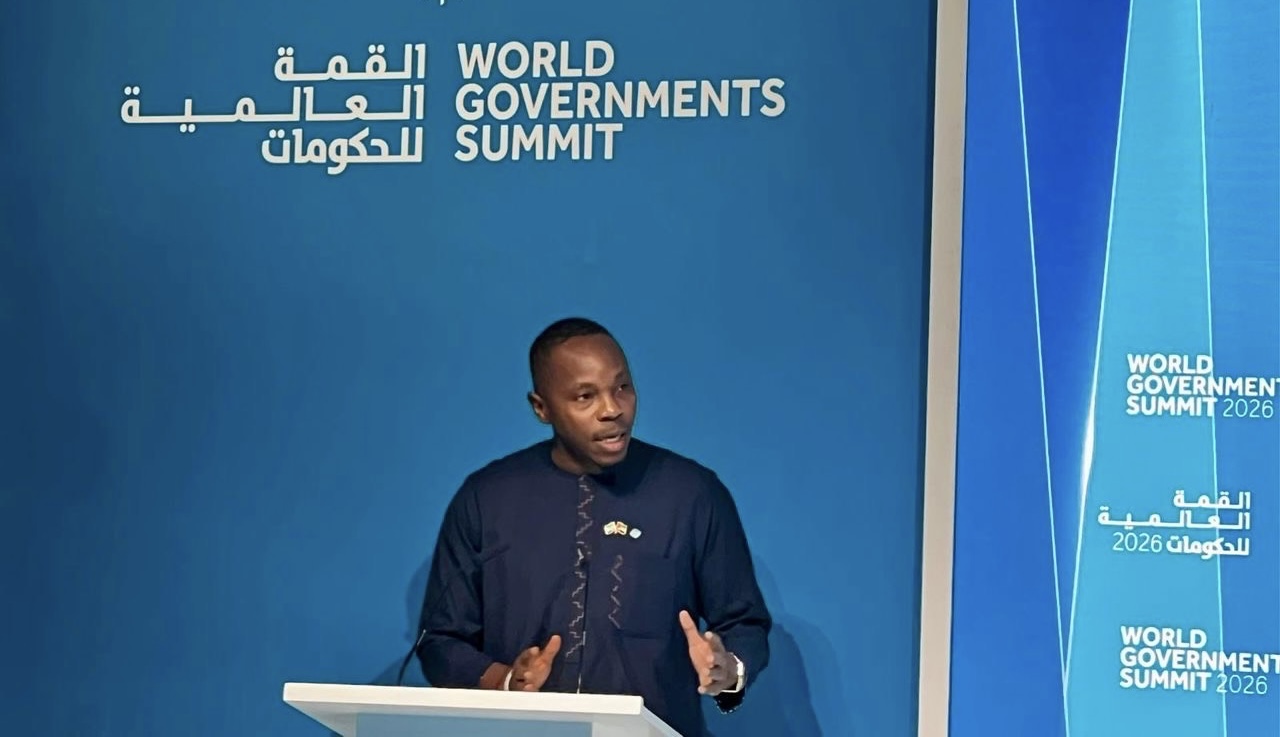
Dr David Moinina Sengeh, the chief minister of Sierra Leone, gave the opening remarks at the Artificial Intelligence Forum at the World Governments Summit 2026 in Dubai on February 3. He urged world leaders to prioritise values, ethics, and human dignity in the development and application of AI. Speaking before an audience of heads of state, policymakers, technologists and private-sector executives, Dr Sengeh argued that governments must look beyond AI as a mere technological tool and explicitly build in fairness, inclusion and social purpose.
The Chief Minister cited specific developments that show how intentional public investment can increase opportunity, framing his comments within Sierra Leone’s national transformation under President Julius Maada Bio and the Big Five Game Changers, particularly Pillar Four: Infrastructure, Technology, and Innovation. He reported nearly 90% 4G penetration, nearly universal 3G coverage, and a fully operational fibre-optic network throughout Freetown. Those connectivity gains, he said, have underpinned the rapid expansion of digital financial services, doubling key financial inclusion indicators, increasing economic opportunities for women, and enabling more effective public service delivery through AI-enabled solutions.
Dr Sengeh pointed to practical deployments of digital tools across sectors: education platforms that reach remote learners, digital health systems that have contributed to a significant reduction in maternal mortality, AI-driven approaches to food security, and the use of satellite imagery to inform environmental governance and policy. These examples, he argued, demonstrate how technology can be marshalled to produce measurable social outcomes when strategic vision and public-sector leadership are aligned.
Central to his address were three guiding principles for governments shaping AI policy and investment. First, “Techquity”: the deliberate use of AI and digital technologies to include those at society’s margins, ensuring that advances bridge—rather than widen—the gap between the “haves” and the “have-nots.” Second, “Interdependence”: a reminder that in an era of strained multilateralism, digital technologies should reinforce global cooperation, improve preparedness for pandemics and environmental disasters, and reflect the reality that no nation can safely or sustainably develop in isolation. Third, “Shared Prosperity” is a call to go beyond innovation for profit alone and consider how AI can contribute to a more equitable world where all children, regardless of where they were born, can realise their full potential.
Concluding his remarks, Dr Sengeh reaffirmed Sierra Leone’s commitment to leveraging technology, innovation and international partnerships to accelerate inclusive growth, strengthen human capital and deliver tangible outcomes under the Big Five agenda. His message at the AI Forum was clear: the promise of AI will be realised only if it is rooted in ethics, equity and collective purpose.
