
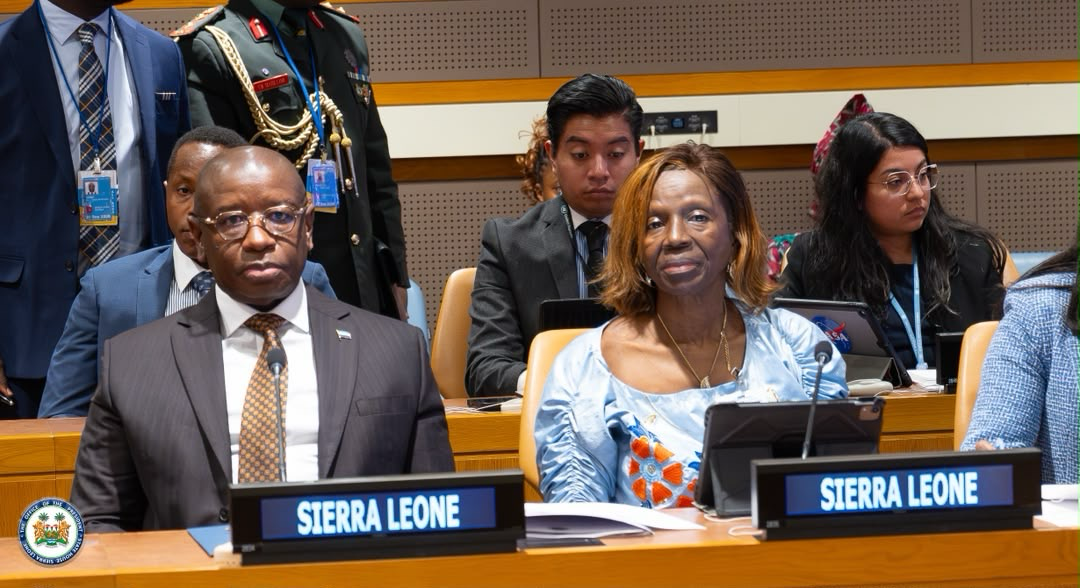
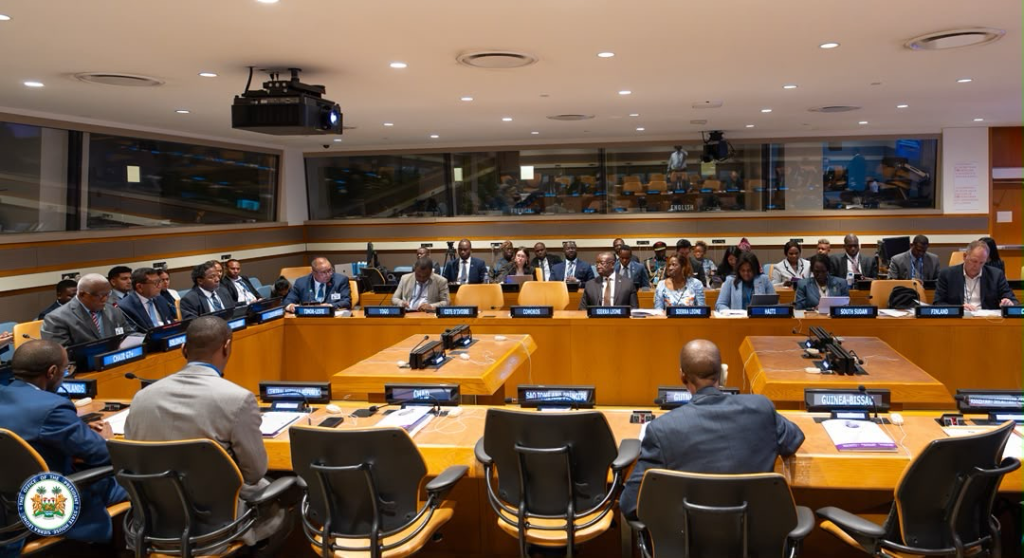
His Excellency President Julius Maada Bio has laid out five guiding principles he said are critical to transform the G7+ Framework for Peace through Dialogue and Reconciliation from an aspirational text into a working tool for conflict prevention and sustaining peace, when he gave a statement at a High-Level Summit on the margins of the 81st UN General Assembly in New York.
In his role as an Eminent Person of the G7+, President Bio spoke at the summit, urging participants to formally endorse the Framework and move quickly from declaration to delivery by establishing clear responsibilities, predictable financing, and mechanisms for accountability. He argued that for the Framework to be effective, it needed five interlocking principles: national ownership, prevention, practical action, adequate resources and coordinated global advocacy.
“National ownership is the first principle that must underpin every activation of the Framework,” President Bio said. It must be based on consent, trust and respect for the sovereignty of the state concerned — only operative at the invitation of a member state and remaining voluntary, confidential and complementary to existing regional and international efforts. The unique comparative advantage of the G7+, he insisted, comes from the lived experience of member countries that have been in conflict, recovered, and rebuilt institutions. “We need to listen, accompany and share experience”, he said, warning against approaches that want to impose from the outside.
“Prevention must be put back at the heart of the Framework,” said the President. We should, instead of counting the number of crises the G7+ responds to, be counting the number of crises it helps prevent. For President Bio, operationalising prevention means making the Council of Eminent Persons a standing, readily available resource that can engage early, discreetly, and constructively when invited by a member state. He also suggested a high-level meeting to develop roadmaps for preventive engagement, including dialogue and reconciliation, before tensions escalate into full-blown crises.
Practicality and inclusion were the third pillar of his remarks. The Framework, he said, must provide tangible and accessible instruments: peer accompaniment missions, structured knowledge exchange, targeted technical assistance, and an expanded Rapid Response Advisory Centre so countries can address legal, political, and development risks before they turn into conflict. President Bio said peacebuilding should not be the exclusive preserve of governments and political elites; women, young people, and communities affected by conflict must play meaningful roles in prevention, dialogue, and reconciliation processes. “Sustainable peace is not only built around negotiating tables, but also in homes, communities, schools, institutions and places of worship,” he reminded the delegates.
The fourth principle is about resources. President Bio warned that “a framework without capacity to act will remain no more than a communiqué.” He called on G7+ member states to provide the Secretariat with the financial and human resources needed to carry out its mandate and to agree on predictable, flexible financing modalities under G7+ ownership. At the same time, he urged international partners to reorient their investments toward prevention, instead of focusing support on emergency response when crises occur. “Investing in prevention is not charity. “It is the most responsible and cost-effective investment the international community can make in the collective peace and security,” President Bio said.
Finally, the President called for stronger and more coordinated advocacy by the G7+ at the global level. He urged member states to speak more coherently in international decision-making bodies to ensure that the practical lessons of conflict recovery and state-building inform global decisions on political transitions, peacebuilding approaches and development financing. Fragility, he argued, should not be seen as a permanent identity or an endlessly manageable condition. This challenge can be overcome through national leadership, sustained partnership, and patient institution-building.
To conclude, the President asked the Summit to formally endorse the G7+ Framework for Peace through Dialogue and Reconciliation and to mandate its prompt implementation, with clearly assigned responsibilities, adequate resources, and accountability measures. That’s when the organisation can transition from statements to real delivery, he said. He also stressed that countries emerging from conflict are not only recipients of international assistance but also potential sources of knowledge, leadership, and solutions that can reinforce collective efforts for peace.
