
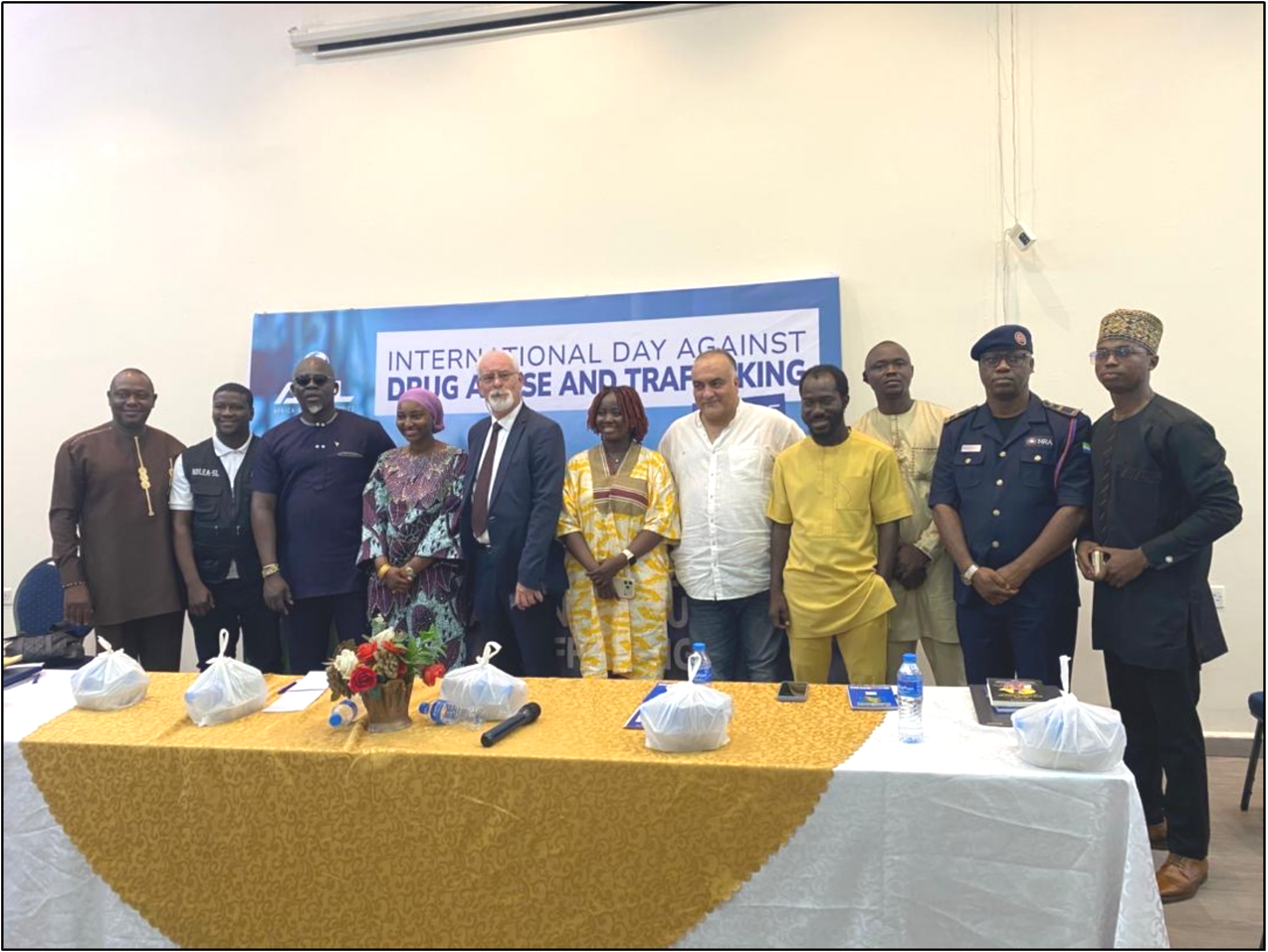
Africa Global Logistics (AGL), through its Sierra Leone operator Freedom Terminal Limited, on Friday led a multi-stakeholder awareness campaign to mark the International Day Against Drug Abuse and Illicit Trafficking. Held at the New Brookfields Hotel in Freetown, the event brought together government officials, law enforcement, customs and revenue authorities, port operators, media, civil society and members of the port community to reaffirm their commitment to reducing drug abuse and halting the flow of illicit drugs through the country’s gateways.
The program was opened by Abibu Jalloh, who welcomed the participants and thanked the diverse group of stakeholders in attendance, highlighting the need for shared responsibility in addressing a growing national and regional threat. The joint turnout showed that ports, borders and associated logistics hubs are key sites of commerce and criminal activity, he said.
The first presentation was delivered by Patrick Sannoh of Freedom Terminal Limited, who stressed the need for a drug-free workplace, especially in the ports and logistics sector where safety, alertness and good judgment were of utmost importance. “It’s not just a priority, it’s the foundation of everything we do,” Sannoh said. Freedom Terminal and the AGL Group adhere to a strict Zero-Tolerance Drug Policy. The policy prohibits possession, use, distribution, sale or trafficking of illegal drugs on company property or while on duty, he said, warning that violations could result in dismissal and referral to law enforcement.
Sannoh has urged port employees and stakeholders to be vigilant as ports, airports and border crossings remain preferred routes for organised trafficking networks. He called on the public to remember three basic principles: to learn about and spread the word on the dangers of drug abuse; to take personal responsibility by following the workplace policy and reporting suspicious behaviours; and to help fellow employees who may be suffering from substance abuse by urging them to seek professional treatment. “Prevention begins with awareness, and awareness leads to action, resulting in safer workplaces and stronger communities,” he said.
AGL’s country manager, Captain Fabjanko Kokan, said the company was still committed to its strict policy against drug trafficking and the social consequences of it. Trafficking, he said, is a criminal enterprise that destroys families, undermines communities and feeds corruption and robs young people of future opportunities. “The money the traffickers make cannot replace respect, dignity or integrity,” Captain Kokan said.
He said education is a key preventative measure and that he recently helped to build a school in a rural community because he believes that education makes people less vulnerable to criminal recruitment and substance abuse. “This is not just my job as General Manager; as a human being, as a father, as a grandfather, it is my duty,” he said, urging stakeholders to work together: “One finger cannot lift a stone.” Only by working together can we protect our ports, protect our communities, and ensure a brighter future for our children.
The Director of Drug Prevention, Education and Training was the keynote speaker on behalf of the Executive Director General, National Drug Law Enforcement Agency (NDLEA). The NDLEA representative acknowledged global progress in addressing the 2026 global theme, “The World Drug Problem: Past Challenges, New Threats, and Innovative Responses,” but warned that criminal groups are growing more sophisticated, leveraging technology, vulnerable populations, weak institutions, and international trade routes.
He said the national response would be based on four pillars: prevention based on strong family values; compassion and rehabilitation for people with substance use disorders, combined with zero tolerance for traffickers and financiers; rehabilitation and social reintegration, supported by government, psychiatric services, faith-based organisations and development partners; and strengthening enforcement through intelligence-led operations, improved border security and international cooperation. “The agency continues to destroy confiscated drugs in public to show transparency,” he said, adding that from January to April 2026 it reported more than 48 drug-related convictions.
A panel discussion was held on practical solutions with representatives from the Customs Service Department, the National Revenue Authority (NRA), Freedom Terminal, port security agencies and Sierra Leone Border Agencies Association. The Customs official explained that traffickers are constantly developing new concealment methods, particularly in legally declared shipping containers, and said that intelligence gathering, information sharing and risk profiling are Customs’ most effective tools. Many of the seizures were a result of intelligence-led, targeted examinations, the official said, acknowledging that it was not possible to physically inspect every container. Customs now requires a physical inspection of containers declared to be carrying medicines, and this has led to the discovery of illicit substances hidden among legitimate pharmaceutical consignments, he said.
NRA officials say investments are being made in sophisticated cargo scanners, enhanced risk-assessment systems and better inter-agency co-operation to bolster border defences. Freedom Terminal reiterated its zero-tolerance policy and described its security measures, including improved access control, increased perimeter security, employee awareness programmes, close collaboration with Customs and constant monitoring of terminal operations. The representative of the terminal called for collective solutions and not for the blame of individual institutions, saying that Customs, NRA, terminal operators, security agencies and community members have roles to play.
The President of the Sierra Leone Border Agencies Association underlined that, while technology and scanners are useful, the best protection against organised trafficking remains professional integrity, rapid information sharing and inter-agency cooperation. He called for ongoing cooperation to secure the country’s borders and communities.
The speakers underlined the importance of a broad-based and long-term response to fight drug abuse and drug trafficking from families, schools, employers, religious institutions, civil society, security agencies and citizens. Ajuah Daramy proposed a vote of thanks to the speakers, panellists and participants for their participation and contribution to the dialogue, bringing the programme to an end.
Subscribe to Updates
Get the latest creative news from FooBar about art, design and business.
AGL, Freetown Terminal launch campaign against drug abuse, trafficking

gleanernewspaper
Gleaner Newspaper is the Home for exclusive local news, views, and adverts from Sierra Leone. Publisher: Gleaner Communications Sierra Leone.