
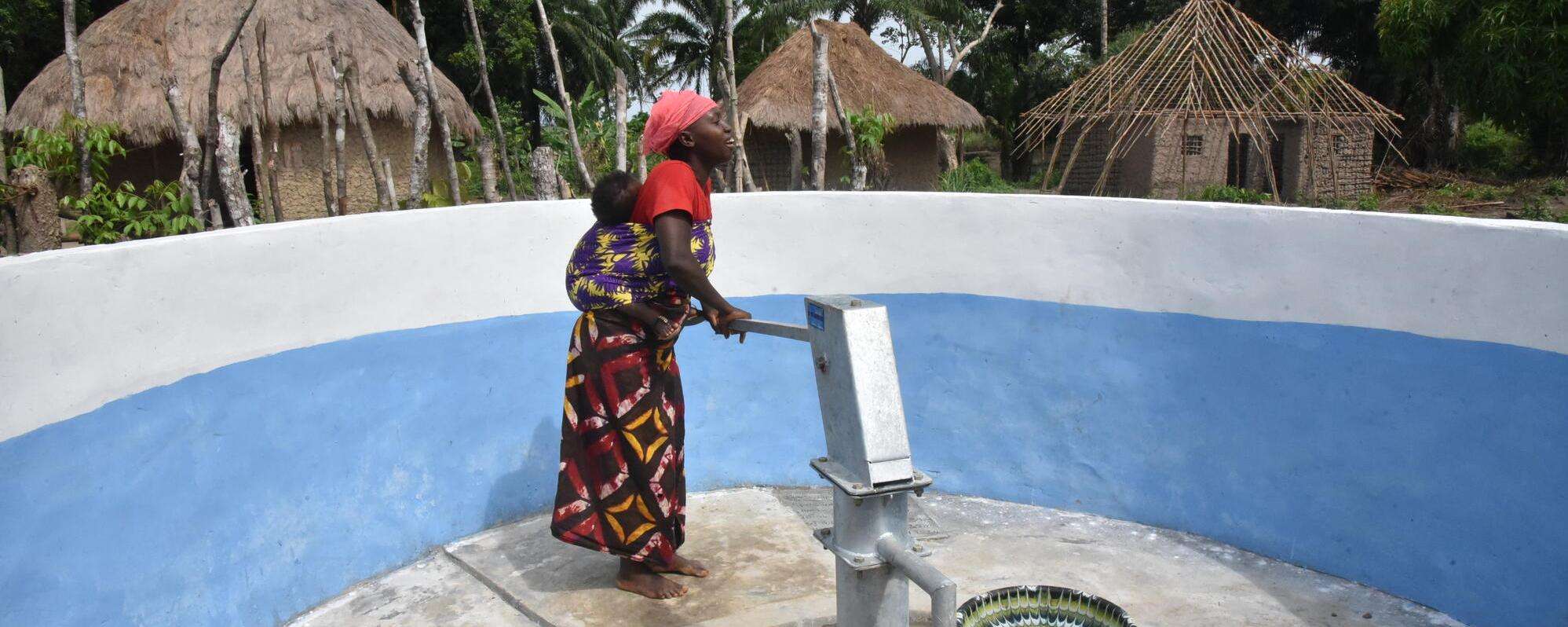
MSF is working to ensure sustainable access to clean water in a country where more than half the population uses unsafe water sources like rivers and unprotected wells.
Health care is more than access to medicine and medical personnel. Clean drinking water and hygiene practices play an integral role in promoting and sustaining people’s overall health.
To improve safe water availability in Sierra Leone, a country with limited available water and sanitation services, Doctors Without Borders/Médecins Sans Frontières (MSF) has built boreholes, each equipped with a hand pump system, in seven communities in Tonkolili district.
In Sierra Leone, 23 percent of people do not have access to basic water services and approximately 58 percent are using unsafe water sources like rivers, dams, and unprotected water wells, according to a 2023 report by UNICEF and the National Institute of Health. Access to clean water is especially challenging in rural areas of the country, where most people rely on hand-dug wells and surface water.
Communities have faced various disease outbreaks like scabies, typhoid, and diarrhoea because of the inadequate supply of clean drinking water and unhygienic practices.
“We get our water from the swamp in our farm or the Pampana river, which is a few minutes away from our village,” says Aminata, a resident of Masiperr village. “We know the water is dirty—it is brown. But we don’t have another option. We have to [use it to] drink, cook, and bathe.”
We know the water is dirty—it is brown. But we don’t have another option. We have to [use it to] drink, cook, and bathe,” Aminata, a resident of Masiperr village said.
“Most people in these communities use a bucket to fetch water from these sources and will leave the water in the bucket for a few hours, hoping that the solid particles floating in the water will settle at the bottom,” says Sheku Jabbie, MSF health promotion supervisor in Tonkolili district. “After a few hours, the colour of the water will be clear and then they drink the water [while] taking caution not to rock the bucket, so the particles don’t float to the surface. This has become a common practice.”
Of the 12 communities where MSF supports peripheral health units, seven did not have safe drinking water, especially during the dry season, and most relied on rivers and swamps for water for daily activities.
Years ago, many people had access to hand-dug wells, which were constructed by individuals from the communities or private organizations, and provided water throughout the year. But now, due to multiple factors including climate change, the wells are not as full as they used to be during the rainy season, and they are dry the rest of the year.
“We used to receive so many cases of diarrhoea in the clinic because of the water that is being used here in the community,” says Aminata Bangura, a Ministry of Health nurse working at the Masiperr peripheral health unit. “Even we, the health workers, use it in the clinic, but we first boil the water or use water filters. These filters are not enough to serve the entire community.’
To address these challenges, MSF drilled seven boreholes in Tonkolili district, complete with hand pumps next to the peripheral health units of Masengbeh, Foindu, Petifu Fulamasa, Makondu, Makeni Rokefullah, and Masiperr villages, as well as beside Ester’s clinic in Mile 91 township. The boreholes were completed in June 2024 and will serve as a reliable and safe source of drinking water for years. They were drilled during the dry season after a geophysical survey was done to ensure they could produce safe water throughout the year.
Water samples from each borehole were sent to the National Water Quality Laboratory in Freetown, which concluded that the water passed the World Health Organization’s recommendation for safe drinking water.
Ensuring the availability and sustainable management of water and sanitation is a Sustainable Development Goal to achieve by 2030. More must be done to support this effort.
MSF has begun training members of each community where boreholes were constructed to fix minor faults. Additional training will focus on how to operate and maintain the boreholes. Repair toolkits, including spare parts, will also be provided to the communities.
“These boreholes belong to the people,” says Mohamed Kuyateh, MSF water and sanitation supervisor. “They are here to serve them for a very long time. We want communities to be equipped to ensure the boreholes can do that.”
MSF has been working with Sierra Leone’s Ministry of Health in 12 peripheral health units in Tonkolili district to provide free health care for pregnant women and children under the age of five. MSF works in the chiefdoms of Yoni Mabanta, Yoni Mamaila, Malal, and the Hinistas community health centre in Mile 91 town, as well as the Magburaka government hospital, where patients with severe symptoms are referred from Hinistas community health centre.
