
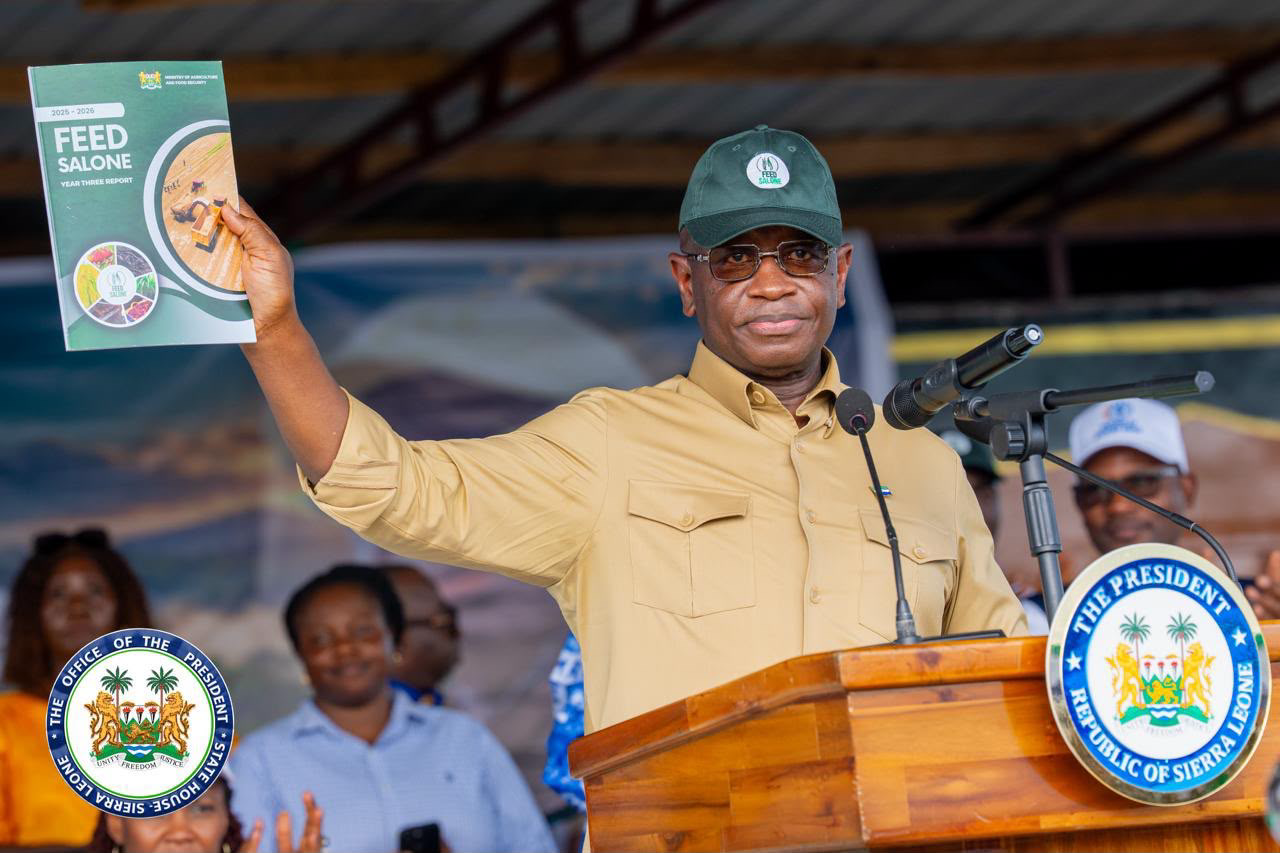
President Julius Maada Bio has called for faster transformation of Sierra Leone’s agricultural sector, emphasising modern technology, increased local food production, and investment in processing to reduce the country’s reliance on imported foods.
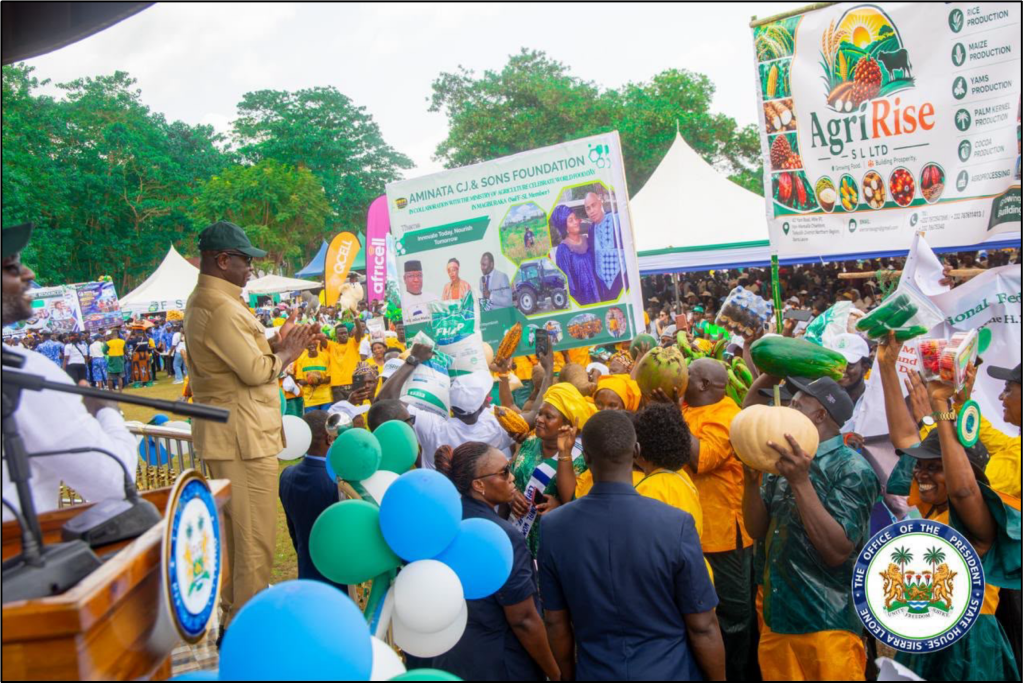
At the World Food Day celebration and launch of the third-year report on the Feed Salone initiative, President Bio stated that producing more food locally was critical to national security, job creation, and economic development. The event was held at Ernest Bai Koroma University of Science and Technology in Magburaka under the theme “Innovate Today, Nourish Tomorrow.”
“Food security is an issue of national security and dignity. “We must boost local production, strengthen our farmers, and expand our capacity to produce more of what we consume,” the President stated.
He advocated investing in improved seeds, irrigation, mechanisation, agricultural research, and financing. He also mentioned emerging technologies like drones as tools that could help boost productivity. At the same time, he urged stronger links between education, technical training, and agribusiness, stating that the sector must provide profitable opportunities for young people and women.
According to President Bio, increased production requires stable markets and improved storage, transportation, and processing infrastructure. Farmers may struggle to sell their produce or earn a sustainable income without these systems.
“Agriculture must be a solid foundation for industrialisation. “We must add value to our locally grown crops, create jobs, strengthen our economy, and reduce reliance on imported food,” he stated.
The President cited figures from the Feed Salone report that show a decrease in severe household food insecurity, from 28% in September 2023 to 13% in July 2025. During its third year, the initiative created over 22,000 direct and indirect jobs, he said.
He cited progress in domestic rice production as another indicator of change. “Today, nearly three out of every four cups of rice on our tables come from our own soil,” he said, emphasising the need for additional efforts to increase production and secure the country’s food supply.
President Bio concluded his address by urging Sierra Leoneans to take ownership of the agricultural transformation agenda. “Wetin wi plant, na I’m going eat. “Salone, go feed Insɛf,” he said.
At the event, traditional leaders pledged their support for farming and peaceful community development. Paramount Chief Dr Masakà Madibie II of Kafe Chiefdom, National Chairman of the Council of Paramount Chiefs, praised the initiative and reaffirmed the traditional leadership’s dedication to agricultural development.
Ibrahim Jalloh, Resident Minister for the Northeast, and Madam Yabom Seay, Chairman of the Tonkolili District Council, welcomed the President and participants to the district.
The Food and Agriculture Organisation’s country representative, Saeed Abubakar Banice, praised the government’s progress and advocated for more investment in climate-smart agriculture and modern technology. He also emphasised the importance of providing opportunities for women and youth.
Princess Dugba, Minister of Fisheries and Marine Resources, highlighted fisheries’ contribution to domestic food supply. Hon. Dr Kandeh Yumkella, chairman of the Presidential Initiative on Climate Change, Renewable Energy, and Food Security, said the overall Feed Salone agenda would be critical to the country’s efforts to improve food security and agriculture.
Yeatta Sama, President of the National Farmers Federation, encouraged more Sierra Leoneans to become farmers and praised local producers.
Agriculture and Food Security Minister Henry Musa Kpaka discussed progress in several areas, including rice production, onion imports, and poultry. He stated that rice self-sufficiency had increased, onion imports had decreased, and domestic poultry production had grown.
Dr Kpaka also mentioned investments in seed production, rice processing, agricultural infrastructure, and the school feeding program. He stated that nearly one million schoolchildren received meals during the previous academic year, with an increasing proportion of the food sourced locally.
Looking ahead to the initiative’s fourth year, Dr Kpaka said the government will prioritise making existing investments fully productive. Priorities include completing key irrigation and rice-processing facilities in Tormabum and Gbondapi, as well as expanding financing and commercial opportunities for farmers, particularly women and young people.
The event concluded with awards presented to ten farmers, entrepreneurs, and agricultural champions for their contributions to food production, innovation, processing, and the Feed Salone initiative.
Lieutenant General Amara Idara Bangura was among those honoured, recognised for his leadership role in the Republic of Sierra Leone Armed Forces farm. Mrs Monica Kwame Greene was honoured for coordinating agricultural programs, while Mrs Sitta Isata Kai Kai was recognised for local production through Mulu Poultry and Chuma Agro Company Limited. Ms Hannah Elizabeth Tarawally received recognition for Coffee Couriers’ contributions to agricultural development.
Other recipients included Paramount Chief Bai Fonti Thangbathi II, for advancing food production and domestic rice supply, and Ms Safinatu Bockarie, whose Evergreen Women organisation promotes inland valley swamp farming and women’s participation in agriculture. Ms Saffie Kalokoh received recognition for her contributions to sustainable agricultural innovation and vegetable production.
Mr Peter Dawah received an award for the National Farmers Association’s work in goat farming and livestock production. Mr John Shallop was honoured for House of Beans’ contribution to agricultural processing and value addition, and Mrs Binta Bio was recognised for Godwill Investment SL Ltd’s investment in domestic rice production.
The celebration emphasised the government’s desire to position agriculture as a source of food security, employment, industrialisation, and improved living conditions. Feed Salone is entering its fourth year, and officials say the next phase will focus on strengthening local production, developing agricultural value chains, and ensuring existing investments better benefit farmers and communities.
