
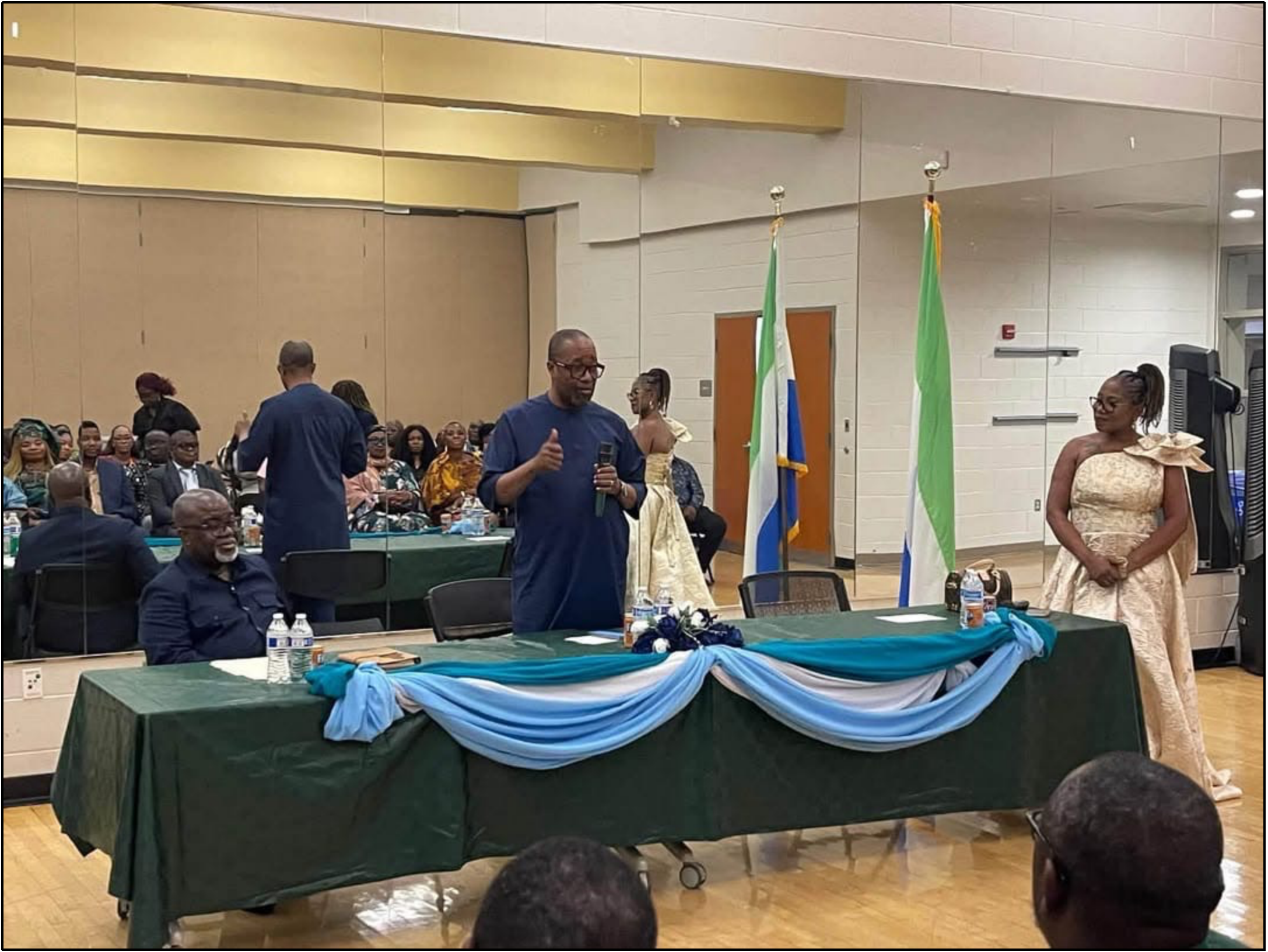
The Minister of Foreign Affairs and International Cooperation of Sierra Leone, Hon. Mohamed Rahman Swarray, appealed to Sierra Leoneans in the United States to collaborate with the government in tackling several emerging national challenges during a Town Hall meeting on 1st October 2026, organised jointly by the Embassy of Sierra Leone in Washington, DC and Berny’s Hope Foundation-USA. Hon. Swarray appreciated the diaspora’s contributions and called for a united, nonpartisan approach to issues that transcend regions and ethnicities at the White Oak Community Centre in Maryland.
The minister’s comments centred on the ongoing US visa ban, which he described as a national challenge that cuts across the political divide and affects Sierra Leoneans. “The measures have had far-reaching and negative consequences,” he said, including limited educational opportunities for Sierra Leonean students who want to study in the United States, disrupted attendance at international conferences, and barriers to many families visiting relatives abroad. He said most of the problems were a legacy, adding that the situation has disrupted life opportunities for many citizens and stifled efforts at professional and academic exchange.
Hon. Swarray told the Diaspora that the Embassy in Washington, DC, and the Foreign Ministry in Freetown are in communication with US authorities to find a solution. He said diplomatic channels were being used to build understanding and negotiate ways forward. He said one possible way out of the deadlock was arrangements for third-party acceptance of deportation of West African citizens to Sierra Leone. This was part of a wider range of measures being explored with US counterparts, he said. “The embassy has put in place more stringent and efficient procedures to ensure expeditious handling of U.S. immigration-related matters,” he said.
Besides diplomatic engagement, the minister cited the need for the diaspora to be a voice for Sierra Leone. He encouraged Sierra Leoneans in the United States to reach out to political leaders in the Senate and House of Representatives, make the visa ban a national advocacy issue, and use their own networks to raise awareness. “The visa ban should be a national agenda,” he said, adding that Sierra Leoneans at home and abroad have a common national interest.
Hon. Swarray’s appeal was linked to a wider call for national unity and inclusive governance. President Julius Maada Bio said he is committed to a united and progressive Sierra Leone and the return of former President Ernest Bai Koroma is a symbol of national unity and reconciliation. The minister said the president cannot do this alone, and the diaspora’s financial, intellectual, and political resources are critical to the country’s development. In that vein, he reiterated the government’s appreciation of the diaspora’s significance by highlighting measures to eliminate legal hurdles that have hitherto denied dual citizens the opportunity to participate fully in political governance.
Hon. Swarray presented a results-oriented 100-day plan for the Foreign Ministry’s leadership, including collaborative solutions to bring Sierra Leoneans together and address immediate needs. He announced plans for a pilot program to address common consular issues faced by the diaspora. The pilot will target services that are often a headache for Sierra Leoneans living far from embassy offices, including visa processing, passport renewal, and issuance of Emergency Travel Certificates.
“The rapid digitisation of consular services is an important part of the ministry’s modernisation plan,” the minister said. The aim is to reduce the need for citizens abroad to visit embassy premises, and to make it easier for them to access important services online. Hon. Swarray encouraged Sierra Leoneans to register with the embassies so they can get consular assistance in an emergency, and stressed that protecting Sierra Leoneans living abroad is his ministry’s top priority.
In the Town Hall, the minister often preached unity and nonpartisan cooperation. He presented the diaspora’s engagement not only as an act of patriotism but also as a pragmatic response to the intertwined challenges of migration policy, economic recovery, and governance reform. As the Foreign Ministry pursues diplomatic channels, administrative reforms, and digitisation of services, Hon. Swarray’s message to Sierra Leoneans in the United States was clear: the government seeks collaboration. It expects the diaspora to play an active role in rebuilding and strengthening the country.
Subscribe to Updates
Get the latest creative news from FooBar about art, design and business.
Foreign Minister Calls on US Diaspora to Join National Efforts to Address Visa Ban, Economic and Governance Challenges

gleanernewspaper
Gleaner Newspaper is the Home for exclusive local news, views, and adverts from Sierra Leone. Publisher: Gleaner Communications Sierra Leone.