
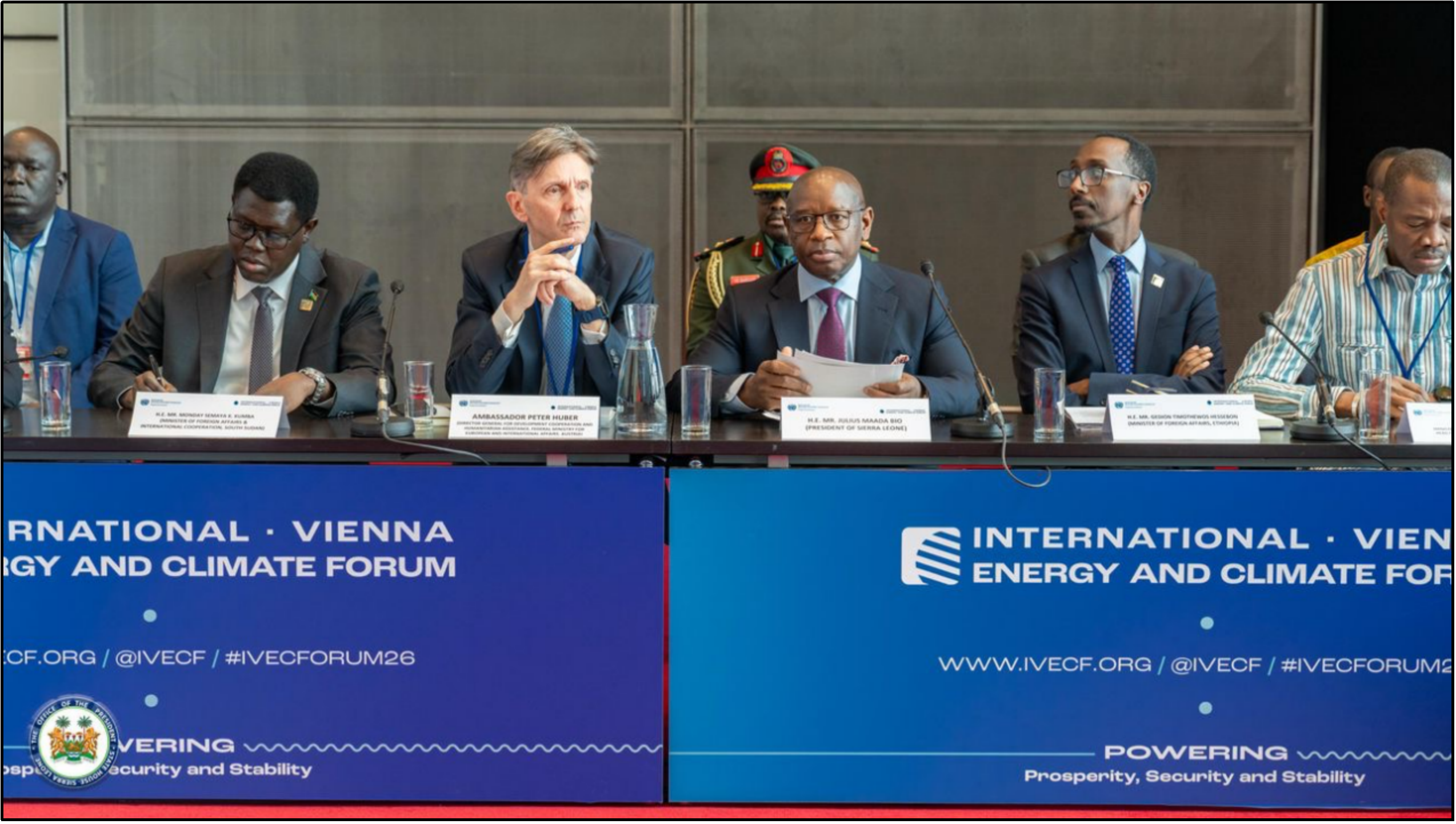
Thursday, April 9, 2026 — Sierra Leone President Dr Julius Maada Bio has called for immediate action to link energy access with economic transformation, arguing that green industrialisation is critical for stability and shared prosperity in Least Developed Countries (LDCs) and Landlocked Developing Countries. President Bio spoke at a high-level roundtable on “Green Industrialisation for Stability and Shared Prosperity” on the sidelines of the International Vienna Energy Forum, urging governments, financiers, and development partners to focus energy investments on tangible economic outcomes rather than treating electrification as an end in itself.
“For countries like Sierra Leone, energy is not the end goal; it is the engine of production, jobs, and stability,” he said, emphasising that expanding power supplies must result in increased employment, productivity, and better livelihoods. The President emphasised Sierra Leone’s strategy of linking energy development directly to productive sectors, citing national flagship programs that connect electricity and clean cooking access with agriculture, processing, and rural enterprise.
Among these initiatives, President Bio cited Feed Salone, a coordinated approach that supports irrigation, agro-processing, cold storage, and rural enterprise growth, as an example of how energy provision can be integrated with value chain development to increase incomes and strengthen communities. He argued that such integration is critical to ensuring that energy investments result in measurable increases in living standards and economic stability across communities.
While acknowledging the continued importance of grid expansion, President Bio stated that distributed renewable energy solutions—mini-grids and stand-alone systems—provide the quickest path to increasing access in rural and underserved areas. He urged a greater emphasis on decentralised approaches that can be implemented quickly to power productive uses and stimulate local economic activity.
Green industrialisation, he added, represents a significant economic opportunity. President Bio cited Sierra Leone’s clean cooking transition as a concrete example of how targeted reforms and strategic investment are generating new value chains and business opportunities, particularly for women entrepreneurs who are increasingly involved in supply and service networks for clean cooking technologies.
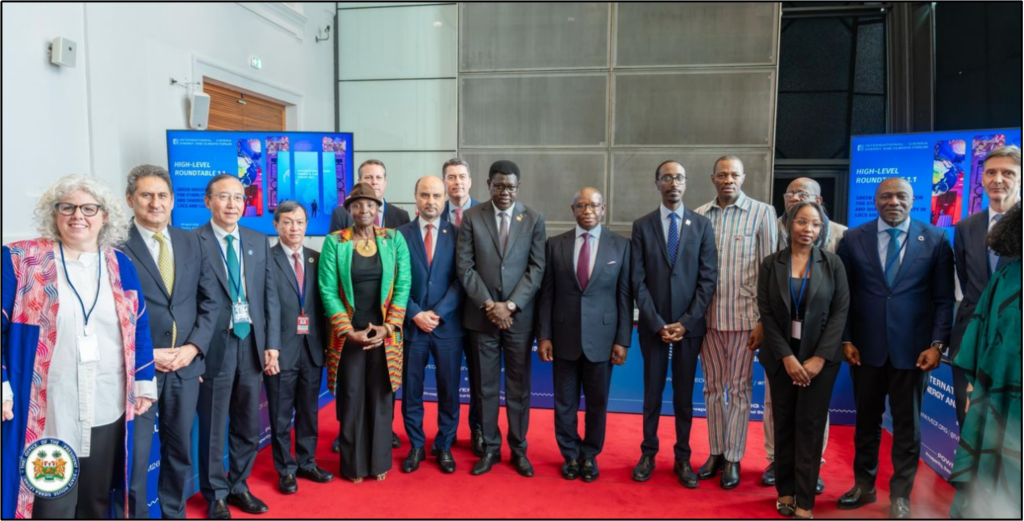
On partnerships, the President discussed ongoing collaboration with international partners to accelerate decentralised energy access and increase private sector participation. In his role as Chairman of the Economic Community of West African States (ECOWAS), he stated that efforts are being made to align regional markets and project pipelines to attract larger-scale private and blended financing.
Looking ahead, President Bio announced that Sierra Leone will launch a Distributed Renewable Energy and Clean Cooking Acceleration Initiative within the next year as part of the Mission 300 Compact. The initiative will prioritise scaling solar energy for productive use, increasing access to clean cooking, and leveraging blended financing through collaborations with development institutions and private investors. He warned that high capital costs and perceived risks continue to limit investment in developing economies, and he advocated for more accessible, affordable financing to help the sector reach its full potential.
In his closing remarks, President Bio reaffirmed Sierra Leone’s readiness to serve as a demonstration country for effective energy solutions, emphasising that the ultimate goal is not just increased power generation, but also improved livelihoods and long-term stability.
