
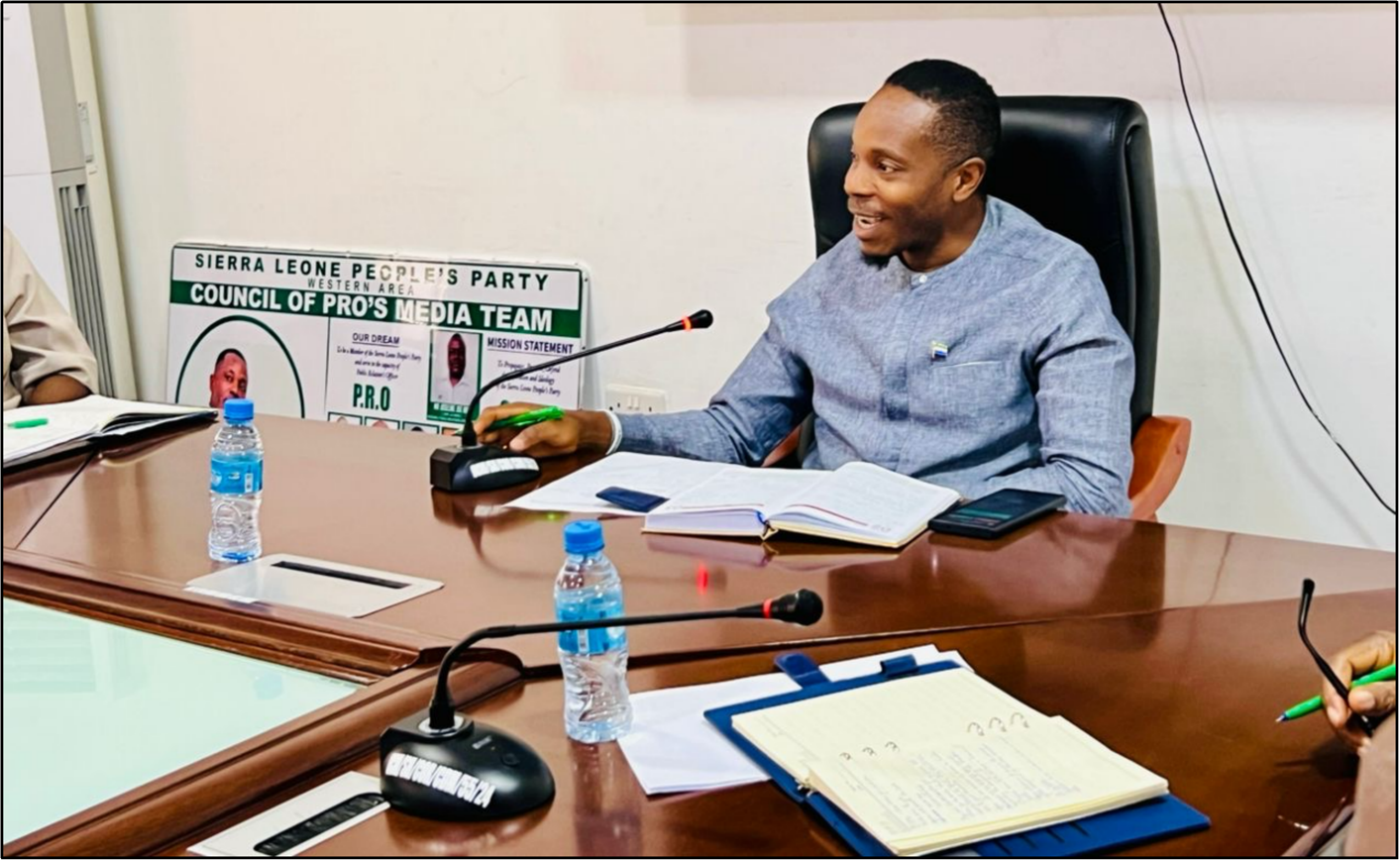
March 2026 — As part of Pillar One of the government’s “Feed Salone” agenda, Chief Minister Dr David Moinina Sengeh convened a strategic inter-ministerial meeting aimed at rapidly increasing local rice production and directing that supply into institutional feeding programs. Dr Sengeh described the talks as “very successful,” saying he briefed His Excellency President Julius Maada Bio on the results and tasked agencies with concrete follow-up actions.
The meeting looked at practical ways to incorporate locally produced rice into public institution food supply chains, with a particular emphasis on the Republic of Sierra Leone Armed Forces and the Sierra Leone Correctional Service. Dr Sengeh emphasised the possibility of replicating and expanding previous efforts: in 2014, locally sourced rice accounted for up to 30% of the supply to the military and correctional services. He also mentioned that security institutions’ monthly rice demand is approximately 30,000 bags, indicating a predictable market that could absorb increased local production.
Minister of Agriculture, Food Security, Dr Henry Musa Kpaka, provided detailed production and stock data to assist with planning. He stated that 62,777 bags of paddy rice (50kg) could be milled to produce approximately 37,800 bags of milled rice. In addition to the potential yield, there are currently 5,900 bags of milled rice available, in addition to an existing stock of 9,000 bags, with additional reserves discovered in Kambia District. “We now have detailed data including farmer contacts, business locations, and district-level production figures, giving us a clearer pathway to mobilise local supply,” Dr Kpaka stated.
The Sierra Leone Produce Marketing Company has been working directly with farmers to improve aggregation and distribution systems, while the Ministry of Trade and Industry will conduct a survey to gauge public perception of locally produced rice to improve marketability and consumer confidence. The initiative seeks to reduce rice imports, provide farmers with a stable market, and strengthen national food security by linking reliable institutional demand to domestic production capacity.
Officials described the coordinated approach as a practical shift toward increasing domestic production that is expected to improve food self-sufficiency, support rural livelihoods, and advance Sierra Leone’s larger agricultural transformation goals. Follow-up meetings will test procurement mechanisms within ministerial feeding systems to determine how sustainable local rice can be sourced for institutional needs.
Subscribe to Updates
Get the latest creative news from FooBar about art, design and business.
Chief Minister Leads Push to Channel Local Rice Into Institutional Feeding Under “Feed Salone”

gleanernewspaper
Gleaner Newspaper is the Home for exclusive local news, views, and adverts from Sierra Leone. Publisher: Gleaner Communications Sierra Leone.