
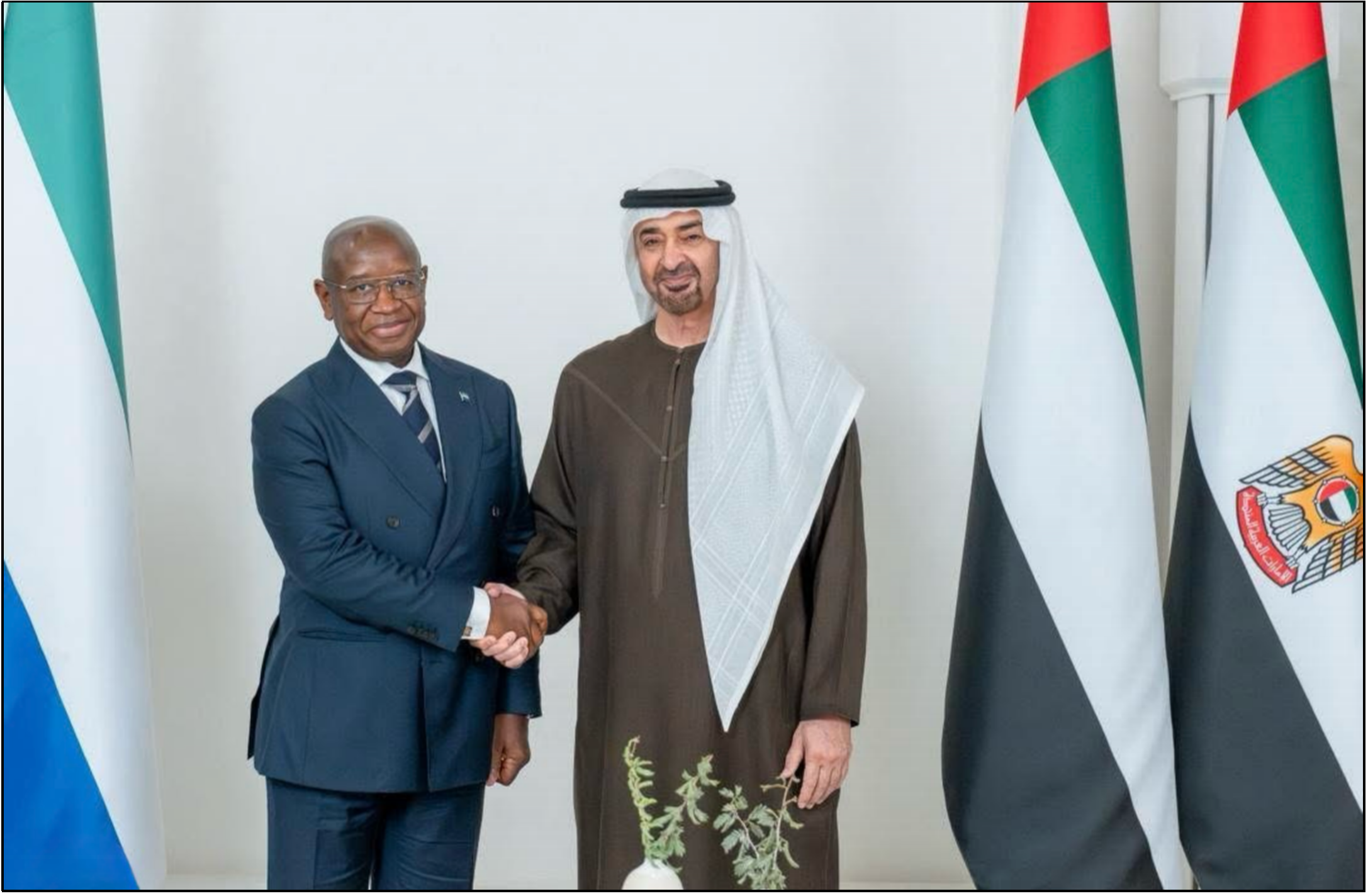
President Julius Maada Bio and His Highness Sheikh Mohamed bin Zayed Al NahyanSigning a comprehensive economic agreement, the UAE and Sierra Leone commit to deeper collaboration in the areas of artificial intelligence, water, energy, and regional security.
To strengthen their relationship and broaden their collaboration across economic, technological, and development priorities, President His Highness Sheikh Mohamed bin Zayed Al Nahyan of the United Arab Emirates and President Julius Maada Bio of the Republic of Sierra Leone met in Abu Dhabi on Monday, February 2, 2026, as part of the World Governments Summit 2026.
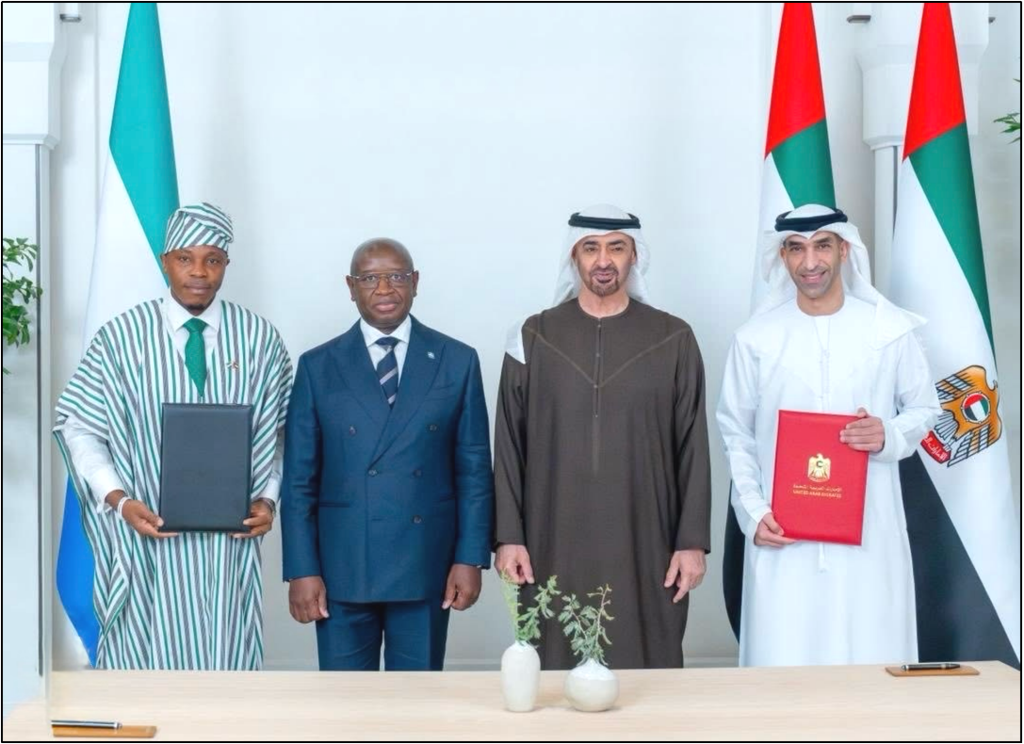
The visit was centred on the signing of the Comprehensive Economic Partnership Agreement (CEPA), a historic agreement that the two leaders claimed would open up new avenues for investment, trade, and cooperation between the private and public sectors.
The CEPA aims to foster business ties between Emirati and Sierra Leonean companies in a variety of industries and to offer a framework for deeper economic integration. The World Governments Summit was cited by both leaders as an important international forum for promoting discourse on international cooperation, development, and governance.
They pledged to increase cooperation in priority areas like artificial intelligence, energy, agriculture, infrastructure, logistics, and healthcare and characterised the high-level discussions between Abu Dhabi and Freetown as positive and forward-looking. Opportunities for improved military and defence cooperation were also discussed. Regarding innovation and technology, Sierra Leone embraced the United Arab Emirates’ USD 1 billion “AI for Development” initiative, which was unveiled by the UAE during the G20 Leaders’ Summit in Johannesburg in November 2025.
Through promoting collaborations that could introduce AI-driven solutions to public services, agriculture, and health throughout the continent, as well as by speeding up innovation and digital transformation, both parties confirmed the initiative’s potential to support Africa’s development priorities.
The two presidents reiterated their shared commitment to the values of international law and the peaceful settlement of disputes while exchanging opinions on a variety of regional and global issues. Both parties reaffirmed their commitment to multilateral cooperation in tackling common issues, and the UAE commended Sierra Leone’s positive contribution in regional and global fora, including the Economic Community of West African States (ECOWAS).
Regarding the Sudanese crisis, the leaders emphasised that the warring parties bear the primary responsibility for bringing the civil war to an end and unanimously denounced atrocities against civilians. They emphasised the pressing need for an immediate, unconditional humanitarian truce, a permanent ceasefire, and unimpeded humanitarian access throughout Sudan and demanded accountability for transgressions of international humanitarian law. Both sides also called for the establishment of a civilian-led administration that reflects the goals of the Sudanese people and is not influenced by the warring parties.
The two governments underlined respect for sovereignty, territorial integrity, non-interference, and the ban on the threat or use of force, and they reaffirmed the significance of adhering to international law, including the UN Charter. They demanded that the occupation of the three UAE islands—Greater Tunb, Lesser Tunb, and Abu Musa—end, and they reaffirmed their support for a peaceful resolution of the conflict, whether it be through bilateral talks or by referral to the International Court of Justice in conformity with UN Charter principles and international law.
In line with the African Union’s 2026 theme, “Assuring Sustainable Water Availability and Safe Sanitation Systems to Achieve the Goals of Agenda 2063,” Sierra Leone also conveyed gratitude for the UAE’s ongoing engagement with Africa and its support of sustainable development initiatives throughout the continent. In order to expedite the implementation of Sustainable Development Goal 6 on water and sanitation, both sides hailed the 2026 United Nations Water Conference, which the UAE and the Republic of Senegal are co-hosting and which is set to take place in the UAE later in 2026.
Sierra Leone praised the United Arab Emirates’ efforts to advance the global water agenda, such as the Abu Dhabi Global Water Platform and the Mohamed bin Zayed Water Initiative, and committed to working closely with Abu Dhabi on concrete, actionable deliverables that will improve sanitation and water availability in Sierra Leone and throughout Africa.
The energy transition and climate action were prioritised in the talks. The need to expedite climate action and increase access to clean energy was recognised by both parties. Sierra Leone acknowledged the United Arab Emirates’ support for global renewable energy initiatives, including its leadership role through the Global Energy Efficiency Alliance and its contribution to advancing the UAE Consensus and the Global Renewables and Energy Efficiency Pledge adopted at COP28. The UAE also commended Sierra Leone’s efforts to increase resilience and expand access to renewable energy.
The two nations emphasised the continued cooperation between Global South Utilities and Sierra Leonean authorities to enhance grid dependability and promote the creation of sustainable energy solutions in order to further those objectives. To expand projects that can provide steady electricity and foster long-term economic growth, they committed to strengthening collaboration in the renewable energy sector.
Both sides expressed confidence that this increased engagement will take UAE-Sierra Leone relations to new heights of cooperation and mutual benefit as they concluded their discussions, promising to continue close coordination across political, economic and technical tracks.
