• Home
  • Gleaner News
  • Loud & Clear
  • Politics
  • Sports
  • Technology

Subscribe to Updates

Get the latest creative news from FooBar about art, design and business.

What's Hot

APC Reviews 1991 Constitution; SLPP to Implement Recommendations

January 23, 2026

President Bio and BADEA Chief Promise Closer Collaboration to Accelerate Development Projects

January 23, 2026

Chief Justice, Chinese ambassador pledged to deepen judicial collaboration

January 23, 2026
Facebook X (Twitter) Instagram
Gleaner Newspaper SL
  • Home
  • Gleaner News
  • Loud & Clear
  • Politics
  • Sports
  • Technology
Facebook X (Twitter) Instagram
Gleaner Newspaper SL
Home » APC Reviews 1991 Constitution; SLPP to Implement Recommendations
Politics

APC Reviews 1991 Constitution; SLPP to Implement Recommendations

gleanernewspaperBy gleanernewspaperJanuary 23, 2026No Comments5 Mins Read
Facebook Twitter Pinterest LinkedIn Tumblr Email
Share
Facebook Twitter LinkedIn Pinterest Email
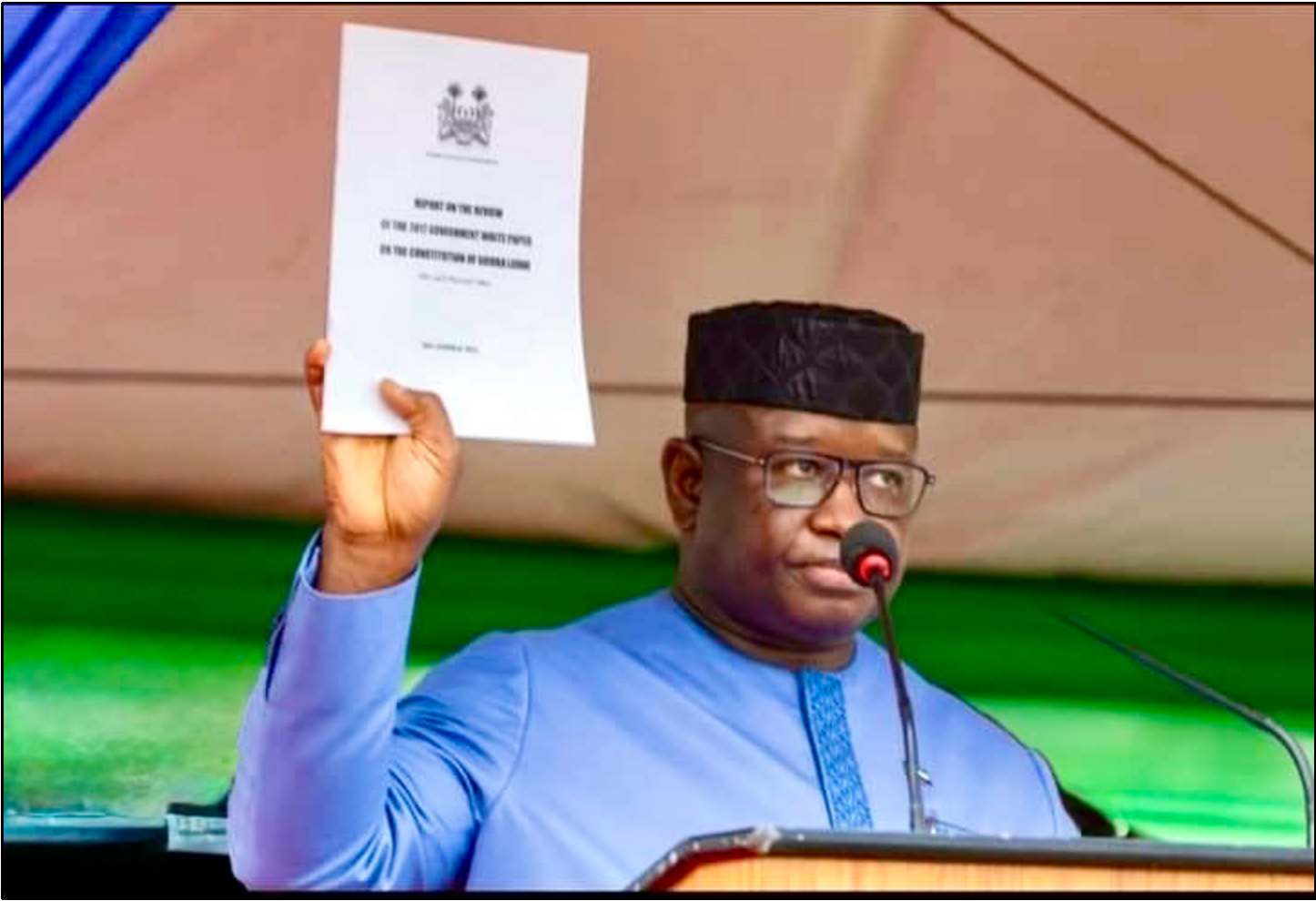
President Julius Maada Bio released the White Paper on Constitutional Review on January 13, 2022.

On 30th July 2013, President Ernest Bai Koroma established a broad-based Constitutional Review Committee (CRC) to lead a national effort to review and strengthen Sierra Leone’s 1991 Constitution. 

The CRC, comprising eighty members and representing political parties, democratic institutions, non-governmental organisations, the media, and key independent bodies, was tasked with conducting extensive civic education and public consultations, as well as making recommendations for constitutional reform. As the CRC itself stated, “The major civic education and consultation process undertaken by the CRC gave the people the opportunity to make meaningful contributions to constitutional change through many and varied recommendations.” Sierra Leone’s recent history is at the heart of the movement to amend the 1991 Constitution.

Adopted a few months after the civil war broke out, the 1991 document restored multi-party democracy and eliminated the 1978 one-party system. However, several observers and transitional organisations have long maintained that the charter failed to address structural issues that fuelled conflict and bad governance because it was drafted in an autocratic setting with little public input. Critics point to the concentration of power in the executive branch, the role and status of traditional chiefs, the role and socioeconomic rights and justice, gender equality, accountability, and environmental protections. Calls for constitutional reform were explicitly linked to efforts to establish long-term peace.

The 1999 Lomé Peace Accord, which formally sought to end Sierra Leone’s civil war, called for a constitutional review to address the root causes of the conflict. The Truth and Reconciliation Commission (TRC)’s 2004 report reinforced this demand. The TRC criticised the 1991 drafting process for a lack of broad public consultation, claiming that this shortcoming undermined the constitution’s legitimacy. It proposed adopting a new constitution based on an inclusive and thorough consultative process.

In response, in January 2007, President Ahmad Tejan Kabbah formed a Commission to Review the Constitution. Members of civil society, traditional and religious leaders, students and academics, professional associations, the media, the judiciary, political parties, and security forces were all represented on that commission. When its report was published in January 2008, several changes were suggested. However, the subsequent change in leadership—Kabbah’s second term ended in September 2007 and Ernest Bai Koroma took over as president—caused a shift in the country’s priorities. The Koroma administration did not immediately move forward with a comprehensive constitutional overhaul, instead concentrating on infrastructure, public services, energy, and economic development.

The 2012 Sierra Leone Conference on Development and Transformation reignited interest in constitutional reform by suggesting that the constitution be reviewed to address issues like women’s participation in decision-making and to contribute to the establishment of a more democratic, peaceful, and politically stable nation. President Koroma established the CRC in July 2013 after being re-elected in 2012 to pursue a more comprehensive, participatory reform process than had previously been accomplished.

The CRC conducted unprecedented levels of public consultation throughout Sierra Leone, seeking input from urban and rural communities, civil society actors, traditional authorities, and political stakeholders. However, the process was significantly disrupted in 2014 when the Ebola epidemic swept the country. The government redirected funds and attention to the public health emergency, so the CRC’s timeline had to be adjusted. Its initial mandate was extended—what was supposed to end in March 2015 was pushed back to March 2016—to allow the committee to regain lost ground and finish its work.

In February 2016, the CRC issued a draft report summarising the results of its first round of public consultations and proposing several significant amendments to the 1991 Constitution. The draft was intended to serve as the foundation for a second round of public consultations; the CRC committed to revising the draft based on the results and submitting a final report to the government. On January 24, 2017, the CRC handed over its final report to President Koroma at State House.

Before the 2018 elections, which installed Julius Maada Bio as president, the Koroma administration was unable to put the CRC’s recommendations into effect, despite the thorough consultation process and specific recommendations. The Bio administration gave constitutional reform a new lease on life. Key components of the CRC’s recommendations were formally accepted when President Bio, four years into his first term, released the government’s White Paper on the constitutional review in January 2022. According to the White Paper, entrenched provisions—those that call for higher legal thresholds or referendums—will be addressed through additional consultations and potential referenda, while non-entrenched constitutional changes will be implemented administratively.

Nearly three years into his second term, President Bio is working to advance the implementation of the reforms before the next round of national elections in 2028, It unclear if the ongoing process is still driven by the same goals that drove previous initiatives: strengthening democratic governance, boosting accountability, more successfully enshrining socioeconomic and gender rights, elucidating the power dynamics between institutions, and enhancing environmental and natural resource governance. 

Share. Facebook Twitter Pinterest LinkedIn Tumblr Email
gleanernewspaper
  • Website
  • Facebook
  • X (Twitter)
  • Instagram
  • LinkedIn

Gleaner Newspaper is the Home for exclusive local news, views, and adverts from Sierra Leone. Publisher: Gleaner Communications Sierra Leone.

Related Posts

President Bio and BADEA Chief Promise Closer Collaboration to Accelerate Development Projects

January 23, 2026

Chief Justice, Chinese ambassador pledged to deepen judicial collaboration

January 23, 2026

Chief Minister, Paramount Chiefs, and Officials Plan Reforms for Chieftaincy, Boundaries, and Local Governance

January 23, 2026

Leave A Reply Cancel Reply

Demo
Top Posts

APC Reviews 1991 Constitution; SLPP to Implement Recommendations

January 23, 2026

First Look At Joaquin Phoenix in Ridley Scott Movie

January 14, 2021
7.2

How to Choose the Best Bike for You, According to Bike Experts

January 14, 2021

More Brands are Making the ‘Easy Transition’ to Home Decor

January 14, 2021
Don't Miss
Politics

APC Reviews 1991 Constitution; SLPP to Implement Recommendations

By gleanernewspaperJanuary 23, 20260

President Julius Maada Bio released the White Paper on Constitutional Review on January 13, 2022.…

President Bio and BADEA Chief Promise Closer Collaboration to Accelerate Development Projects

January 23, 2026

Chief Justice, Chinese ambassador pledged to deepen judicial collaboration

January 23, 2026

Parliament threatens legal action and accuses the CEO of Accord Logistics of contempt

January 23, 2026
Stay In Touch
  • Facebook
  • Twitter
  • Pinterest
  • Instagram
  • YouTube
  • Vimeo

Subscribe to Updates

Get the latest creative news from SmartMag about art & design.

Demo
About Us
About Us

Gleaner Newspaper is the Home for exclusive local news, views, and adverts from Sierra Leone. Publisher: Gleaner Communications Sierra Leone.

Email Us: gleanernewspaper@gmail.com
Contact: +23278717497. +23280286691

Facebook X (Twitter) YouTube LinkedIn WhatsApp
Our Picks

APC Reviews 1991 Constitution; SLPP to Implement Recommendations

January 23, 2026

President Bio and BADEA Chief Promise Closer Collaboration to Accelerate Development Projects

January 23, 2026

Chief Justice, Chinese ambassador pledged to deepen judicial collaboration

January 23, 2026
Most Popular

APC Reviews 1991 Constitution; SLPP to Implement Recommendations

January 23, 2026

First Look At Joaquin Phoenix in Ridley Scott Movie

January 14, 2021
7.2

How to Choose the Best Bike for You, According to Bike Experts

January 14, 2021
Facebook X (Twitter) Instagram Pinterest
  • Home
  • Gleaner News
  • Loud & Clear
  • Politics
  • Sports
  • Technology
© 2026 Gleaner Communications, Sierra Leone.

Type above and press Enter to search. Press Esc to cancel.