
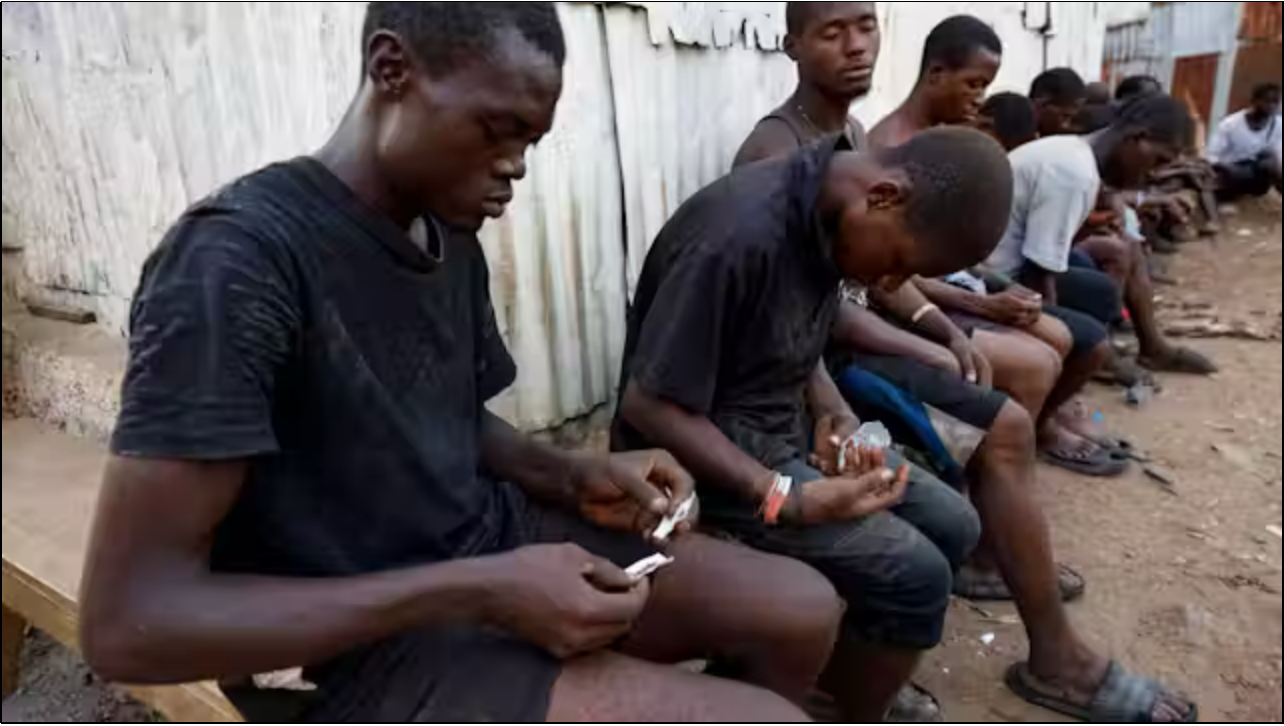
A young man rolls kush as other users sleep at a hideout in Freetown, Sierra Leone. Associated Press/AlamyIn the blistering heat of Freetown, Sierra Leone, young men gather on street corners, their limbs swollen, eyes glazed. They are the victims of kush, a cheap and deadly synthetic drug sweeping the country.
But kush is not an isolated tragedy. From the townships of apartheid South Africa to the 21st-century streets of the UK, synthetic drugs have a long history of flourishing in places where society has abandoned its most vulnerable.
Kush first appeared in Sierra Leone around 2016, but its spread in recent years has been nothing short of catastrophic. Between 2020 and 2023, psychiatric admissions linked to the drug skyrocketed to a reported 1,865 cases at the country’s only psychiatric hospital.
The drug claims mostly young men between the ages of 18 and 25, whose bodies are ravaged by kush’s toxic effects. Doctors in Freetown estimate that hundreds of users have died from organ failure caused by the drug in recent months.
Sierra Leone’s president, Julius Maada Bio, branded kush a “death trap” and declared a national emergency. The drug, he says, represents an “existential crisis” for the nation.
Kush is both cheap and easily accessible, sold openly on the streets for as little as 20 pence per joint. But for those hooked on it, the cost can climb to £8 a day. This is a staggering sum in a country where the average income barely exceeds £4,000 a year.
The drug’s ingredients are equally chilling. A mix of cannabis, synthetic opioids like fentanyl, formalin (used in embalming) and, according to some reports, ground human bone, it’s a concoction that speaks to the bleakness of life for those who turn to it.
Kush’s grip on Sierra Leone is not a random phenomenon but a symptom of a much deeper problem. The drug has become a chemical escape for people who see no viable future for themselves.
For those living in poverty and experiencing hunger, kush offers something that life in Sierra Leone often cannot: temporary relief from trauma and despair. It’s not a recreational indulgence but survival in a country where many face daily battles just to get by.
The drug’s rise follows a pattern seen in other parts of the world, where synthetic substances fill the void left by broken systems.
Apartheid South Africa
The situation in Sierra Leone echoes a chilling chapter from South Africa’s apartheid era. In the 1980s, methaqualone, a synthetic sedative-hypnotic drug – sold as quaalude or mandrax – became widely used in the townships, particularly among Black communities.
Often smoked alongside cannabis in a mix known as the “white pipe”, it became a cheap, sedative drug much like kush in Freetown today.
The apartheid government didn’t just turn a blind eye to its widespread use but deliberately encouraged it. Under the secretive Project Coast, the government’s chemical and biological warfare programme, scientists developed large quantities of methaqualone, ostensibly for crowd control and incapacitation.
Methaqualone was not officially declared a weapon. But evidencecompiled by the UN suggests it was developed and stockpiled in prototype delivery systems that were intended to incapacitate without killing, then deployed quietly among the dissenting population.
The parallels with kush are undeniable. Both are chemically produced, highly addictive depressants offering cheap and easily accessible sedation to marginalised populations. These types of drug do not just affect individuals but serve to suppress entire communities under the weight of structural violence.
In South Africa, methaqualone was weaponised by the state as a means of control, while in Sierra Leone, kush has emerged in areas abandoned by the government. In both cases, the effect is the same: a drug-fuelled stasis that deepens despair and maintains a status quo of social neglect.
It’s a pattern where a synthetic depressant materialises in places where no other social or economic medicine exists, sedating not only bodies but resistance and possibility.
Spice in the UK
This pattern of synthetic drugs as a response to social decay is not confined to Africa. In the UK, synthetic drugs such as spicehave become more common over the past decade, especially among homeless people and prisoners. Described as a “zombie drug” for its paralysing effects, spice is often used not for pleasure but to escape hunger, cold and trauma.
A 2023 study among the UK’s homeless population found that nearly 70% of participants, aged 18-64, used synthetic drugs such as spice to escape the harsh realities of homelessness. Many reported adverse effects that led to hospitalisation.
In many British towns and cities, it has become common to see users slumped on pavements or convulsing in parks, echoing the scenes from Sierra Leone’s kush hotspots.
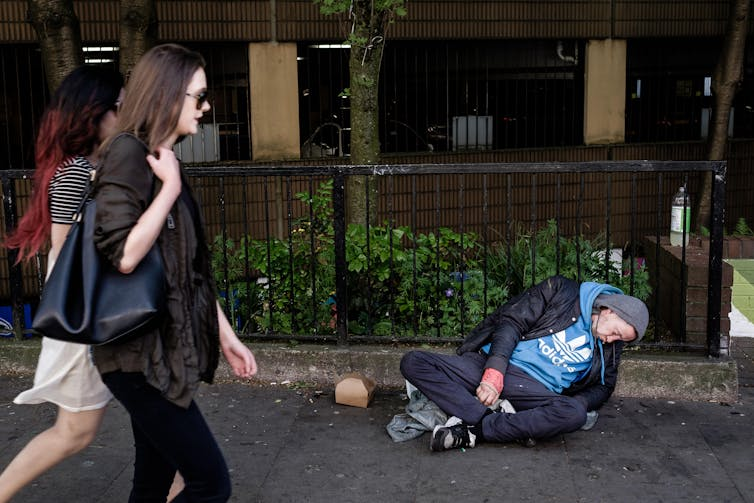
A suspected spice user in Manchester, 2017. Ian Wray/AlamyThis serves as a stark reminder that synthetic drugs are not an isolated issue. They are a global crisis playing out in different forms but with the same underlying causes.
Synthetic drugs like kush, methaqualone and spice are symptoms of deeper systemic failures. They thrive where housing is unstable, unemployment is rampant and healthcare is out of reach. Addressing the crisis requires more than just cracking down on drug use. It demands a radical shift in how we treat the most vulnerable in our society.
In Sierra Leone, this means investing in youth employment, improving nutrition and strengthening mental health services. In the UK, it calls for restoring funding to housing and substance use services, and recognising that stable shelter and social support are fundamental to recovery, not rewards for abstinence.
If we are serious about tackling this problem, we need to move beyond punishment and focus on addressing the root causes of addiction. Only by investing in social care and harm reduction can we hope to break the cycle of sedation and despair.
