
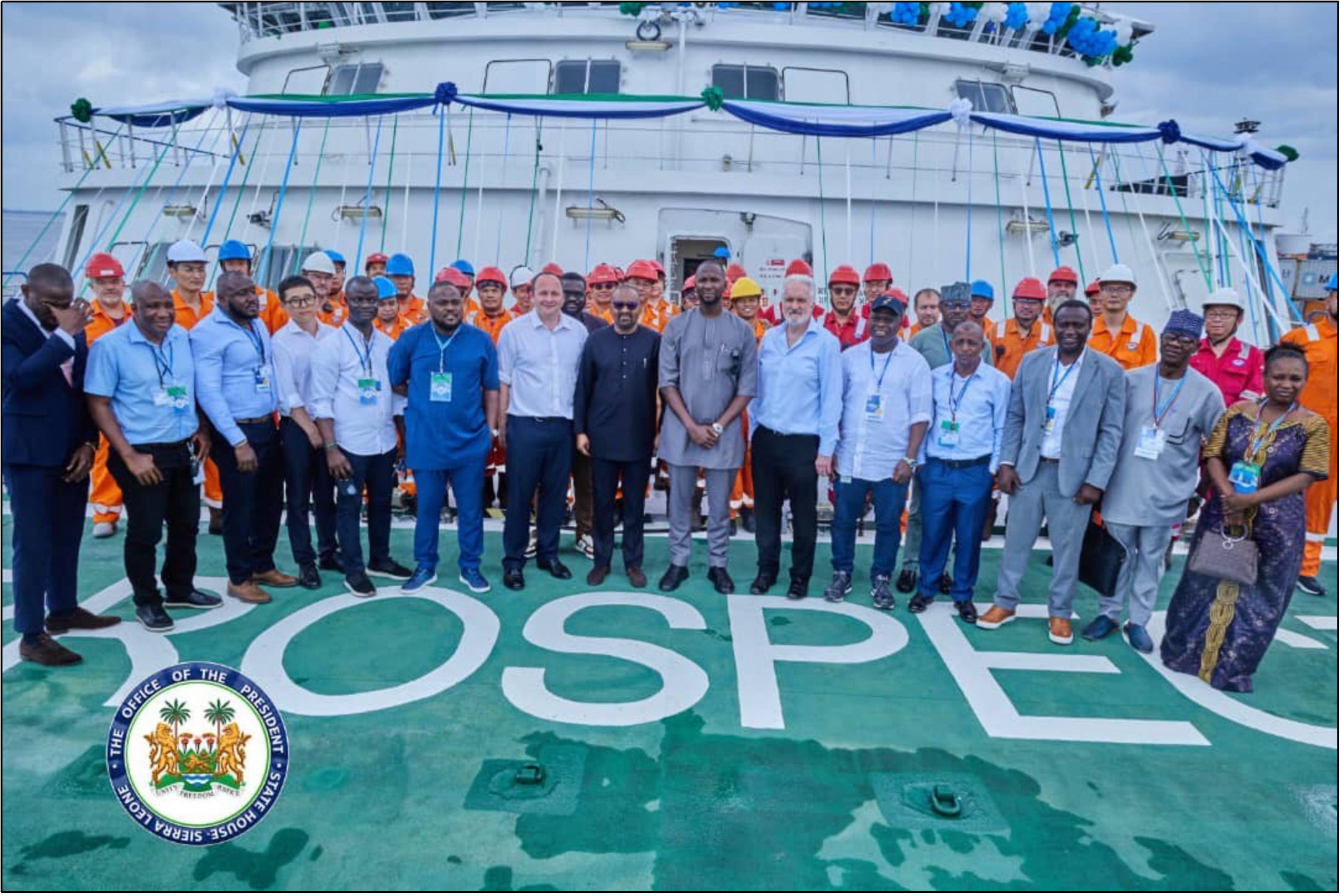
On behalf of His Excellency President Dr. Julius Maada Bio, Vice President Dr. Mohamed Juldeh Jalloh has toured the BGP offshore seismic vessel anchored at Queen Elizabeth II Quay and been given a thorough briefing on the findings, limitations, and next steps resulting from a significant offshore seismic survey that was carried out this year.
Jim Gulland, Director of GeoPartners Limited, gave the update and thanked President Bio and the Petroleum Directorate for starting the project to evaluate the offshore oil and gas potential in Sierra Leone. The GPSL25 3D Seismic Geophysical Survey was the name of the seismic campaign, which spanned about 2,900 square kilometres. Gulland stated that the survey was finished in August 2025, having started in June 2025.
Gulland stated that to guarantee operational effectiveness and data quality, the survey made use of several vessels, including the GPSL25 platform, Moonrise-G, and the 7 Star vessel. To ascertain whether commercial hydrocarbon accumulations exist in Sierra Leone’s offshore basins, 71 seismic sequences were deployed, yielding high-resolution geophysical data. He emphasised that operations were authorised by an operating license granted by the Environmental Protection Agency (EPA) and that the work was carried out under stringent environmental safeguards.
Now that the seismic data has been processed and analysed, a full data report is expected in eight to twelve months, with summary results due in six weeks. According to Gulland, President Bio will be shown the processed data to make decisions regarding potential drilling campaigns and future exploration.
Gulland emphasised the operational difficulties faced at sea while highlighting the technical achievements of the survey. One of these was the existence of fishing aggregation devices in survey areas, which can make survey lines and safety more difficult. These structures are frequently connected to illicit fishing activities. He emphasised how crucial Sierra Leone’s navy is to maintaining maritime security and preventing interference with offshore energy operations.
Vice President Jalloh, speaking on behalf of President Bio, praised the campaign’s crews and called the results a significant turning point in the nation’s efforts to achieve energy security. “The findings of your investigation point to a significant chance for our nation’s shift to energy independence. This survey is a significant accomplishment and the kind of innovation we’ve been looking for in the field,” he stated. Jalloh emphasised the potential economic benefits once the oil and gas sector moves toward production and said the results show Sierra Leone is prepared to draw in investment.
It occurs during a period of fierce worldwide competition for income. The vice president promised that the government would implement suggestions about maritime security and stated that once this industry starts up, it will produce income and jobs to strengthen our economy. “The key to changing our economy is energy security. The energy sector in Sierra Leone is open and ready for business,” he continued.
Foday Mansaray, the Director General of the Petroleum Directorate, commended President Bio’s leadership for making the work possible and for allowing young Sierra Leoneans to get involved in the developing sector. According to Mansaray, the survey was initially planned for 2029 but was moved up after his team convinced FA Oil to expedite the project. According to him, the survey was carried out by the UK-based seismic firm GeoPartners Limited, and certain operational components were subcontracted to BGP Exploration, a division of China National Petroleum Corporation.
Mansaray also emphasised the campaign’s capacity-building elements, stating that several Sierra Leoneans, including petroleum engineers and geophysicists, received training in advance of the expansion of the industry. According to him, FA Oil’s licensed plots are thought to contain roughly 10 billion barrels of oil, and the seismic work focused on the nation’s offshore basin, which is thought to contain up to 30 billion barrels of oil in situ. According to Mansaray, the economic impact could be revolutionary if some of those estimates are shown to be commercially recoverable.
To make well-informed decisions regarding possible exploration drilling, authorities are currently concentrating on quickly processing and analysing the seismic data. The next stage of Sierra Leone’s upstream development will be largely determined by the interim summary anticipated in the upcoming weeks.
