
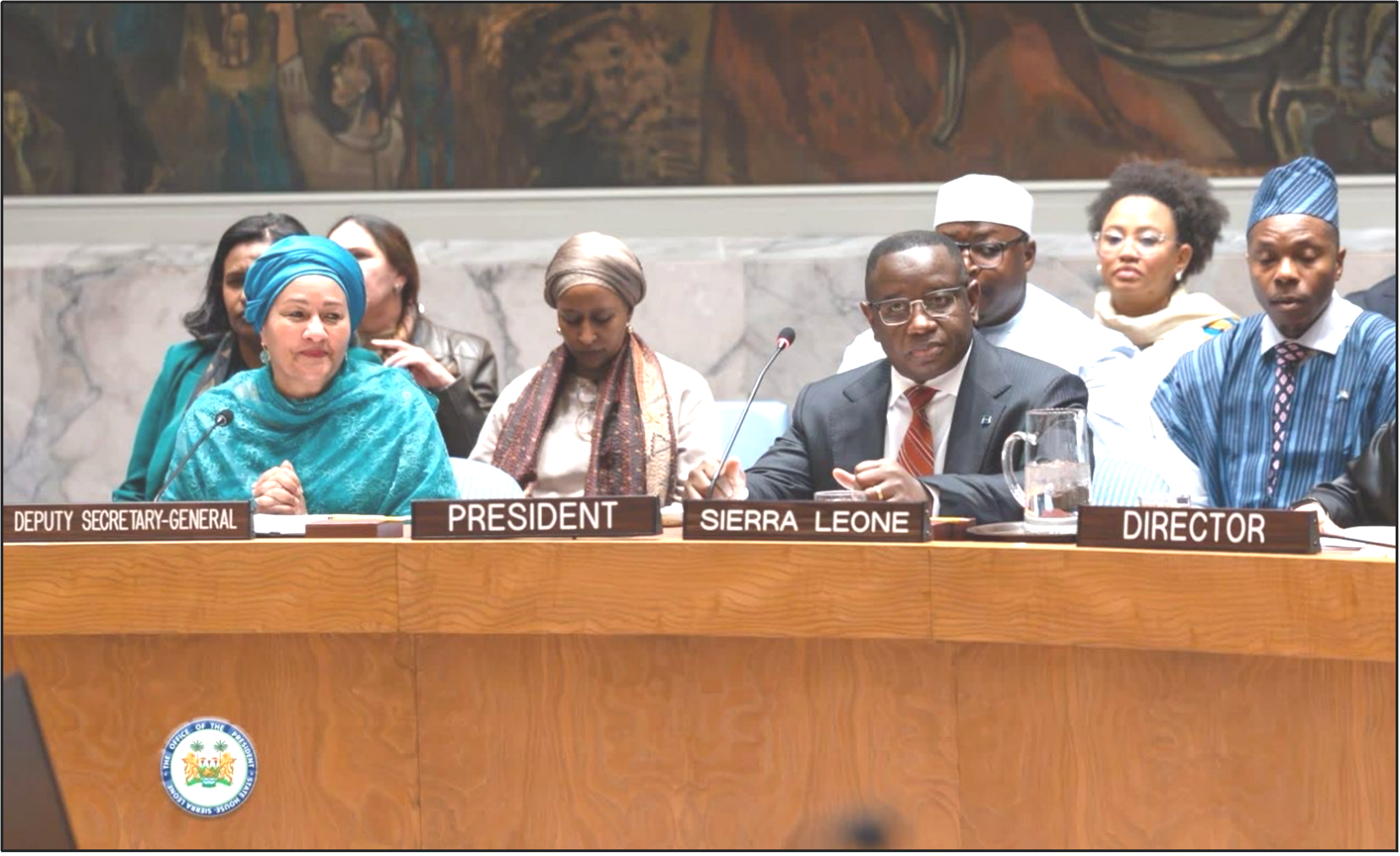
New York, November 17, 2025. His Excellency Dr Julius Maada Bio, President of the Republic of Sierra Leone and current Chair of the ECOWAS Authority, today chaired a high-level United Nations Security Council open debate on “Threats to International Peace and Security: Conflict-Related Food Insecurity.”
President Bio, speaking at UN Headquarters during Sierra Leone’s tenure on the Council, warned that hunger is increasingly being weaponised in conflicts and called for stronger, coordinated international measures to prevent deliberate civilian starvation.
President Bio, in his second address to the Security Council in two years, stated that acts of intentionally depriving populations of food are prohibited by international law and constitute war crimes. He described starvation as a “slow, silent, corrosive” form of violence that not only kills and maims but also contributes to instability, displacement, and new cycles of conflict. He highlighted the ongoing crises in Gaza, Sudan, Haiti, Ukraine, and the Sahel, describing how warfare and instability continue to shatter food systems, destroy livelihoods, and exacerbate humanitarian emergencies.
President Bio delivered three key messages: first, that starvation should not be treated as collateral damage, but rather as a crime; second, that food insecurity is both a cause of conflict and a critical component of peacebuilding; and third, that long-term peace necessitates investment in agricultural resilience, functioning markets, and human capital, with a focus on empowering women and youth.
He used Sierra Leone’s Feed Salone Initiative as an example of national best practice. The four-pillar programme focuses on production, resilience, markets and value chains, and human capital, to increase domestic productivity, reduce reliance on food imports, and develop climate-smart agricultural systems that generate stable livelihoods. President Bio cited Feed Salone as evidence that food security and development are inextricably linked to long-term peace.
Regionally, he emphasised ECOWAS’ efforts to incorporate food security into peacekeeping, early warning systems, and trade policies. He cited initiatives like expanding the ECOWAS Food Security Reserve and strengthening the ECOWARN early warning network as critical tools for anticipating and responding to emerging threats to West Africa’s food systems.
President Bio concluded by proposing six concrete global actions for the Council and international community: protect food systems in conflict zones, institutionalise early-warning mechanisms for food insecurity, safeguard and facilitate unimpeded humanitarian access, advance accountability for crimes of starvation, link peacebuilding finance to agriculture and livelihoods, and prioritise the economic and leadership empowerment of women and youth across agricultural value chains.
Reiterating that Africa seeks partnership rather than pity, he highlighted the continent’s vast untapped arable land and young, innovative population. He urged the world to view food security as central to preventing future wars, rather than as a secondary humanitarian concern, and urged nations to align moral conviction with international law and collective action so that “no child is starved into submission, no harvest is held hostage, and no community is driven to violence by hunger.”
