
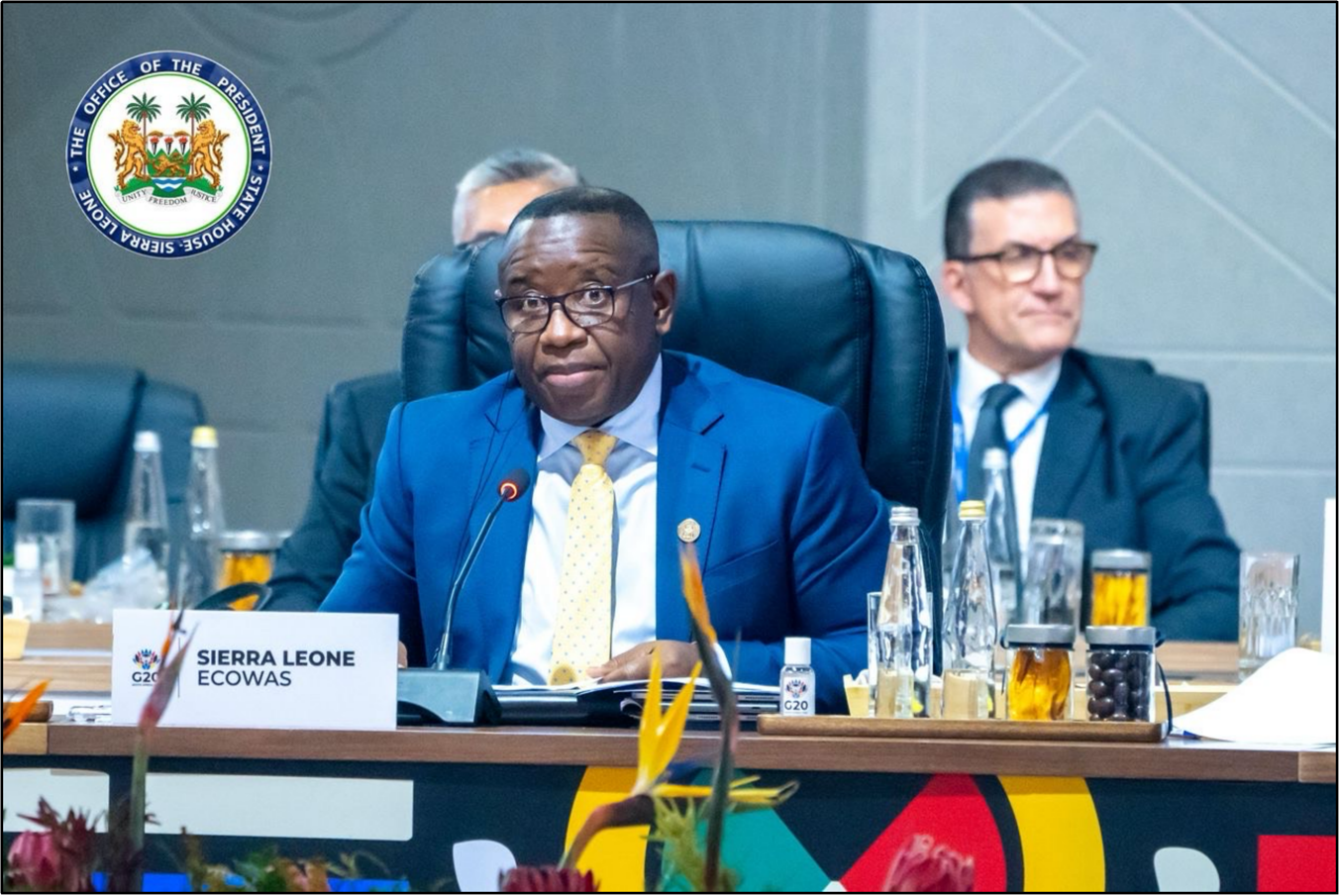
November, 2025: Sierra Leone’s President and current Chair of the ECOWAS Authority of Heads of State and Government, His Excellency Dr. Julius Maada Bio, put Africa’s mineral endowment center stage at the G20 Summit in Johannesburg, calling for a formal G20-Africa Compact on Critical Minerals.
Ensure fairness, value addition, and transparency as the world moves toward a clean-energy transition.
In a forceful intervention, President Bio argued that Africa, which holds nearly one-third of the world’s critical minerals needed for renewable technologies, advanced manufacturing, and artificial intelligence, should not be excluded from the economic benefits of the global transition. He recalled Sierra Leone’s significant contribution to the global supply chain through its iron ore, rutile, bauxite, and diamond reserves, but cautioned that without new mechanisms, history will repeat itself, with African countries supplying raw materials while capturing the least value.
“For too long, our resources have powered global industries while our countries have received the least value.
This generation must break that cycle, beginning with a G20-Africa Compact based on justice,” President Bio stated, urging G20 leaders to adopt a framework that will reshape how minerals are developed, processed, and traded. President Bio stated that his generation must break the cycle, beginning with a G20-Africa Compact based on justice, and urged G20 leaders to adopt a framework that would reshape how minerals are developed, processed, and traded. industrialization and job creation. “Africa alone cannot meet the demand for minerals. We need to process, refine, and benefit from them. “This is how we create jobs, industries, and transformation,” the President emphasized.
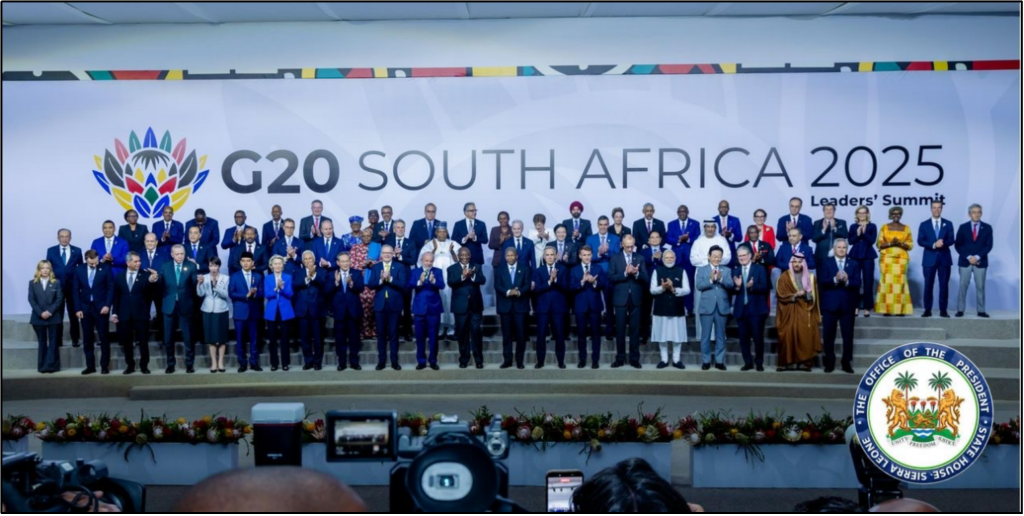
President Bio delivered his address in response to the Summit’s overarching theme, “Building Our Economy: The Role of Trade, Finance for Development, and the Debt Burden,” but he focused on the geopolitical and economic importance of Africa’s mineral resources. He argued that the global clean-energy transition is inextricably linked to Africa’s deposits, and that any transition that excludes African participation would be unjust and unsustainable.
Beyond mineral governance, President Bio connected the compact concept to broader economic and financial challenges confronting low-income countries. He cited slowing global growth, tighter financial conditions, and rising debt-servicing pressures as factors undermining development prospects. Sierra Leone, he stated, supports accelerated debt restructuring, the expansion of Special Drawing Rights via regional development banks, and increased access to long-term financing for critical infrastructure, digital systems, and trade facilitation.
Climate vulnerability was another key component of his intervention. President Bio reminded world leaders that while Africa contributes less than 4% of global emissions, it bears a disproportionate share of climate impacts. He described the severe effects unfolding in Sierra Leone, from coastal flooding and landslides to erratic rainfall that disrupts agriculture and food security. He reiterated his call for a West African Climate Adaptation Acceleration Facility to raise funds for food security initiatives, clean energy deployment, and coastal protection projects.
In terms of emerging technology governance, President Bio warned that artificial intelligence and digital innovation could either accelerate development or exacerbate existing inequalities, depending on how access and rules are defined. He advocated for ethical, inclusive, and equitable global frameworks that ensure AI benefits are shared and do not exacerbate technological exclusion in African countries.
In his closing address, the Sierra Leonean leader urged G20 members to seize a “defining moment” and commit to a development compact based on fairness and shared prosperity. He argued that the proposed G20-Africa Compact on Critical Minerals is more than just an economic initiative; it is an opportunity to correct historical imbalances and ensure the continent’s just future as the world transitions to a low-carbon, technology-driven economy.
President Bio’s intervention contributes to ongoing global discussions about supply chains, industrial policy, and the geopolitics of energy transition metals, and it is likely to inform future discussions between African leaders, development institutions, and G20 partners in the coming months.
