
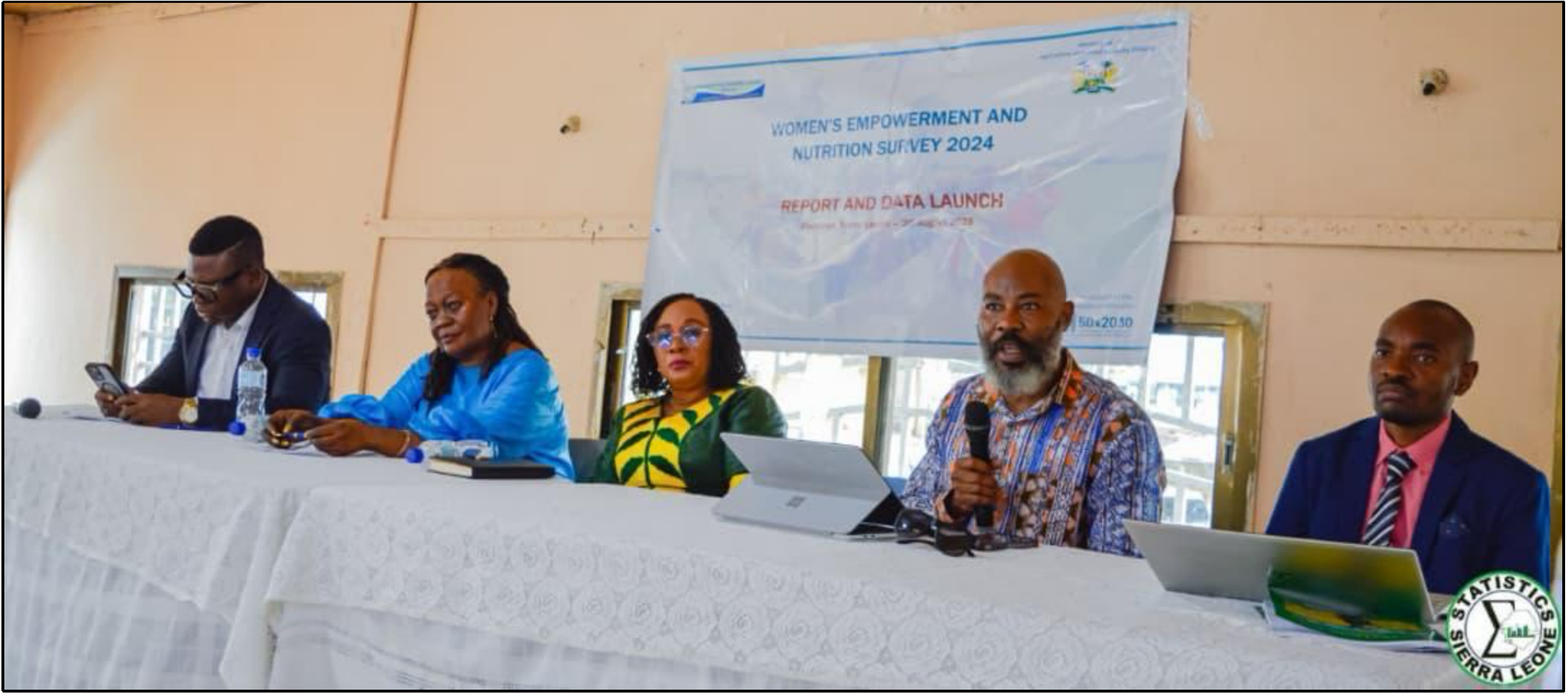
Statistics Sierra Leone (Stats SL), in collaboration with the Food and Agriculture Organisation (FAO) and the Ministry of Agriculture, Forestry, and Food Security (MAFFS), has released the 2024 Women’s Empowerment and Nutrition Survey (WENS) Report and anonymised microdata, paving the way for evidence-based gender, agriculture, and nutrition policy in Sierra Leone. The launch event, held at New Sella Sport on King Harman Road, brought together senior government officials, UN agency representatives, civil society leaders, and development partners to emphasise the importance of addressing the systemic barriers that prevent women from fully participating and leading in agriculture.
Deputy Statistician-General Lansana Kpewolo Kanneh emphasised the importance of data in national planning, stating that “this report links women’s roles in agriculture directly to household food security and nutrition—key to achieving our Medium-Term National Development Plan (MTNDP 2024-2030).” Dr. Tenema Theresa Dick, Deputy Minister of Agriculture and Food Security, delivered the keynote address, describing women as the backbone of Sierra Leone’s agricultural economy while acknowledging their continued marginalisation. “Change starts from data—not just numbers, but the real stories of women’s resilience and struggle,” she told the audience.
WENS 2024, under the 50×2030 Initiative, used advanced measurement tools developed by IFPRI and FAO, including the Women’s Empowerment Metric and Minimum Dietary Diversity modules. Stats SL oversaw data collection and purposefully hired mostly female enumerators to create a safe environment for respondents and ensure authenticity in women’s responses. Policymakers, researchers, and development organisations can now use the survey’s anonymised microdata and full report to design programs, formulate policies, and conduct additional research.
Key findings from the survey highlight both women’s central role and the constraints they face: women participate widely in agricultural production but frequently lack influence over farm and household decisions; more than half of surveyed women reported limited control over household finances; customary and traditional systems continue to impede women’s access to and ownership of land; and significant gaps remain in leadership roles, financial inclusion, and women’s autonomy.
Stakeholders at the launch emphasised that these findings provide a practical and timely tool for guiding interventions that increase women’s decision-making power, access to productive resources, and nutritional autonomy, to transform women’s contributions from largely unrecognised labour into recognised leadership that can help drive national food security and development.
