

Minister of Justice, Alpha Sesay ..........................Convicted Drug Trafficker Jos "Bolle Jos" Leijdekkers.According to AD and Follow the Money’s reconstruction of events, the Netherlands has quietly escalated an international diplomatic campaign to pressure Sierra Leone for the extradition of convicted drug trafficker Jos “Bolle Jos” Leijdekkers. What started as a routine legal request has turned into a long-running, high-stakes diplomatic operation that reveals the limits of formal cooperation with Freetown—as well as the broader geopolitical tensions that complicate efforts to bring a major cocaine kingpin to justice. Leijdekkers, a Dutch national linked to large-scale cocaine shipments to Europe, is said to be living openly in Sierra Leone.
Last year, Dutch media published photographs and videos of him sitting in the pews directly behind President Julius Maada Bio and his family during a New Year’s Mass in the president’s hometown. Those images, combined with reports that Leijdekkers may be dating President Bio’s daughter, UN diplomat Agnes Bio, prompted the Netherlands to file a formal extradition request in February. Since then, the relationship between The Hague and Freetown has been marked by repeated reminders, private urgings, and missed opportunities.
The situation is complicated from the start. Because the Netherlands lacks an embassy in Sierra Leone and has no formal mutual legal assistance agreements with the country, formal communications must be routed through Dutch embassies in Brussels and Accra. Sierra Leone initially pledged to investigate and even announced a nationwide manhunt, but soon began to suggest confusion about the suspect’s identity, claiming that the man in the photos was a local businessman named Umar Sheriff. Following that explanation, Freetown mostly remained silent on the extradition request.
According to Dutch officials, the delays indicate a high level of protection. Sierra Leonean ministers have repeatedly indicated limits on their authority in diplomatic exchanges, claiming that arrest decisions require approval from the internal affairs ministry or, ultimately, President Bio himself. This reality has shifted the Netherlands’ efforts from procedural to political. A series of bilateral meetings over the last year demonstrates how determinedly the Dutch government has pursued the matter.
When Sierra Leone’s Minister of Justice, Alpha Sesay, paid a visit to The Hague late last year for an ICC member states meeting, Dutch officials took the opportunity to question him directly. However, the meeting was awkward because the ministers in charge of the case were on a state visit to Suriname, so State Secretary for Justice and Security Arno Rutte handled the exchange. The Sierra Leonean delegation initially opposed a meeting and demanded that the Dutch come to them; when the conversation finally took place, it yielded limited results.
Other contacts have been just as frustrating. Sesay held a video call with Dutch Minister David van Weel in March, during which, according to Dutch reports, he turned off his camera feed for much of the conversation. Later that spring, Sesay cancelled a planned visit to the Netherlands and refused to reschedule. Van Weel expressed growing doubt that the case would proceed without more direct engagement.
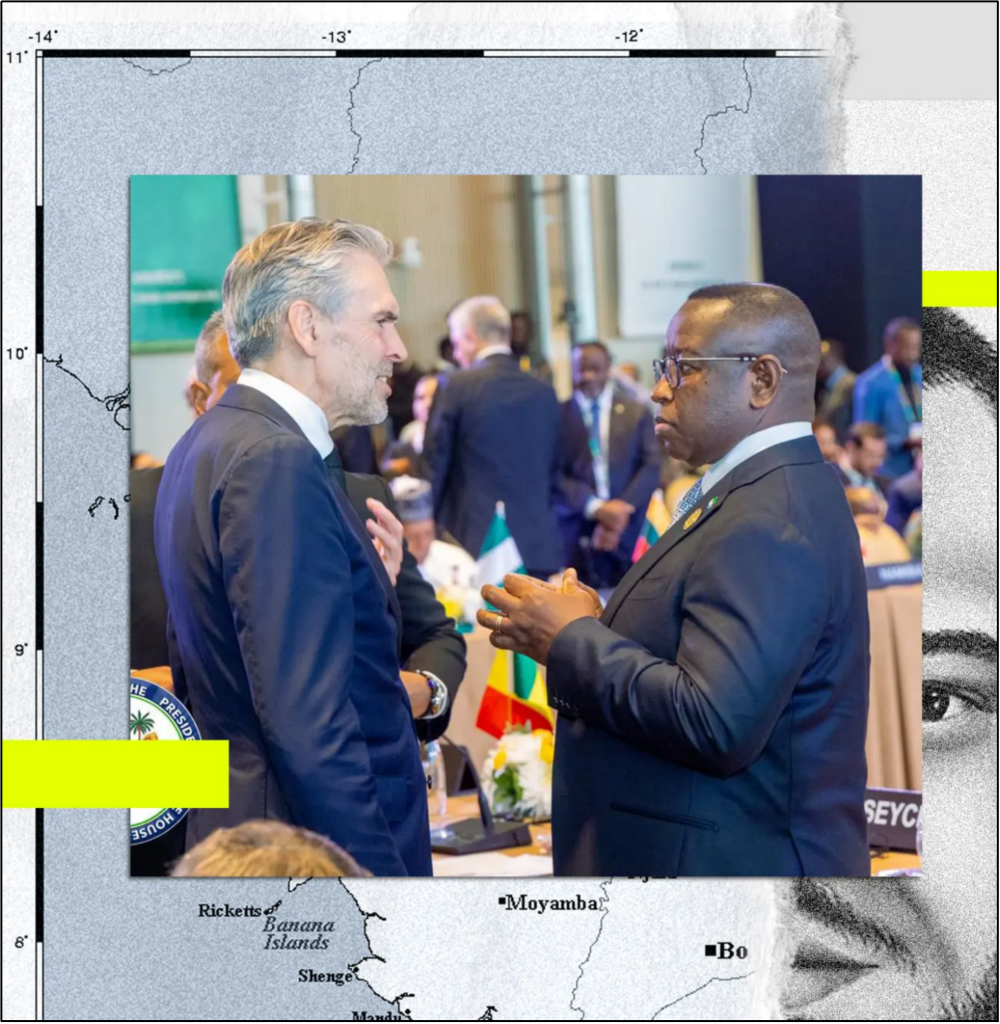
Then-Prime Minister Dick Schoof and President Julius Maada Bio in 2025
A Dutch ministerial presence kept bringing the topic up in Freetown. Van Weel brought up the issue again during the September UN General Assembly. During a drug-control conference in Ghana, then-Minister of Justice Foort van Oosten spoke with Sierra Leone’s Minister of Internal Affairs, Morie Lengor. Van Weel spoke with his counterpart, Timothy Kabba, in December. Following the presentation of credentials in January, Sierra Leone’s newly appointed ambassador to The Hague, Philip Bob Jusu, met with Van Weel.
At the highest level, the Netherlands ensured that the case was prioritised on diplomatic agendas. Last November, Prime Minister Dick Schoof met privately with President Bio in Angola, telling Dutch officials that he had “emphatically” requested extradition. The public photograph of Schoof and Bio that later appeared on the Sierra Leonean press page demonstrated how sensitive the situation had become.
According to experts, the intensive Dutch campaign reflects a growing awareness in The Hague that the Leijdekkers case is more than just a criminal one. According to Kars de Bruijne of the Clingendael Institute, Leijdekkers’ alleged ties to senior officials and security services in Sierra Leone, as well as reports that he holds a Sierra Leonean passport, indicate an influence that could extend into the heart of the state. Last year, videos surfaced showing him socialising with the head of immigration, the chief of the anti-narcotics unit, and hugging a former national police chief. Those images have sparked concerns in the Netherlands that his presence could endanger Sierra Leone’s political stability and have destabilising ramifications across West Africa.
The stakes in Europe are also substantial. If Leijdekkers is returned, he faces lengthy prison terms, including up to 24 years in the Netherlands and 57 years in Belgium. Belgian prosecutors recently sought an additional 13-year sentence in connection with the seizure of 11,000 kilograms of cocaine in 2023. Given the cross-border nature of his alleged network, European partners have joined the Dutch in putting pressure on Sierra Leone, transforming an otherwise bilateral legal request into a larger diplomatic issue within the EU.
One complicating factor is the broader European interest. Sierra Leone’s president has taken on a prominent regional role, unexpectedly taking over as chairman of ECOWAS last year, giving him leverage and complicating any attempt to isolate Freetown. Meanwhile, Western governments are wary of putting too much pressure on Sierra Leone for fear of pushing it closer to other global powers like Russia or China. According to analysts, some members of Bio’s administration have expressed a willingness to deepen cooperation with Russia, complicating a calibrated approach.
The Netherlands’ efforts have been controversial. Guy Weski, Leijdekkers’ lawyer, has accused the Dutch government of overreach and claimed, citing unnamed sources, that the Hague attempted to deploy intelligence assets in Sierra Leone. AIVD, the Dutch domestic intelligence service, declined to comment on the specific allegation. Sierra Leone maintains its sovereignty; public statements by government officials have alternated between promises to investigate and denials of knowledge about Leijdekkers’ identity or status.
Sierra Leone’s domestic situation is delicate. President Bio has publicly pledged a tough stance against drug crime in national speeches, but he has not addressed the alleged “Leijdekkers affair.” Meanwhile, the public health impact of synthetic drugs on the country’s youth raises the issue locally.
The case has been a risky story for journalists covering it. Sophie van Leeuwen, Follow the Money’s Africa correspondent, reported being arrested and interrogated for 15 hours while looking for Leijdekkers last year, highlighting how difficult reporting and investigation in this case can be.
As things stand, the Netherlands is pursuing a multifaceted strategy: pressuring Sierra Leone through repeated diplomatic contacts, enlisting EU partners to apply collective pressure, and strengthening cooperation with Sierra Leone’s neighbours to limit the suspect’s ability to cross borders. However, given the political sensitivities, the lack of formal legal links, and Leijdekkers’ reported connections within Sierra Leone’s elite, Dutch officials acknowledge that a breakthrough may be difficult to achieve in the near future.
Credit: FTM and AD
