
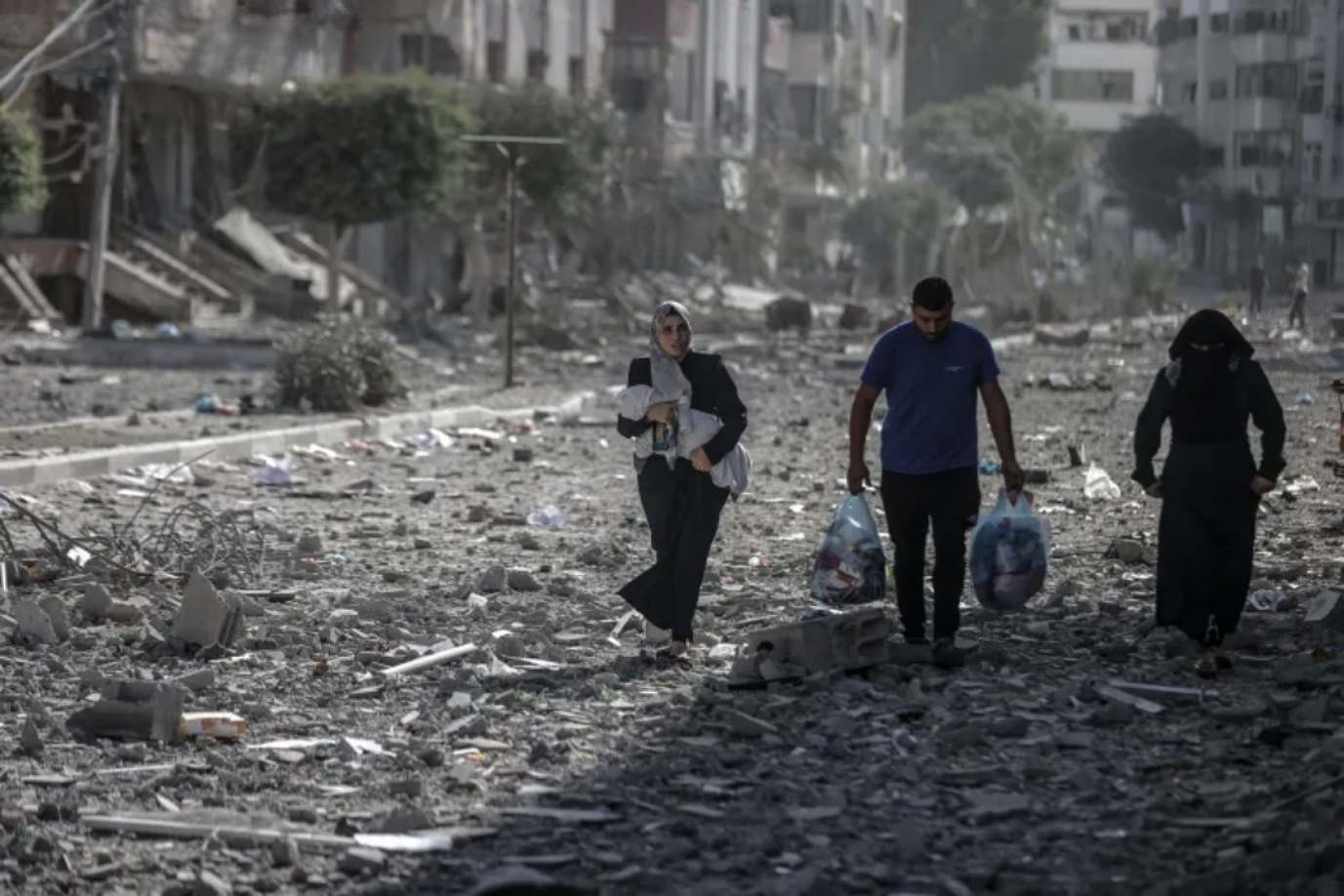
A woman with a baby walks with relatives amid buildings damaged by Israeli bombardment in the Tel al-Hawa neighbourhood on October 30, 2023 [Anadolu Agency/Ali Jadallah]
By Belén Fernández
On October 28, Israeli military spokesperson Daniel Hagari took to X – the platform formerly known as Twitter – with an “urgent message” for the residents of the Gaza Strip. For their “immediate safety”, Hagari said in a message entirely in English, residents of northern Gaza and Gaza City were urged to “temporarily relocate south”.
The performance was grotesquely preposterous for a variety of reasons, not least of them that English is the official language of neither Israel nor Palestine – which suggests that the intended audience was not, in fact, the population whose “immediate safety” was supposedly of such concern to Hagari & Co.
Indeed, if safety were a concern, the Israeli army would not have slaughtered more than 8,000 Palestinians in three weeks, among them more than 3,000 children. Nor would Israel have continued to carpet-bomb both northern and southern Gaza following its previous warning to Palestinians in the north of the enclave to evacuate south.
Just as critically, it is not clear how anyone in Gaza was supposed to see this “urgent message” from Hagari given the total communications blackout that Israel had orchestrated the day before, leaving the territory without telephone or internet service. Anyway, the evacuation warning was presumably appreciated by the section of the online anglophone world that insists on believing that Israel tries hard not to kill civilians.
Communications in the Gaza Strip have since been partially restored, a turn of events that The Wall Street Journal attributes to the United States’ pressure on Israel. To be sure, it is far more ethically important to keep the internet on in Gaza than to, say, stop funding Israel’s genocide of Palestinians.
The temporary blackout was, however, long enough to induce an all-penetrating sense of helplessness in a whole lot of people worldwide, particularly those with family in Gaza. The torturous uncertainty was captured in many social media posts such as this one from my Facebook friend Majed Abusalama: “Mama, Baba, Mohammed, Naya, Eliya, Asmaa and the rest may be killed or alive.”
Majed, an Al Jazeera contributor who hails from Gaza’s Jabalia refugee camp but currently resides in Berlin, is himself a survivor of repeated Israeli aggression against Gaza, including having his school hit with illegal white phosphorus munitions. Eliya is his six-year-old niece; his other niece Naya is just two months old, meaning she has spent nearly half of her life under Israeli bombs.
When my father died of cancer in August of this year, Majed sent me a moving note expressing his heartfelt condolences and his fear of losing his parents – a distinctly constant possibility given their place of residence. Once during an Israeli bombardment, he said, his mother had phoned him from Gaza to say goodbye.
Now, of course, the phone lines were down, and I found myself manically checking Majed’s Facebook page to see if any news had managed to pierce the void. He had already lost numerous relatives and friends to the Israeli onslaught, but his immediate family had thus far survived. When communications were partially restored on Sunday, they were still among the living – although many Palestinians were not.
The 36-hour blackout likely proved especially deadly as it hindered the work of rescue teams, who could not be contacted to extricate folks from the rubble and otherwise respond to those in need. Meanwhile, the communications shutdown naturally only further inhibited the efforts of journalists and Gaza residents – who already contend daily with shaky phone and internet service – to transmit the truth of a genocide happening in real time.
And while Gaza is currently precariously back online, the bloody offline interlude no doubt also metaphorically encapsulated Israel’s unspeakably sinister objective: to disappear Palestinians both physically and conceptually.
It is hardly a stretch to argue that taking the Palestinians of Gaza off the online grid is a modern twist on the age-old phenomenon of forced disappearances, at least in terms of the lack of accountability for victims as well as the psychological effects on their families. Just as disappeared people cannot aspire to justice while being disappeared, their loved ones cannot aspire to emotional closure without knowing their whereabouts and fates.
As has been seen time and again over the decades in situations of mass forced disappearance from Argentina to El Salvador and from Spain to Sri Lanka, family members of disappeared people are often condemned to perpetual psychological limbo, unable to commence the necessary human grieving process while remaining in the dark as to what exactly befell the missing person.
Some years ago in the south Lebanese village of Maaroub, I spoke with a silver-haired man named Abed, whose younger brother Ahmed had been involved with the Palestine Liberation Organization (PLO) in Lebanon and had disappeared in 1983, the year after an apocalyptic Israeli invasion of the country killed tens of thousands of Lebanese and Palestinians. According to Abed, one theory was that Ahmed had ended up in an Israeli prison, but the lack of any concrete information meant that his family members got to spend the rest of their existence in a state of emotional torture.
Israel’s recent blackout experiment in Gaza was a more short-lived disappearing act. And yet in the context of the past 75 years of Israeli ethnic cleansing and massacres of Palestinians, it should send a fairly “urgent message” – to borrow those well-phrased words of Israeli spokesperson Hagari.
One recalls the notorious claim by late Israeli Prime Minister Golda Meir that there was “no such thing as a Palestinian people”, which has certainly aided Israel’s history of butchery; after all, it is easier to bomb people if they don’t exist, right? And even more so, perhaps, if they are all offline.
But unfortunately for the state of Israel, neither the Palestinian people nor Israeli war crimes have easily disappeared – and that in itself should be an urgent message for Israel.
About the Author

Belén Fernández is the author of Inside Siglo XXI: Locked Up in Mexico’s Largest Immigration Center (OR Books, 2022), Checkpoint Zipolite: Quarantine in a Small Place (OR Books, 2021), Exile: Rejecting America and Finding the World (OR Books, 2019), Martyrs Never Die: Travels through South Lebanon (Warscapes, 2016), and The Imperial Messenger: Thomas Friedman at Work (Verso, 2011). She is a contributing editor at Jacobin Magazine and has written for the New York Times, the London
