
The United States Drug Enforcement Administration (DEA) and the National Crime Agency (NCA) of the United Kingdom have joined Nigeria’s National Drug Law Enforcement Agency (NDLEA) in their investigation into what authorities believe to be an international cartel that is in charge of a 1,000-kilogram shipment of cocaine that was purportedly sent from Sierra Leone.
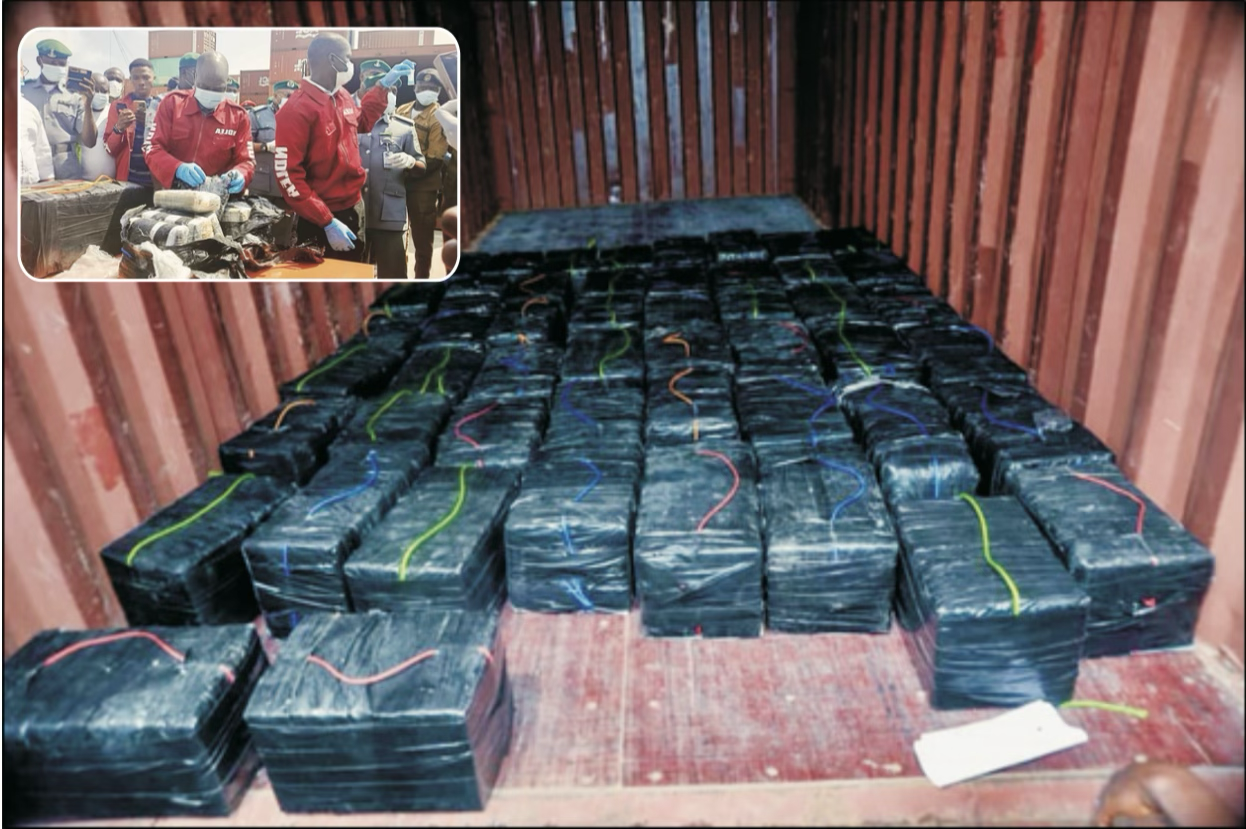
At the Port and Terminal Multiservices Limited (PTML) in Lagos, the shipment was found inside a 20-foot export container. It is estimated to have a street value of N29.4 billion, or roughly $20.4 million. On October 7, 2025, while PTML staff were cleaning a set of 39 empty containers meant for export, they spotted suspicious packages in a container with the number GCNU1332851. A joint on-site inspection by customs, NDLEA, and other security agencies was initiated after the terminal operator notified the Nigeria Customs Service (NCS). Journalists were later shown the confiscated drugs after rapid field tests conducted by the NCS and NDLEA on the packages revealed positive results for cocaine.
Joe Anani, the Customs Area Controller for the PTML Command, said the interception was the first and biggest hard-drug seizure in the command’s history. The container contained 50 outer packages, each of which contained 20 internal packages, according to officials. This arrangement equates to 1,000 individual parcels and roughly one metric tonne of cocaine. According to preliminary inspections, the container was logged as an export container rather than an import, meaning it had been loaded empty at its final port of call in Freetown, Sierra Leone, and had no consignee attached.
International partners have been swiftly enlisted by Nigerian authorities due to the operation’s size and apparent sophistication. Customs officials and the NDLEA say that officers from the UK NCA and the US DEA have already joined the ongoing investigation at Tin Can Port, Lagos. “The goal of working with our international partners on this case is to make sure that every possibility is explored and that every gap is adequately covered so that, in the end, we can bring all of the masterminds of this massive consignment to justice, wherever they may be located throughout the world,” an NDLEA representative said.“Esentative.”A Police Anti-Bomb Squad, the Department of State Services (DSS), and other pertinent security units, as well as customs and drug enforcement officers, were part of the joint examination team on the scene. Following initial testing and documentation, the shipment was officially moved into NDLEA custody for intelligence tracing, forensic analysis, and additional investigative work.Leading international partners were fully involved in the transfer, which followed a coordinated engagement between the NDLEA Chairman and the Chief Executive Officer, Br. The seizure was deemed “mysterious” and unprecedented in the NDLEA’s port operations by Daniel Onyishi, Strategic Commander of the Tin Can Port Command. The source of such consignments and the people behind extensive smuggling networks usually require time and meticulous detective work, he cautioned, even though the agency would pursue the case vigorously. Although the agency would vigorously pursue the case, we warned that it usually takes time and meticulous detective work to track down the source of such consignments and identify those behind extensive smuggling networks. Brought into a container that was noted as empty in Freetown, which actors oversaw the drugs’ transportation and concealment, and whether this shipment is a component of a larger transnational trafficking network or a single criminal cell. Because drug trafficking and maritime shipping are cross-border, authorities say international cooperation is essential to addressing those questions.The confiscated shipment is currently being held by the NDLEA while laboratory testing, chain-of-custody confirmation, and intelligence-driven investigations are carried out. Although officials have not given a timeline for when the investigation will be finished, they have promised transparency after the investigations are finished.As the investigation progresses, Nigerian and foreign law enforcement organisations will attempt to chart the shipment’s path, locate middlemen, and pursue prosecutions that may extend across international borders.
