
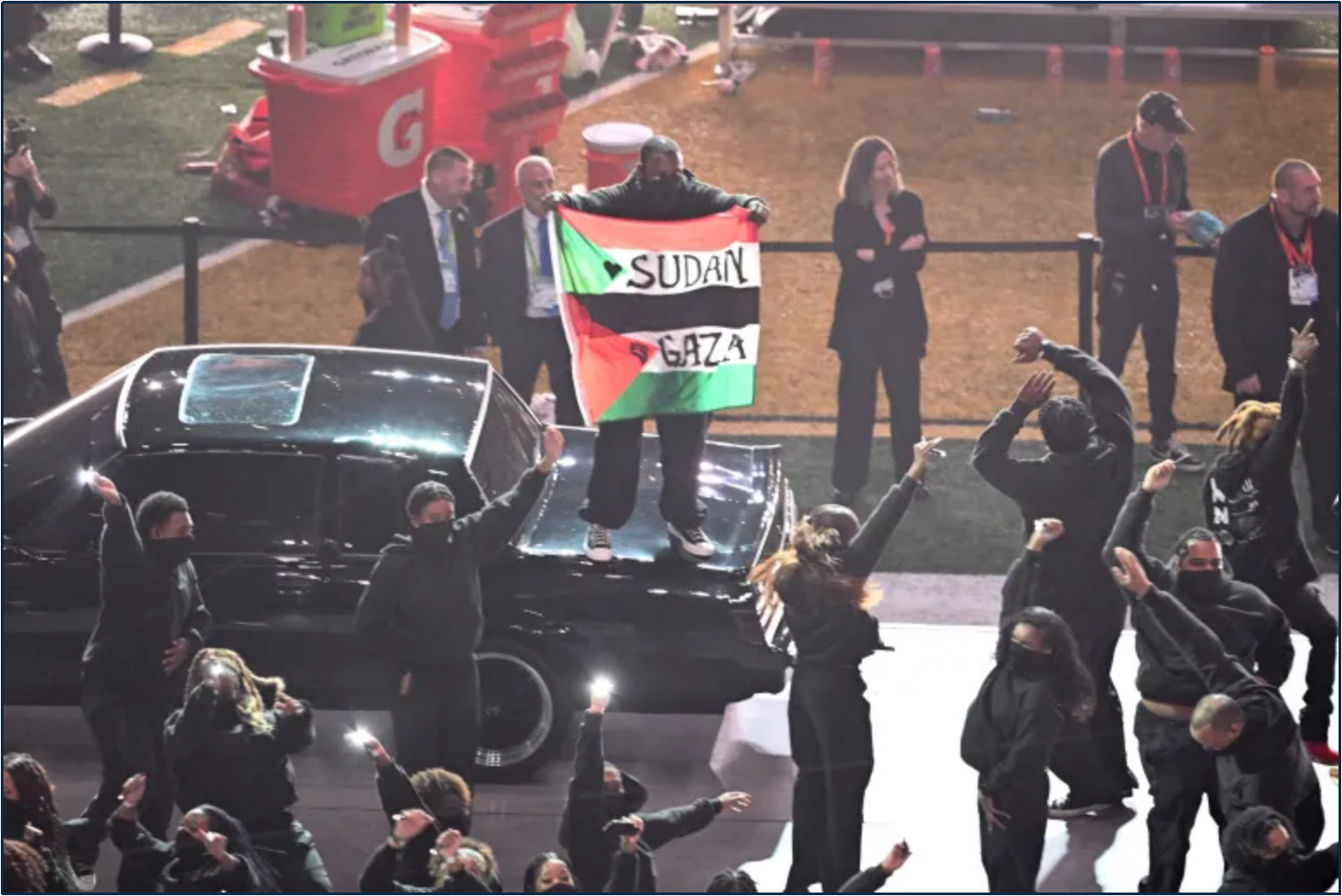
A protestor raises Sudanese and Palestinian flags as US rapper Kendrick Lamar performs during the Super Bowl in New Orleans, Louisiana, on February 9, 2025 [Chandan Khanna/AFP]
By Omar Suleiman
On Sunday night, amid the spectacle of the Super Bowl halftime show, a performer raised the flags of Sudan and Palestine. In an event as meticulously controlled as the Super Bowl, his interruption was brief, quickly handled by security, and not shown on the live broadcast. But the moment itself, fleeting as it was, was deeply symbolic.
It reflected the resolve of the Sudanese and Palestinian people to break through the censorship of their narratives imposed by mainstream platforms and speak out. It was yet another example of how, when faced with systematic suppression, they ingeniously found cracks in the system to make their voices heard.
Indeed, for more than a year, Sudanese and Palestinian people have made every effort to speak up. They have protested, organised and risked their lives to bring attention to their struggles. But the world has refused to listen.
This wasn’t the first time the Super Bowl was a backdrop for the erasure of their suffering. Last year, while millions of Americans were watching the game, Israel carried out a massacre, killing at least 67 Palestinians in a matter of hours in Rafah – an area designated as a “safe zone” by the Israeli army where 1.4 million Palestinians were sheltering. The timing was no accident. Israel knew that American media would be too distracted to pay attention and too complicit to care.
And many of us, as activists, knew that we had to find ways to counter the distraction. In collaboration with Know Collective, I released a different kind of Super Bowl commercial – not one selling chips or cars but one reminding people of the crimes our government was actively enabling in Gaza. The ad, shared widely on social media, had a simple yet urgent message: America is being distracted. As we are entertained, children are being slaughtered with our tax dollars. As we cheer for teams, our government is providing the weapons that turn Palestinian homes into mass graves.
The Romans called it “bread and circuses” – keep the masses fed and entertained, and they will not rise against oppression or even notice it. The Super Bowl is modern America’s greatest circus, a carefully manufactured distraction from the atrocities our nation funds.
But there are moments like Sunday night’s protest that demonstrate that not everyone is willing to be distracted.
There are also moments like the protest of January 15, 2024, when more than 400,000 people gathered in Washington, DC, to call for an end to US complicity in Israel’s genocide of Palestinians – an unprecedented act of mass mobilisation. It was a protest that dwarfed many historic demonstrations in the nation’s capital – yet the media barely covered it. If 400,000 people had gathered for any other cause, it would have led the evening news, dominated social media and filled headlines the next morning. But for Palestine, silence.
This was not an oversight. It was a deliberate effort to suppress the voices calling for Palestinian liberation.
Palestinians have always had to fight for visibility. When their voices have been blocked from mainstream platforms, they have taken to social media. When their protests have been ignored, they have organised bigger ones. When they have been erased, they have made themselves impossible to forget.
Sudan is a similar story in many ways, but it has its unique considerations. If Palestine is deliberately censored, Sudan is almost entirely ignored. The Sudanese people have been devastated by a war that has destroyed their country. Nearly every war crime imaginable has been committed against the Sudanese people. The scale of suffering is staggering: Tens of thousands of civilians have been killed, more than eight million people have been forcibly displaced, entire villages burned to the ground, and famine is looming. And yet Sudan remains barely a footnote in Western media.
Sudanese activists have responded with the hashtag #EyesOnSudan, a desperate plea for the world to pay attention. But their cries, like those of Palestinians, are met with deafening silence.
The suppression of Sudan’s story is a consequence of a media system that prioritises only conflicts that serve political interests. Sudan, unlike Ukraine or Israel, does not fit neatly into a Western foreign policy agenda. There is no incentive for coverage. No rallying cry from politicians. No flood of aid. Just millions of people left to suffer. The media blackout on Sudan is not just neglect; it is complicity in the erasure of an entire people.
And so for Sudan and Palestine, what happened at the Super Bowl was not just an act of defiance. It was part of a long tradition of people who have had to break through silence when all official channels have failed them. It was a reminder that no matter how much the mainstream tries to erase the suffering of Sudan and Palestine, the truth will break through.
It breaks through in the streets, where hundreds of thousands of people continue to march for Palestine despite arrests, blacklisting and violent suppression. It breaks through in Sudanese and Palestinian communities, where activists risk their lives to get the world’s attention. It breaks through in the digital sphere, where independent journalists and grassroots movements are outpacing corporate media in telling the real story.
And last night, it broke through on the stage of one of the most-watched events in the world.
About the Author
Imam Omar Suleiman is an American Muslim scholar and a theologically driven activist for human rights. Imam Dr Omar Suleiman is an American Muslim scholar and a theologically driven activist for human rights. He is the Founder and President of the Yaqeen Institute for Islamic Research and a Professor of Islamic Studies at Southern Methodist University.
