
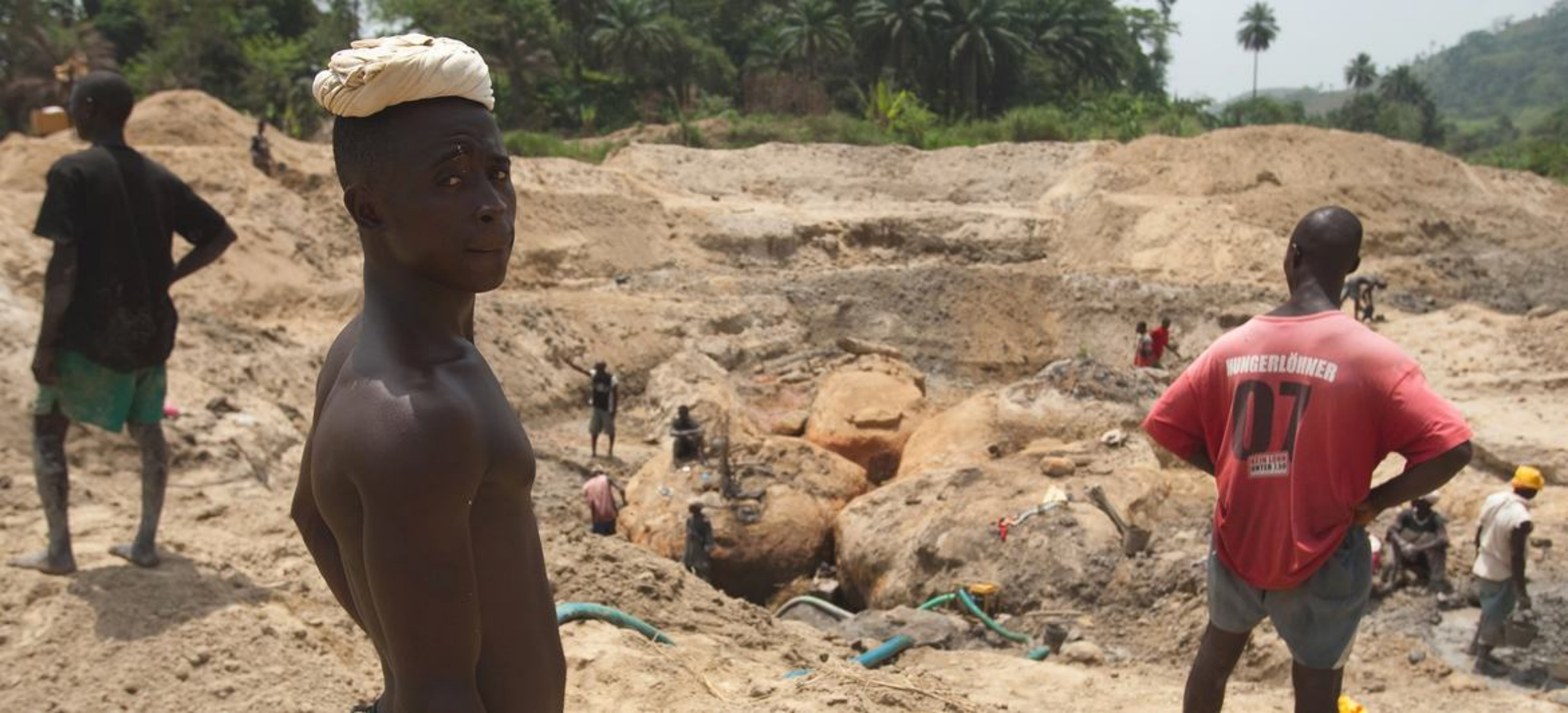
© UNICEF/Olivier Asselin-Young men work on a diamond mining site near Koidu, Sierra Leone. (file)
Craters filled with muddy water pocket the landscape of the Kono district in Sierra Leone – the result of a blood diamond mining industry which contributed to a decade-long civil war.
But now, parts of the land have been restored. Crops are beginning to flourish and bees are buzzing around once again.
The people responsible for this change are a hodgepodge group – former taxi drivers and miners, people who barely finished secondary school and some with higher education degrees. The unifying factor? Most have youth on their side.
“There is life beyond mining [but] we all grew up with the mentality that diamond is the only solution,” said Sahr Fallah, chairman of the Youth Council in Kono.
Over 44 percent of the 1.3 billion people aged 15-24 are employed in agrifood systems. However, this group often does not have the same access to resources as older generations. Moreover, they are sidelined in the conversations which might change this systemic exclusion.
“A lot of the time, what we find is that young people are included in policy processes but it is a little bit tokenistic. They don’t feel like their voice really matters,” said Lauren Phillips, a deputy director at the Food and Agriculture Organization (FAO).
Decent work = economic growth
The High-Level Political Forum on Sustainable Development in New York has been convened this week and next, to discuss progress – or lack thereof – towards the globally agreed Sustainable Development Goals (SDGs), one of which guarantees decent work for all.
Despite this commitment, over half of the global workforce remains in informal employment, according to the Secretary-General’s report on the SDGs released Monday. This means that they do not have adequate social or legal protections.
“Decent work must be at the heart of macroeconomic planning, climate and diesel transitions and social recovery strategies,” said Sangheon Lee, director of employment policy at the International Labor Organization (ILO).
Don’t ignore youth
Like other vulnerable groups, young people face unique challenges in the agrifood sector. Specifically, they often lack land rights and will struggle to act collectively to protect their interests.
“If you are not looking at data with a lens of age or gender, you are actually missing part of the story,” Ms. Phillips said.
Among these assets are land titles – which the elderly may be reluctant to pass down because of insufficient social protections. Youth also are less able to access credit so they can invest in themselves and their families.
Betty Seray Sam, one of the young farmers in Kono, said that her family never used to come to her when they were going through a crisis – they knew that she had no money and a child to support.
But now, through an agricultural job in Kono, she can support her family during times of crisis.
“This project has had a rippling effect for the youth in terms of not only improving their livelihoods but also the livelihoods of their families,” said Abdul Munu, president of Mabunduku, a community-based farmers’ organization in Kono.
Bee a farmer
Providing training to young people in agrifood systems is absolutely essential to ensure that they can practice sustainable agriculture.
In Chegutu, Zimbabwe, FAO has helped establish Bee Farmers Schools where young people are taught how to support apiaries through hands-on training activities.
“The idea is that one of the apiaries can be turned into a classroom where youth from different parts of a district can come just like a school,” said Barnabas Mawire, a natural resource specialist at FAO.
This training has helped local youth beekeepers to move beyond local and small-scale honey production to a fully-fledged business model that has the potential to not just fight poverty but actually create local wealth.
Evelyn Mutuda, the young entrepreneurs representative in Chegutu, aspires to plant Jacaranda trees which she says will improve the quality of the bees’ honey and enable the beekeepers to export beyond local markets.
“We want to maximize all the profits so we can become better and bigger,” Ms. Mutuda said.
From Facebook to TikTok
Being able to form labour associations is one of the key factors of decent work. This sort of collective action is even more important for youth in agrifood who often lack the social capital to enact real policy change.
“Young people are just starting out, making bonds within their group but also with people outside of their group. Those bonds are important…because there is power in numbers,” Ms. Phillips said.
She also noted that young people are forming these bonds across geographic distances, often by using technology. Agrifood influencers on Instagram and TikTok, for example, are increasingly shaping conversations about the sector.
Ms. Phillips also noted that it is important to think of collective action for youth as intergenerational.
“While the report is focused on young people, it’s not ignorant of the fact that young people live in families…There is a lot which talks about the need for solidarity between generations,” Ms. Phillips said.
Youth optimism
The next generation will be the stewards of the food we eat, so integrating them into that system now is essential for future food security and sustainability.
“Many youth integrate tradition with innovation, creating sustainability and community resilience,” said Venedio Nala Ardisa, a youth representative at the Asia Indigenous Peoples Pact, at an online side event during the high-level forum.
Angeline Manhanzva, one of the beekeepers in Chegutu, said that the opportunity to become a beekeeper changed her life. One day, she dreams of owning her own bee farm.
“I will be an old person who has so much wealth and can buy her big land to keep my hives and process my honey.”
