
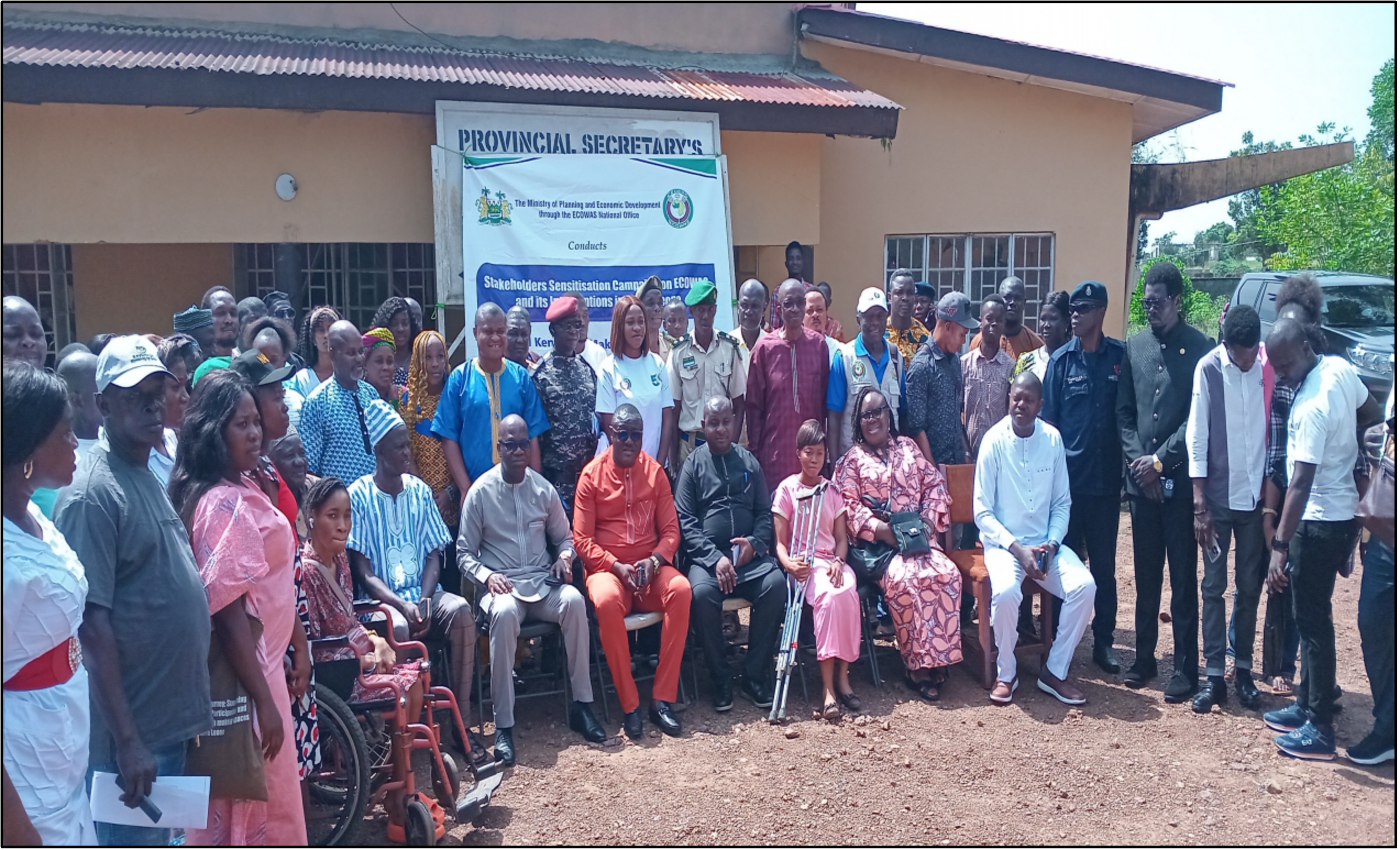
The Ministry of Planning and Economic Development (MoPED), working in partnership with the ECOWAS National Office in Sierra Leone, has completed a two day series of stakeholder sensitisation meetings in the country’s North West region aimed at deepening public understanding of the Economic Community of West African States (ECOWAS) and its range of interventions in Sierra Leone.
The outreach events took place at the District Council Hall in Makeni on 6 November 2025 and at the Provincial Secretary’s Office in Port Loko on 7 November 2025. Organisers said the sessions drew more than 134 participants representing a broad cross section of society: civil society organisations, teachers, nurses, persons with disabilities, members of the security forces, women’s groups, youth representatives, traders’ and drivers’ unions, and local council officials, among others.
Provincial Secretary for Port Loko, Mr Augustine Forbie, lauded the initiative, describing it as timely and necessary. He highlighted a range of environmental and developmental threats affecting Sierra Leone — including climate change, deforestation and global warming — and praised the event’s inclusive composition, noting that participants had been drawn from “across the board.” His comments underscored the local appetite for information and engagement on regional matters that directly affect community livelihoods and resilience.
At both events, the Head of the ECOWAS National Office in Sierra Leone, Mr Komba Momoh, formally introduced the newly appointed ECOWAS Ambassador to Sierra Leone, Mr John Azumah, and reiterated the rationale for the outreach. “ECOWAS is for all,” Mr Momoh told attendees, stressing that the sensitisation campaign was designed to bring the regional organisation “to the doorsteps of the people.” He further assured those present that similar campaigns would be held in other parts of the country to widen awareness and encourage public participation.
Ambassador John Azumah used the platform to underscore the importance of public knowledge about ECOWAS’s work and its impact in Sierra Leone. He commended President Julius Maada Bio on his selection as Chairman of ECOWAS and noted the confidence the region has vested in the Sierra Leonean leader to help steer efforts to maintain peace and security across West Africa.
Providing a historical overview of the regional bloc, the ambassador traced ECOWAS’s roots to early integration efforts in the 1970s. He recalled how Nigeria’s then Head of State, Yakubu Gowon, and Togolese President Gnassingbé Eyadéma championed the idea of regional cooperation during tours of West African countries, culminating in the signing of the ECOWAS Treaty in Lagos on 28th May 1975. According to Mr Azumah, ECOWAS was conceived to raise living standards, foster trade and economic cooperation, and promote peace and development across member states — objectives intended to contribute to “meaningful, happy lives” for West African citizens.
Ambassador Azumah also revisited ECOWAS’s interventions in times of crisis, recalling the role of the community’s military wing, ECOMOG, which intervened in Sierra Leone, Liberia and Côte d’Ivoire during periods of civil conflict to help restore democracy and good governance. He outlined a range of ECOWAS supported initiatives currently underway in Sierra Leone, including human capital development projects, support to women affected by obstetric fistula at the Aberdeen Women’s Center, agricultural assistance, construction of an ECOWAS logistics depot in Lungi, plans for a university in Kono, scholarship awards for outstanding girls administered through the Ministry of Gender and Children’s Affairs, and the construction of a joint border post in Jedema. The ambassador also cited recent humanitarian responses — support to flood victims in Bonthe and Kambia districts and food and nutrition assistance to underprivileged communities — as examples of ECOWAS’s multi sectoral engagement.
On sensitive regional border issues, Ambassador Azumah sought to reassure participants, stating, “Yenga will soon be a thing of the past after the elections in Guinea next year.” The remark drew attention to ECOWAS’s role in supporting peaceful dispute resolution and the organisation’s interest in stable, cooperative relations among neighbouring states.
A key feature of the sessions was a PowerPoint presentation by Dr Robert Moikowa, who set out factual information about the regional organisation and the contemporary challenges it faces. Dr Moikowa reminded attendees that ECOWAS operates in three official languages — English, French and Portuguese — and that its membership currently comprises sixteen countries with a combined population of roughly 400 million people. He also noted that three Sahelian countries, Burkina Faso, Mali and Niger, had left the bloc, a development that presents both political and operational challenges for regional cohesion.
Dr Moikowa detailed a wide array of emerging threats confronting the region and the community: organised crime, climate change, drug and human trafficking, money laundering, limited institutional capacity, cultural and linguistic diversity, the rise of extremist actors, and instances of non-compliance with ECOWAS protocols. He positioned these challenges within the framework of ECOWAS Vision 2050, an aspirational plan to transform the organisation from a “Community of States” into a “Community of People.” The vision, he said, rests on five pillars — including governance, the rule of law, and economic integration and trade — and carries a pledge that “no one will be left behind.”
Local traditional authorities also expressed support for the outreach. Regent Paramount Chief of Bekah Loko Chiefdom in Port Loko District, Mr Foday S. Kanu, pledged his chiefdom’s readiness to learn about ECOWAS programmes and to pass the information on to communities at the grassroots. Such endorsements from community leaders were seen by organisers as critical to ensuring that information shared during the sessions reaches ordinary citizens and is translated into local action.
Both events concluded with lively question and answer sessions that allowed participants to probe project details, timelines and modalities for community engagement. Stakeholders made pledges to support ECOWAS programmes and activities, and participants delivered votes of thanks to organisers. Officials described the two-day outreach as part of a broader effort to demystify ECOWAS for ordinary Sierra Leoneans, build local ownership of regional projects, and strengthen the link between regional decision-making and day-to-day realities on the ground. Organisers said future sensitisation campaigns will continue as the drive to take ECOWAS “to the doorsteps of the people” is sustained across other regions.
