
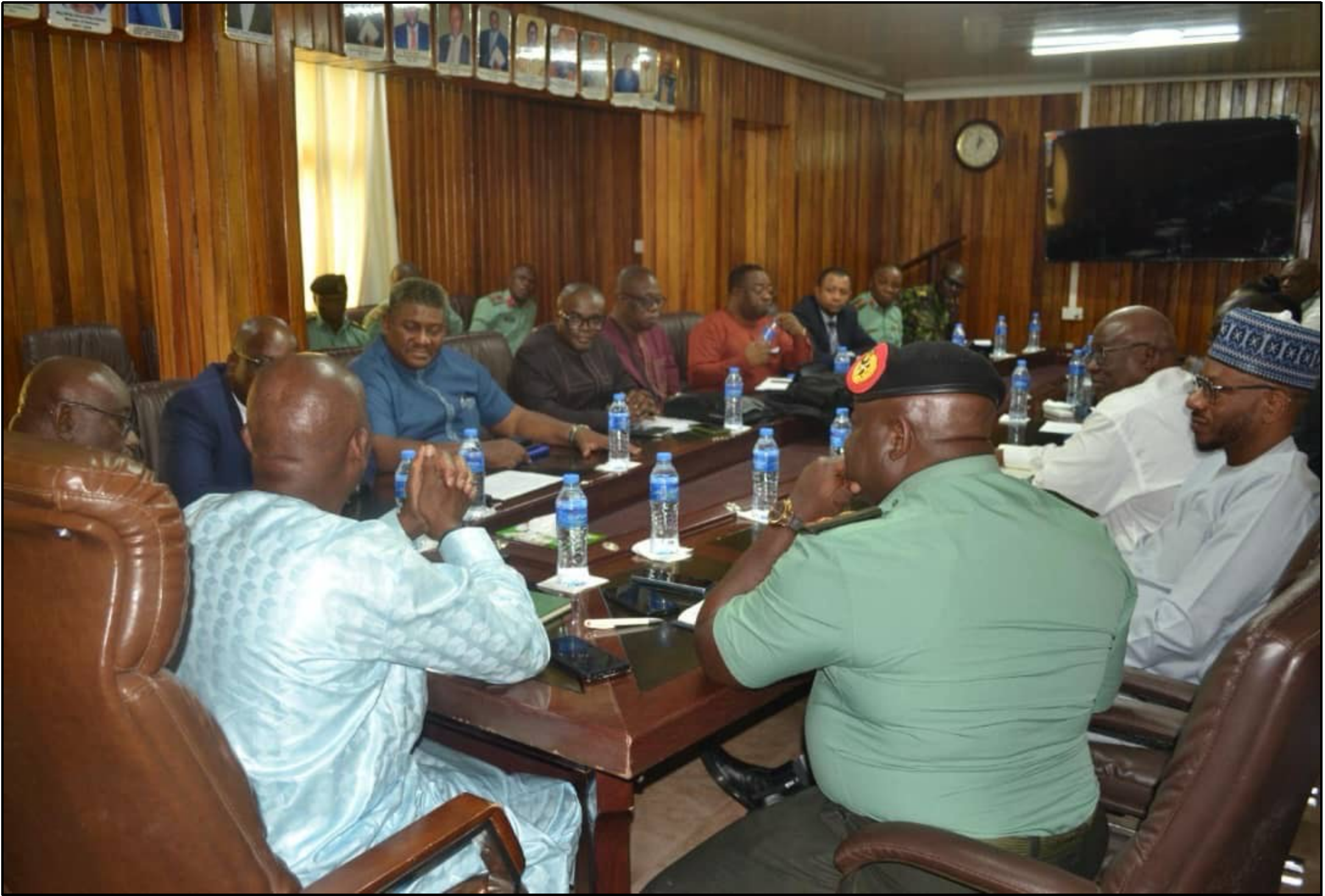
A 12-member Assessment Mission from the Economic Community of West African States (ECOWAS) arrived in Freetown last week to investigate the long-standing dispute over the border village of Yenga, officials said. The delegation, which arrived on Monday, August 25, 2025, met with Sierra Leonean authorities before departing for the contested frontier community.
On Tuesday, August 26, the ECOWAS team paid a courtesy visit to the Deputy Minister of Defence, Colonel Muana Brima Massaquoi (Retired). ECOWAS Resident Representative in Sierra Leone, Ambassador John Azumah, briefed Colonel Massaquoi on a fact-finding mission to gather information on the disputed border area between Sierra Leone and Guinea. He emphasised that the assessment would be “purely technical” and impartial, and that the team would consult with a variety of stakeholders and visit Yenga to gather information to help resolve the dispute.
“The team’s work will be purely technical and impartial,” Ambassador Azumah informed officials.
Colonel Massaquoi welcomed the mission, thanking ECOWAS for its prompt response and reaffirming Sierra Leone’s commitment to pursuing a diplomatic solution. “Sierra Leone and Guinea are the same country, despite the imaginary border. Taking a different approach will result in a serious humanitarian crisis for the peoples of both countries,” the Deputy Minister stated, emphasising the importance of dialogue and calm.
Major General Kemoh Tewoh Sesay, Chief of Army Staff and currently acting Chief of Defence Staff, gave the visitors a military overview of the situation. He stated that the people of Yenga consider the village to be part of Sierra Leone and identify as Sierra Leoneans. The mission was told that the village is located in Kissi Teng Chiefdom, Kailahun District, eastern Sierra Leone, on a hill above the south side of the confluence of the Mafissia and Makona (Moa) rivers, the latter of which forms part of the international boundary.
Officials explained the historical context that has fueled the dispute. Guinea first sent troops to Sierra Leone during the country’s civil war, which began on March 23, 1991, to support the Republic of Sierra Leone Armed Forces (RSLAF) against the Revolutionary United Front (RUF) and its allies. In 1998, amid threats by the RUF to invade Guinea in retaliation for its support for Sierra Leone, Guinea sent troops to Yenga with the permission of the Sierra Leone government to guard against incursions.
Guinea did not immediately withdraw from Yenga after the civil war was declared officially over on January 18, 2002. Diplomatic efforts resulted in a series of agreements, including an understanding in 2002 that Yenga would be returned to Sierra Leone once Guinea’s border was secure, a 2005 agreement affirming Yenga’s status as part of Sierra Leone, and a Joint Declaration on July 27, 2012, calling for the area’s demilitarisation. According to reports, the final batch of Guinean troops left Yenga in May of 2013.
Tensions rose again in 2020, when Guinean troops retook Yenga. On April 28, 2025, Guinean forces attempted to annexe two more border villages, Sokoma and Pengubengu, prompting the RSLAF to deploy quickly to secure those areas. The standoff escalated when Guinean troops opened fire, instilling fear in residents and forcing villagers, including the elderly, women, and children, to flee.
In response to the humanitarian crisis, President Julius Maada Bio (Retired) directed relief assistance to the affected populations. According to government briefings, the president distributed 400 bags of 50kg rice, 2,000 bags of 25kg rice, and other relief items to displaced families.
The incident was quickly de-escalated through diplomatic channels, including “very serious diplomatic talks at the highest levels” between the two governments. Diplomacy picked up pace after President Bio was elected Chairman of the ECOWAS Authority of Heads of State and Government on June 22, 2025, at the 67th ECOWAS Ordinary Session in Abuja. Since becoming ECOWAS chairman, President Bio has worked to resolve the Yenga dispute through regional mechanisms.
On August 5, 2025, ECOWAS Commission President Dr. Omar Alieu Touray paid a courtesy visit to President Bio and assured him that the Commission would carry out the decision to deploy an ECOWAS Assessment Mission to both Sierra Leone and Guinea as part of ongoing efforts to find a long-term solution.
The 12-member delegation in Freetown has met with various Sierra Leonean institutions, including the Office of National Security (ONS), as well as the Ministries of Foreign Affairs, Defence, Internal Affairs, and Planning and Economic Development. On their last day in Freetown, the team left to conduct fact-finding in Yenga. According to ECOWAS officials, the delegation will visit Guinea in the coming weeks to complete bilateral inquiries and prepare recommendations for resolving the dispute and restoring long-term peace along the shared border.
