
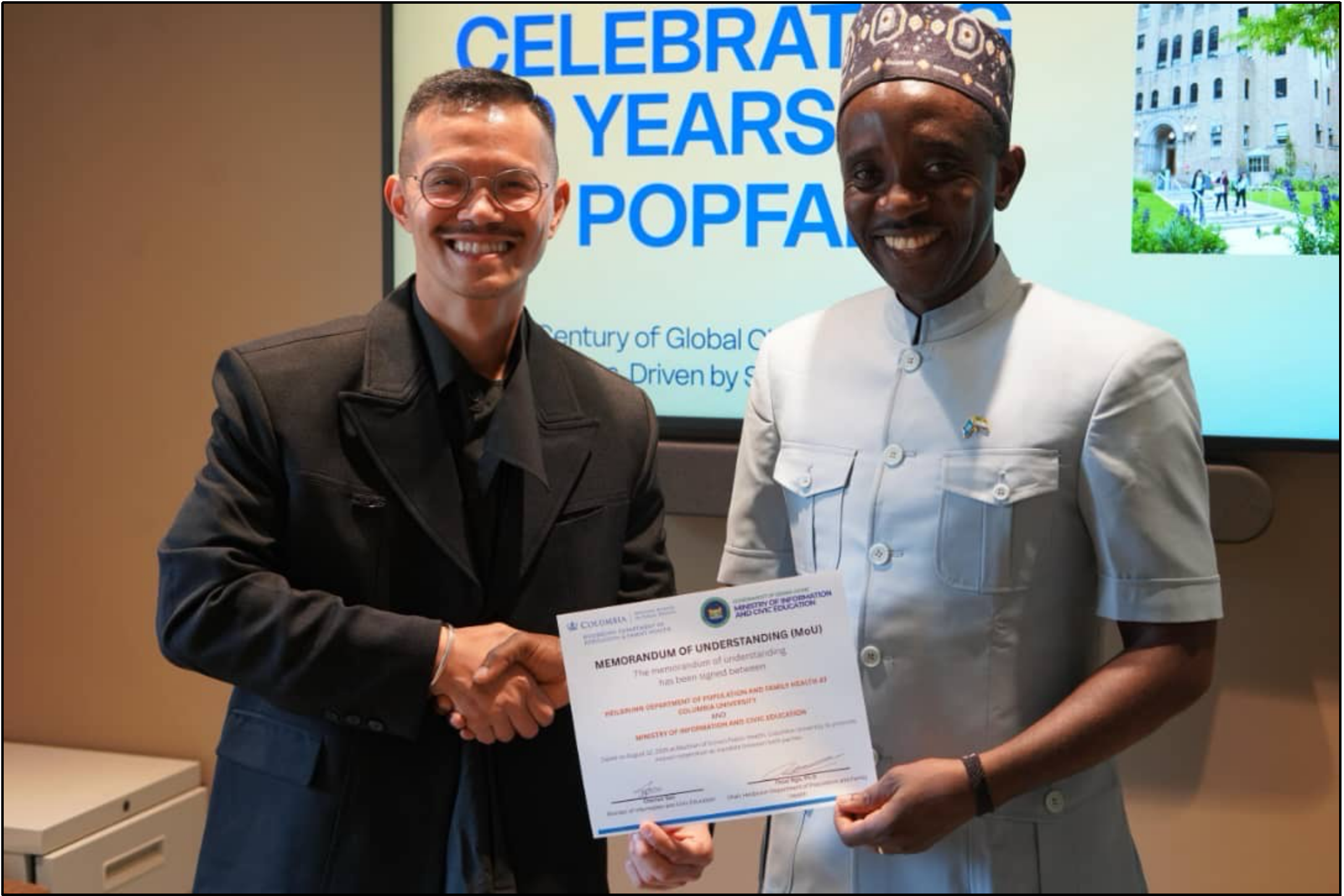
Hon. Chernor Bah, Sierra Leone’s Minister of Information and Civic Education, signed a Memorandum of Understanding (MOU) with Columbia University’s Mailman School of Public Health on August 12, 2025, following Columbia’s official announcement on August 27. The agreement, signed on behalf of Columbia by Dr. Thoai Ngo, Professor and Chair of the Heilbrunn Department of Population and Family Health (PopFam), represents a significant, long-term collaboration aimed at strengthening research capacity, education, and policy development in Sierra Leone and the wider West African region.
The MOU commits both institutions to a multifaceted cooperation program that will prioritise Sierra Leone in efforts to generate actionable evidence, develop local expertise, and train the next generation of public-health and civic-leadership professionals. The partnership focuses on building long-term institutional capacity through joint research projects, curriculum development, faculty and student exchanges, and training programs for government officials and community leaders. By focusing these activities in Sierra Leone, the partners hope to establish a long-term “centre of excellence” that will serve the country and neighbouring states.
“This collaboration is about more than responding to immediate health challenges,” Bah told reporters. “Sierra Leone’s greatest asset is its young people—and investing in their education is how we invest in our future.” This investment-focused framing is central to the MOU. It envisions educational and training pathways that will provide young Sierra Leoneans with skills in epidemiology, health policy, data science, communication, and civic education—skills that can lead to better health outcomes, stronger institutions, and increased civic participation.
Dr. Thoai Ngo highlighted the partnership’s strategic regional importance. “Investing in research and training in Sierra Leone is not only vital for the country, but also strategic for the region,” Dr. Ngo said at the event. Her remarks highlight Columbia’s commitment to producing locally relevant evidence that can inform policies throughout West Africa, as well as creating an environment in Sierra Leone where scholars, practitioners, and policymakers can work closely together on pressing public-health and development issues.
The MOU includes a significant component of capacity building for government officials and public institutions. Training programs for policymakers, civil servants, and civic educators aim to increase awareness of civic duties and responsibilities, strengthen public communication strategies, and improve data-driven decision-making. These activities aim to improve governance and public trust by educating officials and citizens about their roles in promoting health and civic life.
The partnership’s goal is to provide Sierra Leoneans with greater access to world-class education and research resources, thereby creating career pathways. Student and faculty exchanges, joint degree programs, and co-designed research projects will expose local talent to global methodologies while maintaining a local focus. This combination of international expertise and local knowledge aims to generate evidence and solutions that are both scientifically rigorous and culturally appropriate. Beyond the immediate educational and research benefits, the MOU envisions Sierra Leone as a regional hub for best practices to be demonstrated, evaluated, and scaled. Both signatories hope that the country will serve as a model for collaborative international partnerships to accelerate progress in health, equity, and sustainable development. Success would entail not only better outcomes in Sierra Leone, but also a replicable approach that other countries in the region could adopt.
The Columbia-Sierra Leone agreement is a concrete step toward long-term transformation, acknowledging the importance of youth, research-driven policy, and long-term institutional partnerships. As the program progresses, stakeholders will be watching to see how quickly training, evidence generation, and policy engagement lead to measurable improvements in health systems, civic engagement, and regional development. If the initial commitments are met, this MOU could usher in a new era of locally led, regionally influential research and capacity in West Africa.
