
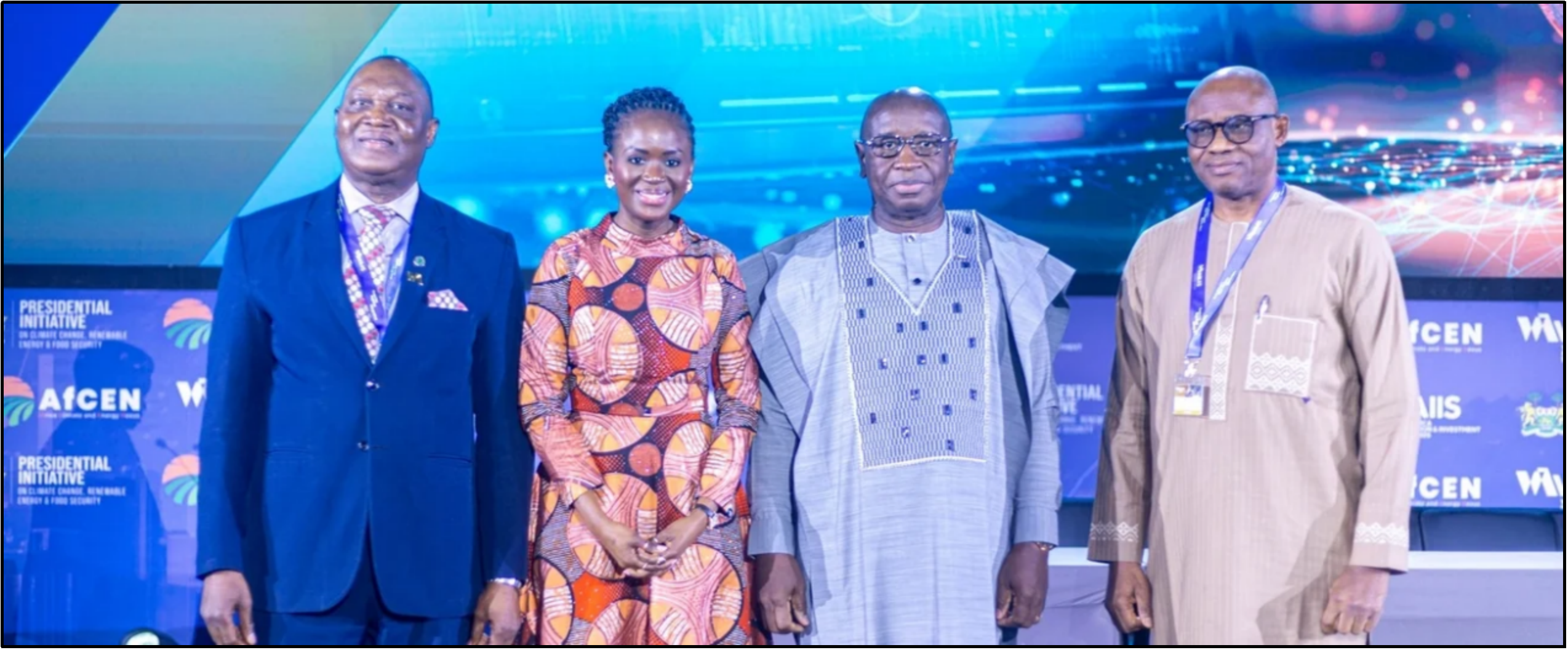
Acting AfDB Vice President Abdul Kamara (far left) with Sierra Leone President Julius Maada Bio (2nd from the right) and Minister Salima Monorma Bah at WAIIS in Sierra Leone.
The African Development Bank Group has given Sierra Leone US$750,000 to assess the country’s capacity to host a proposed regional data embassy for West African governments.
The Korea-Africa Economic Cooperation (KOAFEC) Trust Fund will fund a feasibility assessment and preparatory activities for the ECOWAS Regional Data Embassy Initiative. The grant is not a commitment by Sierra Leone to host the facility, but it will help assess the country’s readiness and potential role in the project.
The announcement was made at the West Africa Integration and Investment Summit (WAIIS) in Lungi from 16–18 November. Sierra Leone’s Minister of Communication, Technology and Innovation, Salima Monorma Bah, and the African Development Bank’s Acting Vice President for Regional Development, Integration and Business Delivery, Dr Abdul Kamara, announced the support.
The initiative aims to create trusted arrangements that allow participating West African countries to securely host and protect critical government data across borders. Within the framework, data would remain under the national jurisdiction and ownership of the country to which it belongs.
The ECOWAS Council of Ministers in charge of Information and Communications Technology has endorsed the initiative, and the ECOWAS Authority of Heads of State and Government has approved it. The initiative seeks to improve cooperation on digital infrastructure and computing capacity as West African countries prepare for a growing artificial intelligence economy.
Sierra Leone had championed the proposal through ECOWAS as part of President Bio’s vision of shared sovereignty, Bah said. She pointed to the Bank’s partnership and KOAFEC funding as critical for the country’s preparations and the broader regional effort.
“The ECOWAS Regional Data Embassy Initiative is an example of how our countries can work together to protect critical national data, build shared capacity and improve our collective position in the global digital economy,” Bah said.
Reliable infrastructure, Kamara said, was key to digital sovereignty. “The Bank’s support will help Sierra Leone investigate the possibilities for a regional data embassy and assist ECOWAS member states to consider ways to safeguard critical data and develop the continent’s AI computing capacity in the region,” he said.
The feasibility work is expected to inform decisions on Sierra Leone’s ability to host and participate in the initiative. It is also part of the ECOWAS Commission’s broader preparatory work to develop a framework for regional cooperation.
The Commission intends to hold regional technical consultations on the initiative in late November 2026. These discussions are expected to inform the preparatory process as member states consider how a data embassy could facilitate secure cross-border data arrangements while respecting national ownership and jurisdiction.
