
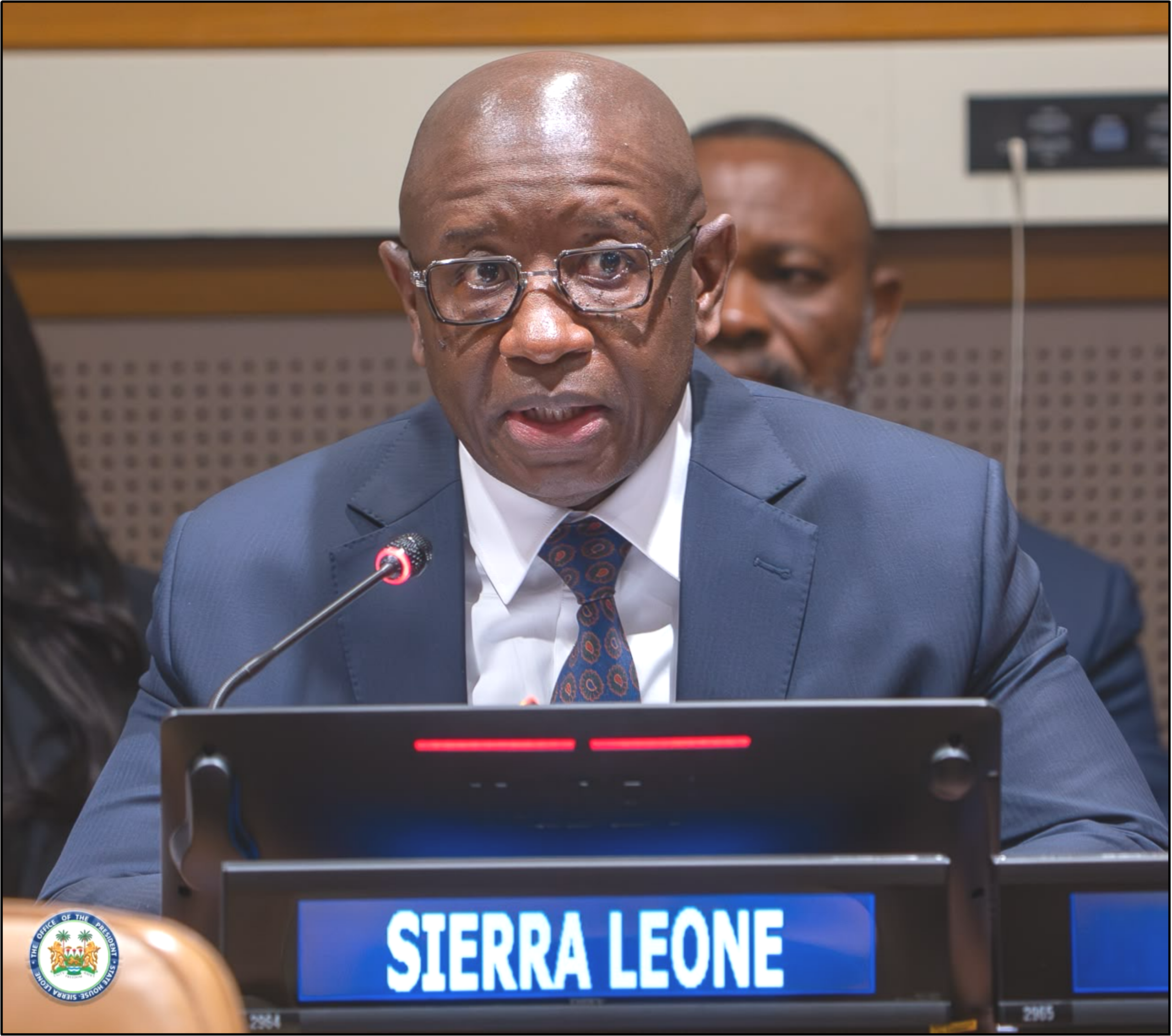
Sierra Leone’s President, Dr Julius Maada Bio, has warned African countries not to repeat historical patterns of economic extraction in the coming era of artificial intelligence at a high-level roundtable convened by Kenyan President William Ruto on the sidelines of the 80th United Nations General Assembly.
In an address to fellow Heads of State, government officials and experts, President Bio urged the continent to take an active role in the development, governance, and benefits of technologies reshaping the world economy. President Bio argued that Africa faces a stark choice.
“Will Africa be a passive recipient of artificial intelligence systems built elsewhere, or will it actively shape the infrastructure, models, data regimes and regulatory rules that determine how value is created and distributed? No single African country could build the entire AI stack on its own”, he said, but the continent should not accept a future in which others determine its digital destiny.
“We have another option,” he said, detailing a strategy he dubbed “shared sovereignty.” T
he approach would involve African countries building what they could on their own, partnering where scale and resilience demanded, protecting sovereign assets and working with external partners on terms that reflected African interests. He said shared sovereignty would allow countries to share resources while still controlling matters of national importance.
President Bio highlighted the continent’s huge infrastructure deficit, noting that Africa represents about one-fifth of humanity yet only a small share of global data-centre capacity. He cautioned that this imbalance could turn Africa into a raw material supplier (minerals and data), while elsewhere more valuable technology, models, and services are developed and monetised.
He said Sierra Leone is already addressing these issues. With support from the World Bank Group, the country is developing its first national artificial intelligence (AI) strategy. President Bio was clear on the starting point: poor internet outside of cities, and the need for pragmatic, locally appropriate solutions given constraints. He added that AI that works for Africa must work in the real world – tools that can be used on mobile phones, work in low-bandwidth environments, comprehend African languages and cultural contexts, and bring concrete improvements to people’s lives.
“That’s the real test for me,” he said. Can a farmer get more information on his crops? Can the health care worker make a more informed decision? Can a teacher use these resources to help a student learn? Is it easier for a citizen to receive a public service?
He said that, understanding that small economies might not be able to develop large-scale digital infrastructure on their own, he proposed innovative regional arrangements. He told the gathering that Sierra Leone has been looking at the idea of regional data embassies – mechanisms that would allow critical public data of a country to be hosted in another participating state with clear legal jurisdiction, control and protections. “The principle is simple: sovereignty should move with the law, not just the building,” he said.
Economically, President Bio warned against repeating old extractive patterns. Africa’s mineral resources will provide the infrastructure that makes AI possible, and its people will generate much of the data that artificial intelligence systems learn from. Without concerted investment and policy, he warned, the continent risks sending inputs out and importing most of the value created. To change that trajectory, he called for more investment in African talent, research institutions, languages, datasets and innovation ecosystems, coupled with strong privacy and citizen rights protections.
His aim, he said, was to move “from mine to model” – lifting African participation in the value chain from extracting raw materials to creating models, platforms and services that generate more economic value.
President Bio called on African countries to engage actively in creating global rules on AI, rather than waiting for others to decide. He urged pragmatic collaboration among interested countries on access to computing capacity, data governance, interoperability, capacity building, safety, and regulatory approaches that African institutions could practically implement. That is why I think it is valuable to start working on a practical framework for shared AI sovereignty with interested African countries,” he told the audience.
President Bio invited governments, investors and business to continue the conversation in Sierra Leone at the inaugural West Africa Integration and Investment Summit (WAIIS) on 17-18 November 2026 with a key focus on digital transformation, in an effort to translate principles into action. The Summit, he saw, was an opportunity to go beyond declarations and pilot concrete projects and partnerships: “So, what we discuss here in New York as principle, let us begin testing in Freetown as practice,” he said.
He concluded that sovereignty was not about isolation, but about the ability to choose, contribute and shape the terms of engagement. “Our generation benefits from an Africa where its raw materials often made countries abroad more prosperous than at home. “We should not leave the next generation with an Africa where data, knowledge and intelligence are the same,” he said, pledging Sierra Leone’s willingness to seek shared sovereignty with other countries.
