
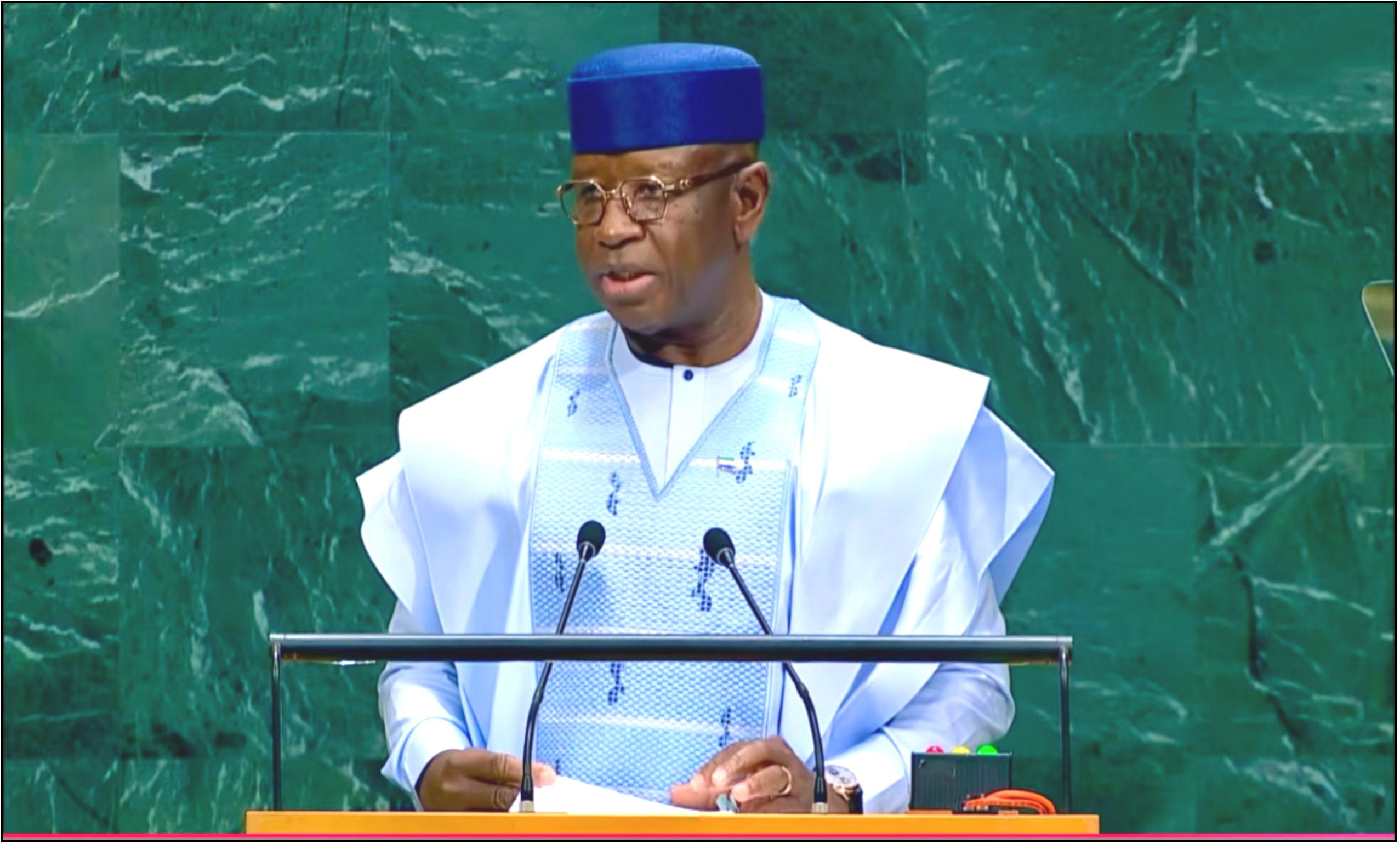
President Julius Maada Bio speaking at the United Nations General Assembly on Tuesday, September 22, 2026President Julius Maada Bio of Sierra Leone, speaking at the United Nations General Assembly on Tuesday, September 22, 2026, called for immediate reform of the UN Security Council, insisting that Africa be given permanent representation at the Council’s highest level. President Bio said the Security Council “still reflects the world of 1945,” and it cannot be fully legitimate and effective when an entire continent of more than 1.6 billion people lacks a permanent voice in decisions with far-reaching consequences.
President Bio referred to the Common African Position enshrined in the Ezulwini Consensus and the Sirte Declaration.
This proposal calls for at least two African Permanent Seats with “all the rights and privileges of permanent membership”, including the veto, and five additional non-permanent seats.
Speaking as Coordinator of the African Union’s Committee of Ten, he said Sierra Leone would keep its stance in the ongoing intergovernmental negotiations. He cautioned that years of talks without real reform had put the UN process’s credibility at risk.
He stressed the need for African leadership to achieve sustainable global solutions to peace, climate, food, energy and technology.
President Bio also pointed to Sierra Leone’s recent contributions in its time on the Security Council in 2024 and 2025, saying the country wanted to be “a voice of reason and a bridge across division”.
In office, he led efforts such as the Council’s first high-level debate on tackling historical injustices against Africa, tackling conflict-related food insecurity, and co-drafting Resolution 2807 on Youth, Peace and Security with Guyana.
The Assembly adopted the text unanimously to strengthen the role of young people in conflict prevention and peacebuilding. President Bio called on member states to adopt a unified reform model and urged the Assembly to honour its commitments under the Pact for the Future by approving a consolidated approach before the end of the session.*****
