
Over 80 community leaders and stakeholders from Turtle Island and other Sherbro Island communities in Deima Chiefdom, Bonthe District, have praised the Reptile and Amphibian Program-Sierra Leone (RAP-SL) for its conservation work. They have pledged continued support for efforts to protect sea turtles, manatees, mangroves, and coastal biodiversity.
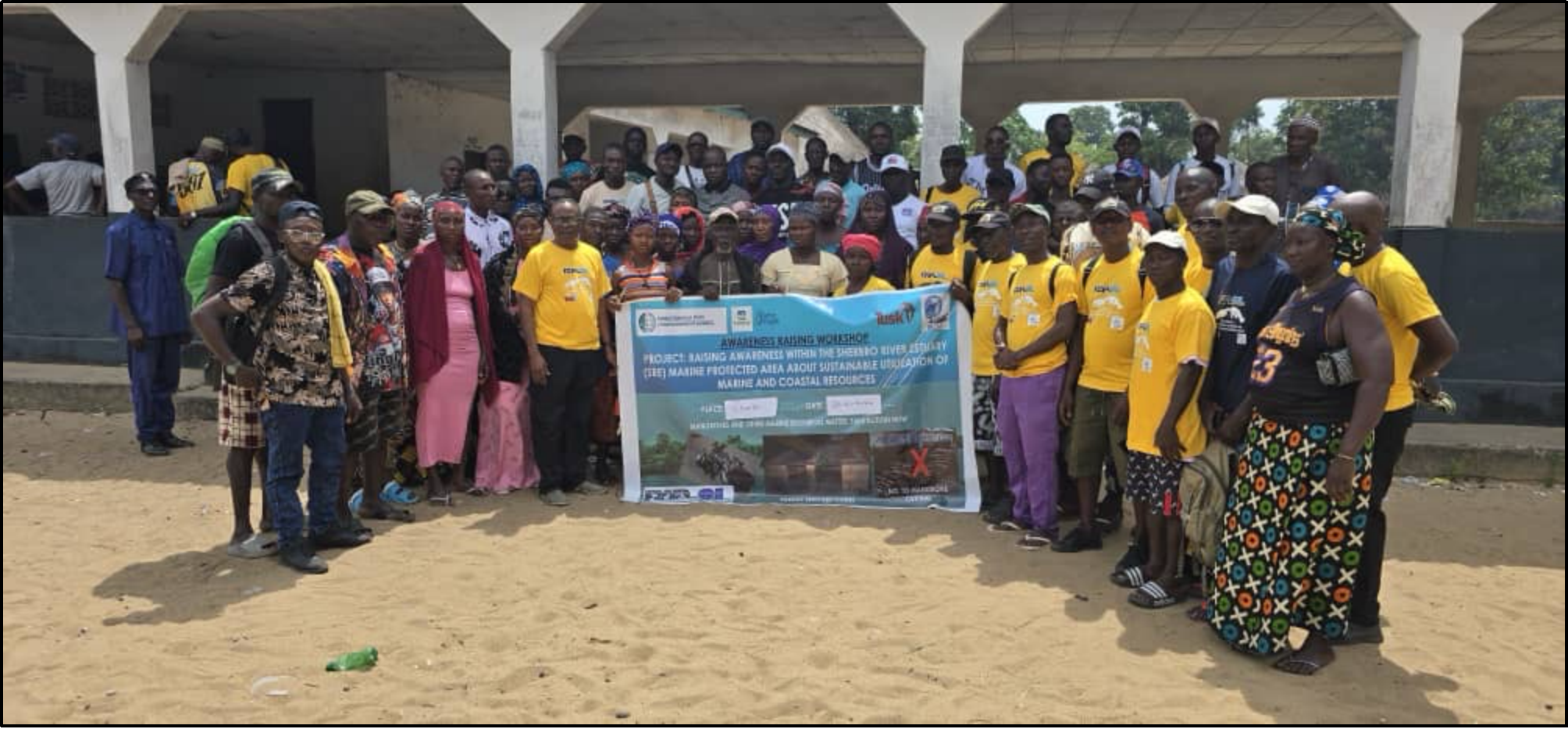
On Thursday, April 30, 2026, councillors, chairladies, headmen, harbour masters, fishermen, fishmongers, sea turtle monitors, and other key actors gathered at the Dama Chiefdom Administration Community Barry in Chepu for a RAP-SL sensitisation meeting. Paramount Chief Anshun Ngabay IV, the Speaker, and other local leaders emphasised tangible community benefits since the conservation campaign began, pointing out that each of the chiefdom’s four sections now has two schools. They stated that these gains show that protecting wildlife and habitats provides longer-term benefits than previous practices of hunting sea turtles.
Paramount Chief Ngabay IV praised RAP-SL for educating and raising awareness about the ecological and economic value of mangroves, sea turtles, manatees, and other coastal species. He praised residents for following laws that prohibit killing sea turtles and cutting mangroves, and he emphasised that those who violate conservation rules will face consequences. The chief stated that most mangrove cutting in the area occurs elsewhere, and that Turtle Island residents typically buy wood for fish processing rather than harvesting it themselves. To strengthen protection, he stated that he is working with neighbouring chiefdoms to coordinate environmental law enforcement.
The chief emphasised the need for increased support from non-governmental organisations (NGOs) for energy-efficient fish processing ovens. He thanked Edward “Eddie” Aruna and RAP-SL donors for supplying over 150 improved ovens, but noted that demand is still high and communities want more units. “If conservation laws are to be respected, NGOs must help provide viable alternatives for people,” he said, urging other NGOs to compete constructively to speed up development and sustainability.
Ngabay IV also opposed plans to mine zircon in the chiefdom. Although five investors have expressed interest, he claims that no zircon mining is currently taking place and warns that allowing such extraction could destabilise the island. He urged residents to report any activities that hampered development to the authorities.
RAP-SL’s founder and managing director, Edward Aruna, has reaffirmed the organisation’s commitment to protecting sea turtles, manatees, and mangroves as flagship priorities, while also safeguarding other threatened species and Sierra Leone’s biodiversity. He emphasised international recognition for the work, including an award related to TUSK presented by His Royal Highness. The Prince of Wales thanked donors including PRCM and RAMPAO. “These donors have one common goal: to protect Sierra Leone’s marine resources,” he said, urging all Sierra Leoneans to see conservation as a shared responsibility.
Aruna warned that climate change is already reshaping the Turtle Islands, causing erosion and loss of land. In sea turtles, temperature-dependent sex determination occurs during incubation. Warmer sands produce more females, while cooler sands produce more males. According to RAP-SL’s bycatch records, the majority of turtles caught during fishing activities are female, which aligns with the warm nesting beaches in Sierra Leone. He advocated for stricter protection of nesting beaches and greater attention to climate impacts on turtle populations.
Aruna reported that RAP-SL has recorded manatees in both Bonthe and Moyamba districts, but they face similar threats such as habitat loss and human pressures. He asked the public to help protect manatees, which are legally protected in Sierra Leone.
Mangroves figured prominently in the discussion. Aruna defined mangroves as salt-tolerant trees that thrive in brackish, waterlogged soils and can filter or excrete salt. He emphasised their critical role in shoreline protection, fisheries support, and carbon sequestration. RAP-SL collaborates with the University of Manchester, Njala University, and two European universities to conduct mangrove research in Sierra Leone, Guinea, and Liberia. RAP-SL prioritises conservation and community benefits over carbon markets, whereas other organisations in Sierra Leone pursue blue-carbon and carbon-credit projects.
Community members expressed high demand for cost-effective ovens. A fishmonger reported that after implementing the improved design, her firewood costs dropped from around Le2,000 to Le400, and some processors now use coconut shells as an alternative fuel. Aruna has announced that RAP-SL will upgrade oven wire mesh to a more durable 8 ft x 4 ft design and survey additional communities to expand the program.
The meeting concluded with a lively Q&A session, T-shirt distribution, and renewed commitments from community leaders and stakeholders to collaborate with RAP-SL to conserve marine life and manage natural resources sustainably across the Sherbro Islands.
Subscribe to Updates
Get the latest creative news from FooBar about art, design and business.
Sherbro Island Communities pledge stronger support for sea turtle, manatee, and mangrove conservation

gleanernewspaper
Gleaner Newspaper is the Home for exclusive local news, views, and adverts from Sierra Leone. Publisher: Gleaner Communications Sierra Leone.