
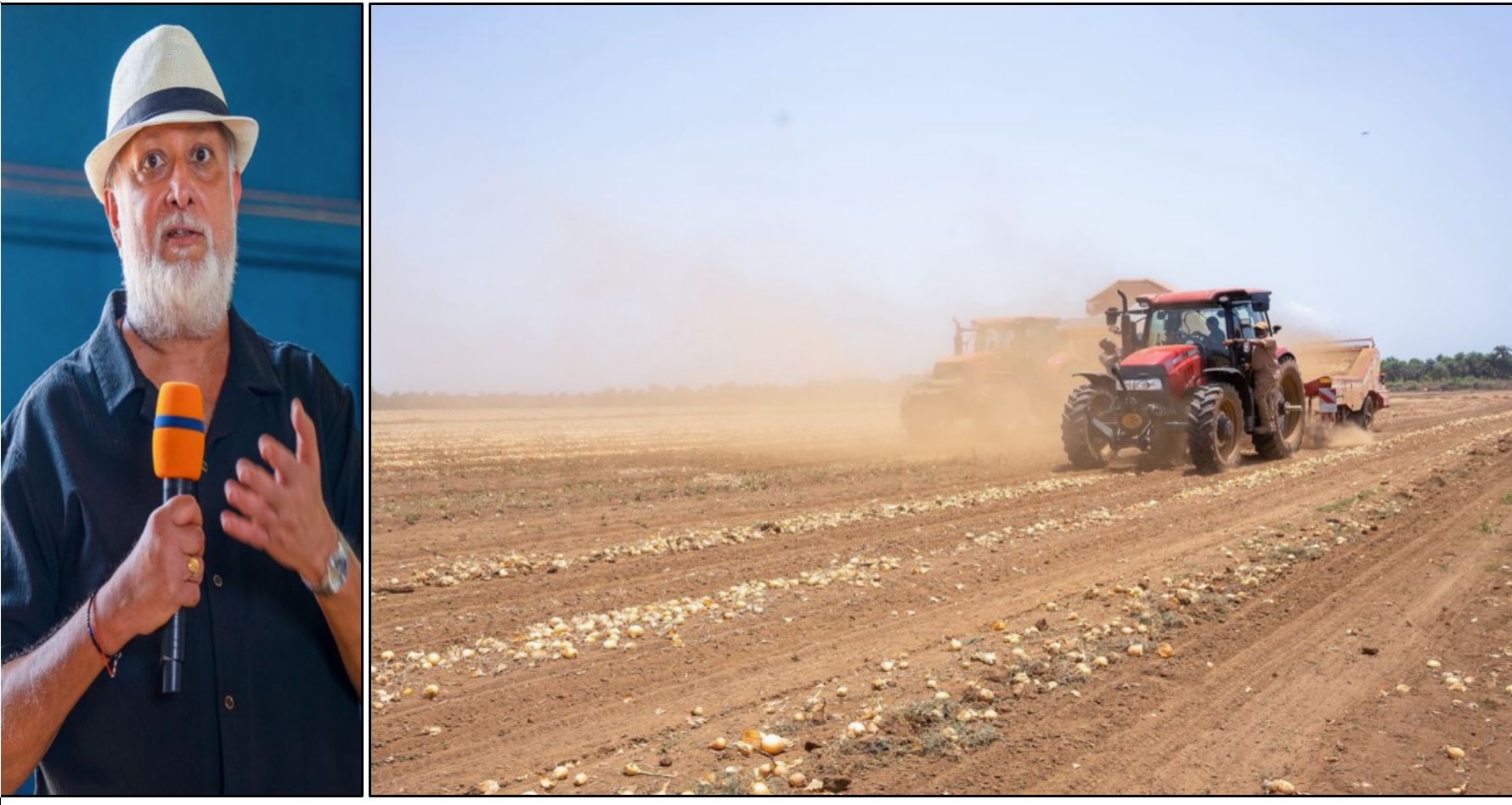
Mahesh Nandwani of Pee Cee and SonsPresident Dr Julius Maada Bio paid a high-profile visit to the Pee Cee and Sons onion farm at Loko Masama in Lungi on April 16, 2026, reaffirming his administration’s commitment to accelerating the Feed Salone initiative and strengthening national food security.
The farm, one of Sierra Leone’s largest onion-producing farms, represents a growing wave of private-sector agricultural investment aimed at reducing import dependence and increasing domestic production. The Pee Cee and Sons operation, which spans extensive acreage, is a model of what government-private partnerships can achieve under the Feed Salone framework.
Speaking at the event, President Bio emphasised that Sierra Leone has the land, labour, and capacity to feed itself if production is increased. “Growing what we eat is critical to reducing our reliance on imported foodstuffs,” he said, praising the company’s role in translating policy into action. The President also made a strong call for more women to participate in agricultural activities. He argued that providing women with resources, training, and market access will be critical to transforming the sector and improving livelihoods in communities.
Mahesh Nandwani of Pee Cee and Sons welcomed the presidential visit as evidence of investor confidence in Sierra Leone’s agricultural prospects. He credited recent reforms and a favourable business climate with allowing the company to transition from trading to large-scale farming and agro-processing. Recounting his own start in business as a 16-year-old trader, Nandwani described his company’s expansion as part of a larger national opportunity to use agriculture as a strategic engine of economic transformation.
The Minister of Agriculture and Food Security Dr. Henry Musa Kpaka, stated that the project has grown from humble beginnings to become one of the country’s primary onion production hubs. He noted the visible market impact, which included increased availability of locally grown onions and improved consumer affordability.
Dr Kpaka reiterated that Feed Salone deliberately places the private sector at the forefront of agricultural development, citing Pee Cee’s transition from importer to major local producer as an example of a shift that the government hopes to replicate across the country. Deputy Farm Manager John Lahai Alieu told visitors that the project’s growth over the last four years has been “transformational.”
He revealed that the farm’s storage infrastructure can now hold up to 2,000 tonnes of onions, significantly reducing post-harvest losses and helping to stabilise supply during the off-season. Alieu explained that the enterprise began with a five-hectare pilot and has steadily grown; this year, the cultivated area reached 70 hectares, with a larger estate footprint identified at the site. Current yields are expected to be around 35 tonnes per hectare, with management aiming for 60 to 70 tonnes per hectare in future seasons as farming practices and irrigation systems are refined.
The presidential delegation toured large cultivation blocks, examined newly installed irrigation systems, and observed cold storage and handling facilities designed to preserve quality for local markets.
During the field inspection, President Bio and Dr Kpaka rode together in a tractor through sections of the farm before visiting Pee Cee’s new processing house, which company officials describe as a modern facility for cleaning, sorting, and packaging produce for domestic distribution.
The visit demonstrated a convergence of government policy, private investment, and on-the-ground agricultural practice aimed at hastening Sierra Leone’s progress toward food self-sufficiency. Officials framed Pee Cee and Sons as more than just a business success, but also as a replicable model for increasing production, improving food availability, and providing livelihoods in rural areas across the country.
