

February, 2026: The Ministry of Technical and Higher Education (MTHE) has hosted experts from Nigeria’s Joint Admissions and Matriculation Board (JAMB), as Sierra Leone moves closer to establishing a centralised admissions system for universities and technical institutions.
The engagement centred on knowledge sharing, technical guidance, and implementation planning for the reform, which seeks to modernise and streamline tertiary admissions.
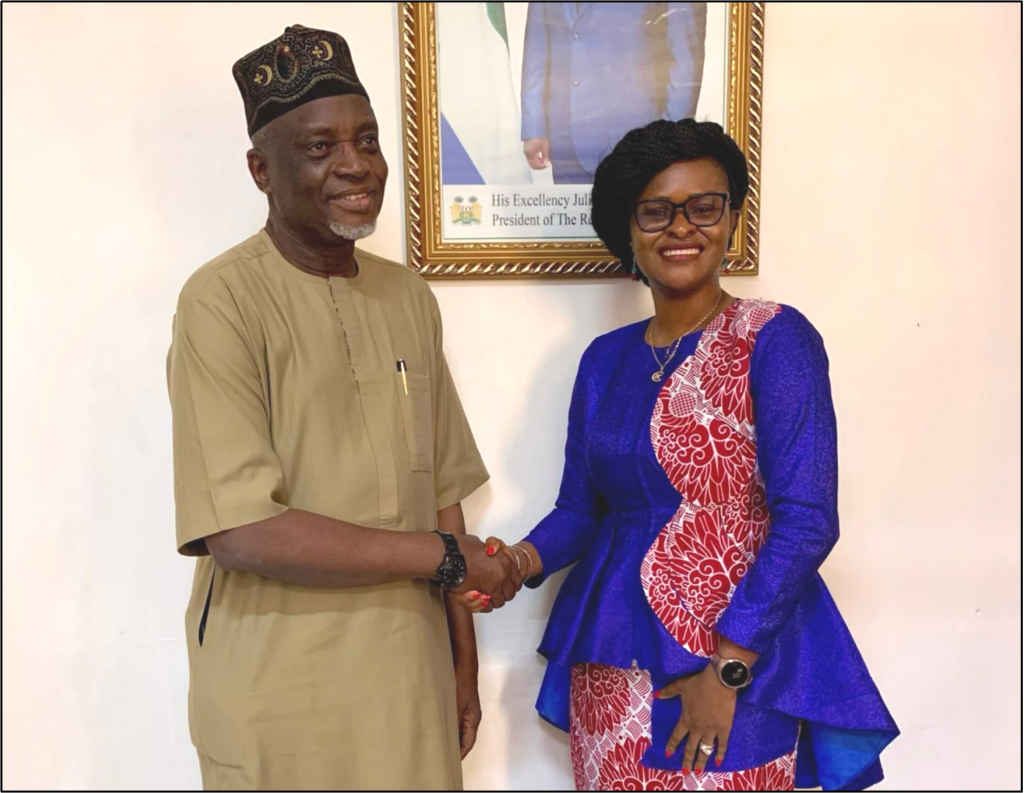
Dr Haja Ramatulai Wurie, Minister of Technical and Higher Education, welcomed the delegation and stated that the government is working to modernise and streamline admissions by establishing a Centralised Admissions Secretariat, noting that legal provisions for such a system already exist in the Universities Act of 2021 and that Cabinet has approved its implementation.
According to the Minister, the reform aims to address long-standing issues such as delayed admissions, fragmented application processes, and late examination results, which frequently disrupt the academic calendar.
Individual universities now manage their own admissions, which she described as historically chaotic, especially in highly competitive programs like medicine.
“We want a one-stop shop where students can apply once and the system collaborates with universities and technical institutes to ensure a smooth process,” she said.
Under the proposed model, students would apply through a centralised digital platform managed by the Ministry in partnership with universities and government technical institutes.
The Minister announced that the Ministry of Finance has approved the Secretariat’s staffing requirements.
Prof. Is-haq Oloyede, Registrar of the Joint Admissions and Matriculation Board (JAMB), explained that Nigeria’s centralised admissions system, established in 1978, was intended to eliminate duplication, increase transparency, and coordinate placements across the country.
He emphasised the importance of effective institutional collaboration. He argued that universities should retain control over admissions criteria, quotas, and program requirements, noting that centralised systems work best when institutions are actively involved in candidate selection.
Prof. Oloyede added that Nigeria’s model incorporates candidate selection, institutional capacity (quotas), and national standards via a digital Central Admissions Processing System that tracks decisions for accountability. He also mentioned the size of Nigeria’s operations, which processes over two million applicants per year.
Dr Josephus Brimah, MTHE’s Chief Technical and Higher Education Officer, traced Sierra Leone’s reform agenda back to the establishment of MTHE in 2018, which separated higher education oversight from the former Ministry of Education, Science, and Technology. He stated that the centralised admissions concept was later incorporated into legislation, including the 2021 Universities Act, to improve coordination among public and private institutions.
Funding arrangements for the new system were also a major topic of discussion. Officials acknowledged that universities currently generate revenue through individual application fees, which could be impacted by a centralised model.
As a result, the government is considering a revenue-sharing framework in which institutions receive application fee equivalents for admitted candidates while surplus funds are used to support the Secretariat’s operations. Authorities say the goal is to ensure financial sustainability without putting additional strain on the public purse.
MTHE Permanent Secretary Mohamed Sheick Kargbo emphasised the importance of developing a system that is tailored to Sierra Leone’s governance structure and educational realities, rather than simply replicating foreign models.
He stated that, while policymakers are studying several international frameworks, the plan is to develop a hybrid model shaped by national priorities, including equity considerations for underserved regions.
