
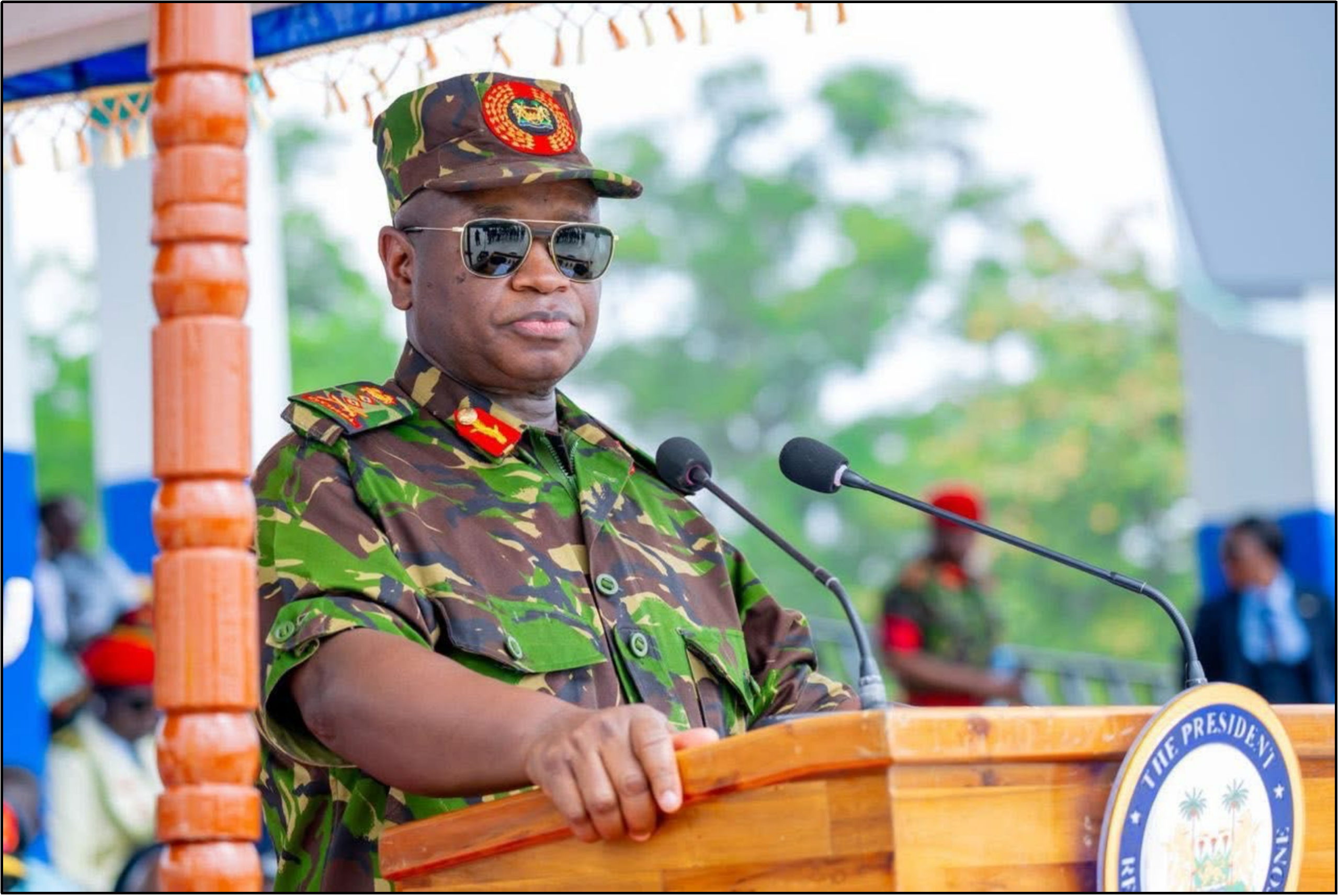
President Julius Maada Bio
Sierra Leone’s President Julius Maada Bio, once derisively referred to as “the Professor of Coup” by his wife, Madam Fatima Bio, now faces what may be his most consequential challenge: steering the Economic Community of West African States (ECOWAS) through an unprecedented wave of military takeovers across the subregion. A new military coup in Guinea-Bissau on November 26, 2025, a day before the official results of the November 23, general election were due to be announced, added another junta-led state to an already disturbing list.
Military officers overthrew President Umaro Sissoco Embaló. President Bio convened an urgent ECOWAS meeting, which helped secure Mr Embaló’s release and departure from the country, but a military leader is now in charge of Bissau’s one-year transitional authority. This development confirms a pattern in which juntas have taken control of Guinea, Mali, Burkina Faso, Niger, Gabon, and now Guinea-Bissau, while a recent foiled attempt in Benin has put capitals across the region on high alert. Because of the frequency and geographic spread of these coups, analysts refer to a “coup belt” that stretches from the Sahel to West Africa’s eastern border.
The root causes are multifaceted and overlapping: protracted security crises, particularly jihadist insurgencies in the Sahel; long-standing governance failures and corruption; and popular dissatisfaction with ruling elites.
Transnational dynamics are also at work: juntas appear to be learning from one another, coordinating security agreements, and increasingly shifting away from traditional Western partners in favour of new alliances with actors such as Russia and Turkey. President Bio, Chairman of the ECOWAS Authority of Heads of State and Government, opened the Community’s 68th Ordinary Session by warning that the summit will be a watershed moment for more than 400 million West Africans.
He reaffirmed ECOWAS’ declared policy of zero tolerance for unconstitutional changes of government, condemned recent threats to constitutional order, and praised the bloc’s efforts to defend democratic governance and accountability.
We reaffirmed ECOWAS’s stated policy of zero tolerance for unconstitutional changes in government, condemned recent threats to constitutional order, and praised the bloc’s efforts to defend democratic governance and accountability. Niger formally withdrew from ECOWAS on January 29, 2025, after announcing its intentions the previous year. They cited undue foreign influence on ECOWAS and dismissed sanctions as illegitimate, forming the Alliance of Sahel States (AES) to pursue common security goals.
These departures complicate collective action, disrupt regional counterterrorism coordination, and highlight how external actors can exploit internal bloc fractures. These departures complicate collective action, disrupt regional counterterrorism coordination, and highlight how external actors can exploit the bloc’s fractures. Coups are fueled by these events. The bloc’s leverage — sanctions, diplomatic isolation, mediation, and the moral weight of regional norms — will be tested by the fact that some military leaders enjoy domestic support and new international partners. The central question confronting President Bio and West African leaders is whether ECOWAS can halt the tide of coups and reassert its role as guarantor of constitutional order, or whether its influence will be eroded further as member states reject its authority.
