
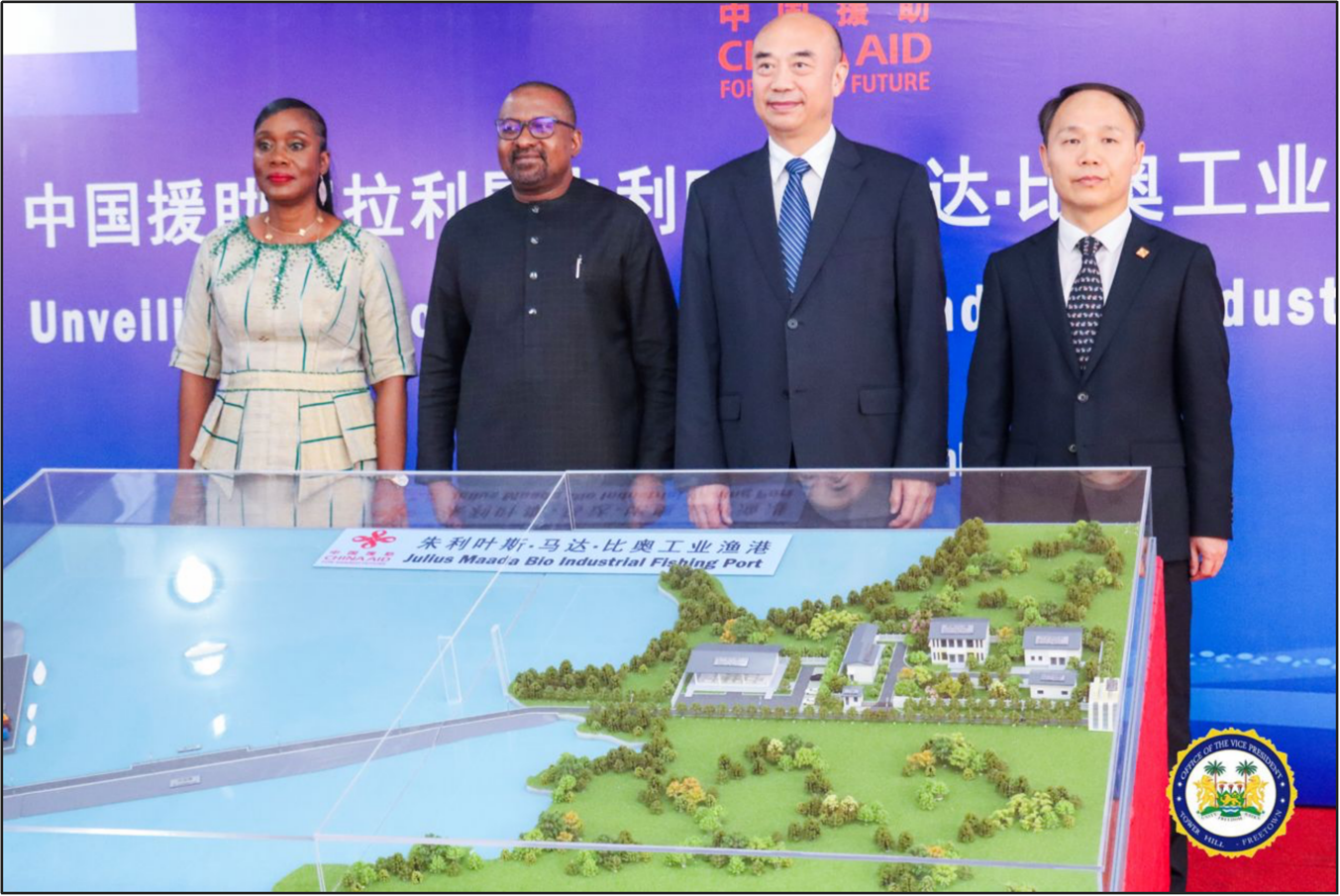
Freetown, Sierra Leone — November 15, 2025 Sierra Leone officially opened the Julius Maada Bio Industrial Fishing Port in a ceremony that leaders say marks the beginning of a new era for the country’s fisheries and blue economy. Vice President Dr Mohamed Juldeh Jalloh, who represented President Dr Julius Maada Bio at the Bintumani (Black Johnson) launch, described the project as a watershed moment in efforts to modernise the sector, strengthen livelihoods, and increase national revenue generation.
Dr Jalloh welcomed a delegation led by Chinese Vice Premier Liu Guozhong, emphasising that the port project is a clear symbol of Sierra Leone’s long-standing and productive partnership with the People’s Republic of China. The Vice President publicly thanked the Chinese government for its continued support, highlighting a $55 million grant that helped fund the construction of the cutting-edge facility.
According to officials, the new industrial port will transform multiple elements of Sierra Leone’s fishing value chain. The facility will help to improve fleet operations and vessel repairs, expand capacity for fish processing and handling, and facilitate increased exports. The government expects the port to create new business opportunities for local entrepreneurs and generate jobs in coastal communities by improving operational efficiencies and reducing post-harvest losses.
Dr Jalloh emphasised that the port is consistent with Sierra Leone’s National Blue Economy Strategy, which seeks to maximise the country’s marine resources in an economically productive and environmentally sustainable manner. He emphasised that the government intends for the port to contribute not only to revenue generation, but also to sustainable fisheries management and increased climate resilience for coastal populations and marine ecosystems.
Chinese Vice Premier Liu Guozhong hailed the launch as a significant achievement in bilateral cooperation, citing decades of collaboration in fisheries, agriculture, resource assessment, and human capacity development. He stated that these collaborative efforts have resulted in job creation, improved livelihoods, and laid the groundwork for increased bilateral trade and investment.
Mr Liu cited recent policy steps taken under the bilateral framework, such as agreements on economic partnership and the export of wild aquaculture products, as examples of how fisheries cooperation has strengthened and the sector has been among the first to benefit from new arrangements. He expressed confidence that, once fully operational, the Julius Maada Bio Industrial Fishing Port will help to grow Sierra Leone’s local fishing industry, facilitate sustainable trade, and provide tangible benefits to communities and partners alike. The Vice Premier concluded by wishing the project success and reaffirming China’s commitment to mutual development and prosperity.
Princess Dugba, Minister of Fisheries and Marine Resources, described the unveiling as a significant milestone for Sierra Leone’s blue economy, describing the $55 million Chinese-funded investment as strategic for modernising the sector and addressing long-standing issues such as post-harvest losses. She described the port’s main infrastructure components: a 500-metre quay, a 3,000-square-metre basin, administrative offices, and a trading market capable of handling 20,000 metric tons of fish.
Princess Dugba also stated that the port is expected to spur private-sector investment along the fisheries value chain. She expects opportunities in fish processing, ice production, net manufacturing, and marine tourism, allowing Sierra Leone to advance up the value chain and emerge as a regional hub for fisheries trade and value addition.
According to government officials and development partners, operationalising the port will necessitate parallel investments in training, regulatory oversight, and resource management to ensure the facility generates long-term economic and social returns.
Authorities have stated that in the coming months, they will prioritise ensuring that the port’s benefits reach local communities, that fisheries are responsibly managed, and that the infrastructure contributes meaningfully to national development objectives under the Blue Economy Agenda. In the coming months, authorities said they will focus on ensuring that the port’s benefits reach local communities, fisheries are responsibly managed, and the infrastructure contributes meaningfully to national development goals under the Blue Economy agenda.
Subscribe to Updates
Get the latest creative news from FooBar about art, design and business.
Sierra Leone Industrial Fishing Port as Part of $55 Million China-Funded Fisheries Modernisation Initiative

gleanernewspaper
Gleaner Newspaper is the Home for exclusive local news, views, and adverts from Sierra Leone. Publisher: Gleaner Communications Sierra Leone.