
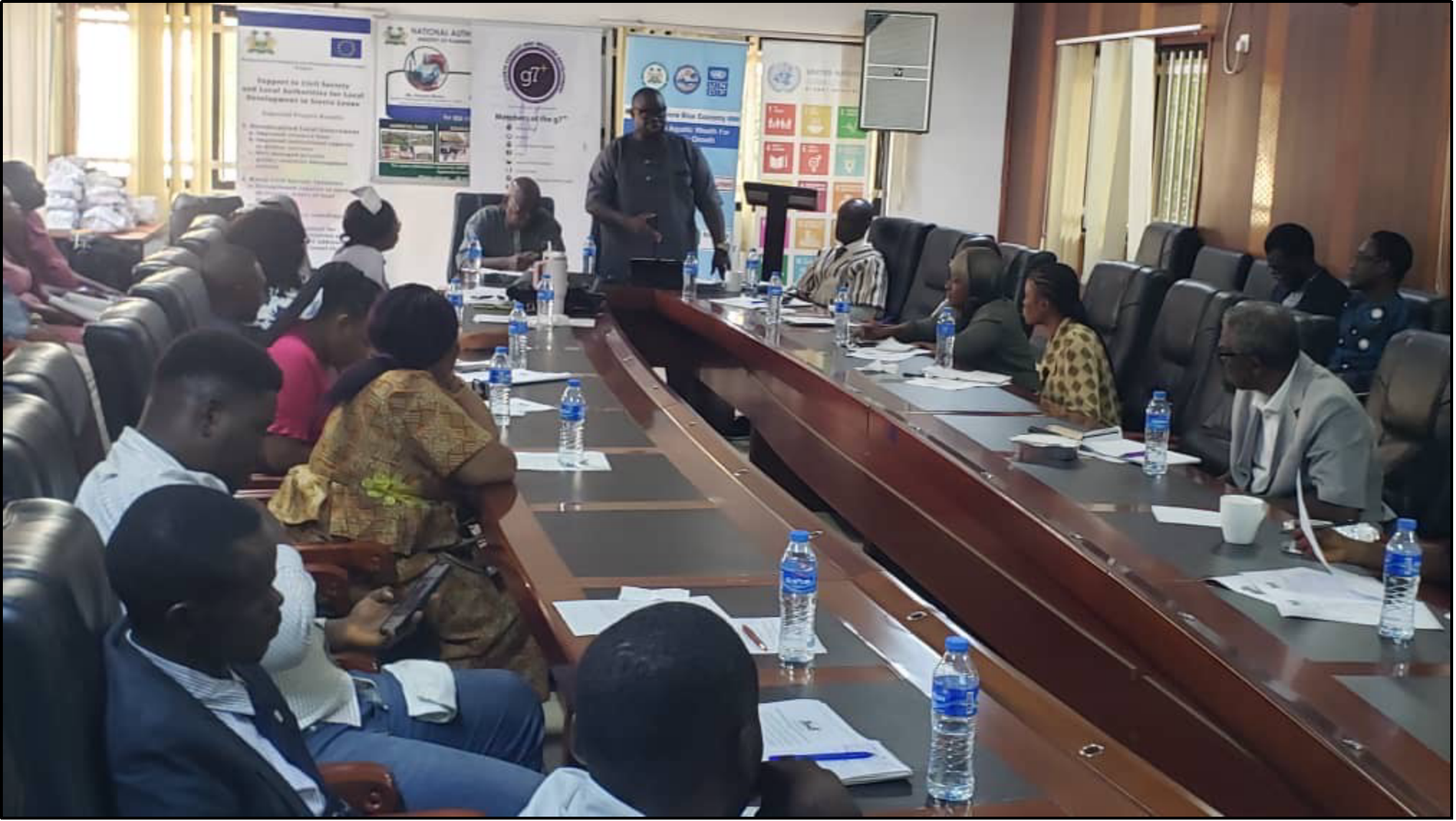
On Thursday, November 13, 2025, the Population Secretariat of the Ministry of Planning and Economic Development (MoPED) completed a full-day stakeholders’ engagement at the Ministry’s conference room in Tower Hill, Freetown, to conduct the Annual Review of Sierra Leone’s commitments under the International Conference on Population and Development (ICPD) framework. The meeting brought together a diverse group of national actors to evaluate progress, identify gaps, and renew collective responsibility for implementing Sierra Leone’s renewed ICPD commitments through 2030.
The engagement aimed to foster national ownership of the ICPD agenda, promote shared responsibility for implementation, and ensure that the commitments were in line with the Medium-Term National Development Plan (MTNDP), Agenda 2063, Vision 2035, and the Sustainable Development Goals (SDG). Presentations, panel discussions, and interactive plenary sessions were used to improve collaboration, gain a better understanding of the connections between population issues and development outcomes, and reach agreement on priority actions to accelerate human capital development and inclusive growth.
More than 48 people attended, including government officials, development partners, academics, traditional and religious leaders, civil society, and community groups. Delegates included the Inter-Religious Council of Sierra Leone, the United Nations Population Fund (UNFPA), the Ministries of Health and Sanitation and Gender and Children’s Affairs, the Institute of Population Studies at Fourah Bay College, the National School of Midwifery, Statistics Sierra Leone, Members of Parliament, traditional leaders, market women, people with disabilities, students from Prince of Wales and Freetown Secondary School for Girls, the media, and others. The diverse representation emphasised the organisers’ desire to foster a broad-based consensus and country ownership of the ICPD roadmap.
Mr Osman Conteh, Deputy Development at MoPED, explained in his welcome remarks that the purpose of the engagement was to assess progress, strengthen partnerships, and renew Sierra Leone’s commitment to delivering on the transformative commitments agreed upon under the ICPD framework. He emphasised that these commitments were not simply policy declarations, but rather national pledges to improve people’s lives through investments in health, education, gender equality, and economic opportunities.
Hon. Musa Fofanah, Chair of the Parliamentary Committee on Planning and Economic Development, emphasised Parliament’s role in implementing ICPD priorities through budgets, legislation, and oversight. He stated that the framework provides a solid foundation for aligning population dynamics with sustainable development goals, emphasising that implementation is both a policy imperative and a national obligation, especially for women, adolescents, and young people.
Stakeholders reviewed progress since the 2024 ICPD status report and discussed priority targets for the years 2025-2030. The meeting resulted in a set of specific, measurable recommendations aimed at accelerating reproductive, maternal, newborn, and adolescent health, strengthening the health workforce, preventing harmful practices, and protecting the rights of girls and young women.
The key resolutions adopted by participants were:
• A commitment from the government to contribute up to US$1.5 million per year, beginning in 2025, toward the procurement of reproductive health and family planning (RH/FP) commodities in collaboration with UNFPA.
• A target of lowering maternal mortality from 443 deaths per 100,000 live births in 2024 to 219 by 2030.
• The goal is to increase cervical cancer screening coverage to 70% of women of reproductive age by 2030 through national awareness campaigns, community outreach, and improved diagnostic and treatment services.
• A pledge to train and employ 3,000 qualified midwives in government health facilities by 2030, improving maternal and newborn care. Additionally, the pledge aims to increase the size of the pin-coded midwifery workforce in public facilities by 50% by 2030 to promote equitable distribution and retention.
• Targeted interventions in high-prevalence districts will reduce the prevalence of Female Genital Mutilation (FGM) from 83% in 2024 to 40% by 2030. An Anti-FGM law will be drafted and enacted by 2026 to explicitly prohibit the practice and impose penalties on facilitators and practitioners.
• Goals include lowering teenage pregnancy from 20% to 10% by 2030, raising awareness and enforcing the Child Marriage Act in all 190 chiefdoms by 2030, and reducing the proportion of girls married before the age of 18 from 30% to 15%.
Participants also discovered a drafting inconsistency in the circulated document regarding the contraceptive prevalence rate, which was listed as falling “from 21% to 20% by the end of 2030” — a decrease that stakeholders suspected was an error. As part of the follow-up process, the assembly decided to clarify and agree on an appropriate, ambitious target for increasing contraceptive prevalence among women aged 15 to 49.
The session included PowerPoint presentations on Sierra Leone’s progress toward ICPD commitments, a feedback-rich interactive plenary in which stakeholders debated recommendations and next steps for updating the ICPD status, and the adoption of a joint stakeholders’ declaration in support of the 2024 ICPD commitments. A question-and-answer session allowed participants to probe technical and implementation issues, while panel discussions emphasised the importance of coordinated action across sectors and levels of government.
MoPED will compile the day’s results, including the joint declaration, agreed-upon targets, and follow-up actions, and incorporate them into national planning and budgeting processes. The meeting inspired stakeholders to prioritise evidence-based, people-centred approaches to improve reproductive health, gender equality, and human capital development in Sierra Leone. The event concluded with a vote of thanks and a pledge to continue collaborating between the government, development partners, civil society, and communities to achieve the ICPD vision by 2030.
