
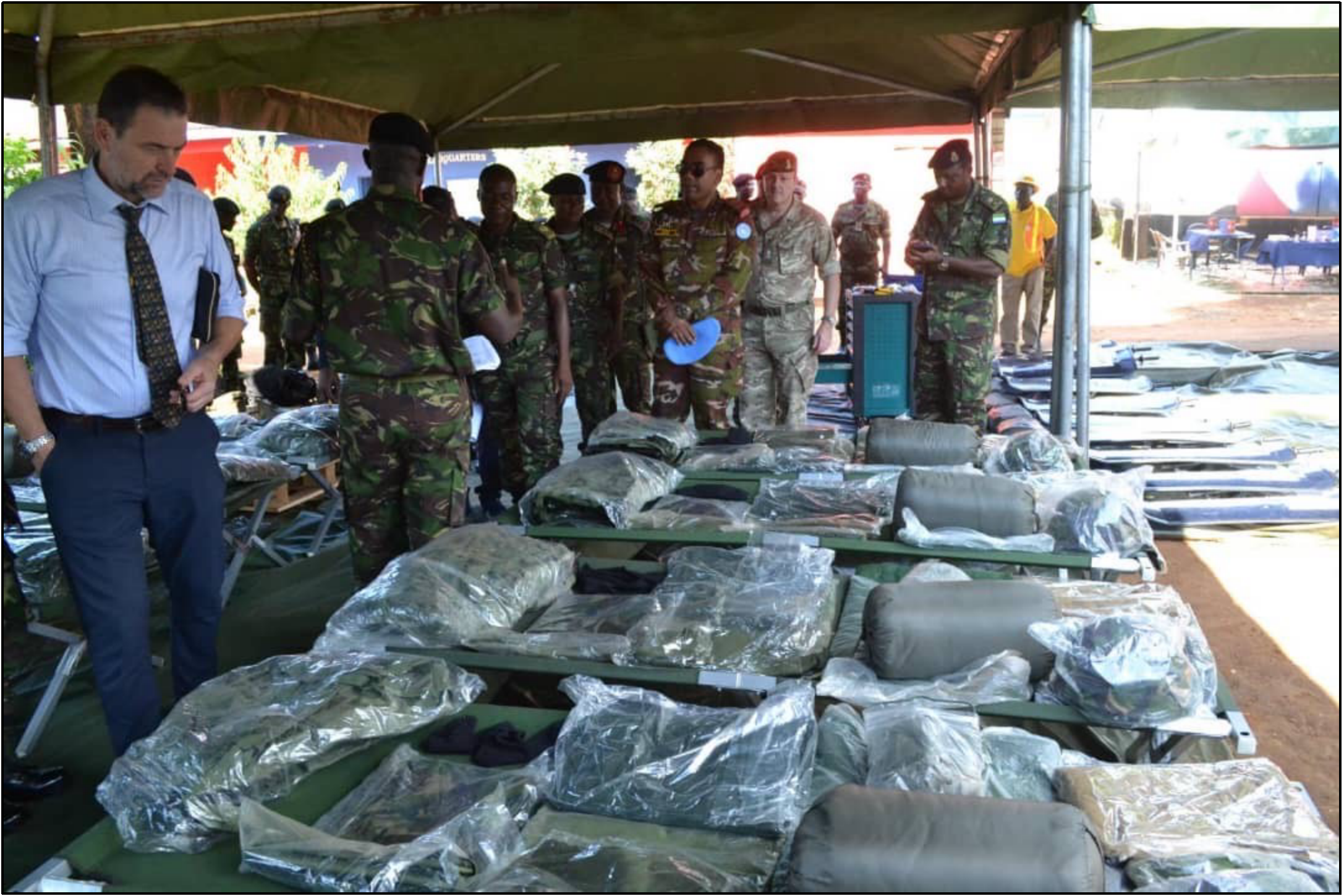
A United Nations Assessment and Advisory Visit (AAV) Team last week conducted a thorough assessment of the Republic of Sierra Leone Armed Forces’ (RSLAF) readiness to return to international peacekeeping missions. The assessment was conducted on October 1 and 2, 2025, by a four-person delegation led by James D’Ercole of the UN Department of Peacekeeping Operations in New York. British and Canadian observers also attended.
Following the UN Statement of Unit Requirements (SUR), the Team assessed a wide range of criteria deemed necessary for deployment to a peacekeeping theatre. The review focused on unit capability and training, personnel strength and readiness, gender inclusivity, medical facilities, equipment, logistics, and other mission support requirements. On-site, inspectors examined a wide range of RSLAF equipment, including vehicles, weapons, ammunition, and support materials.
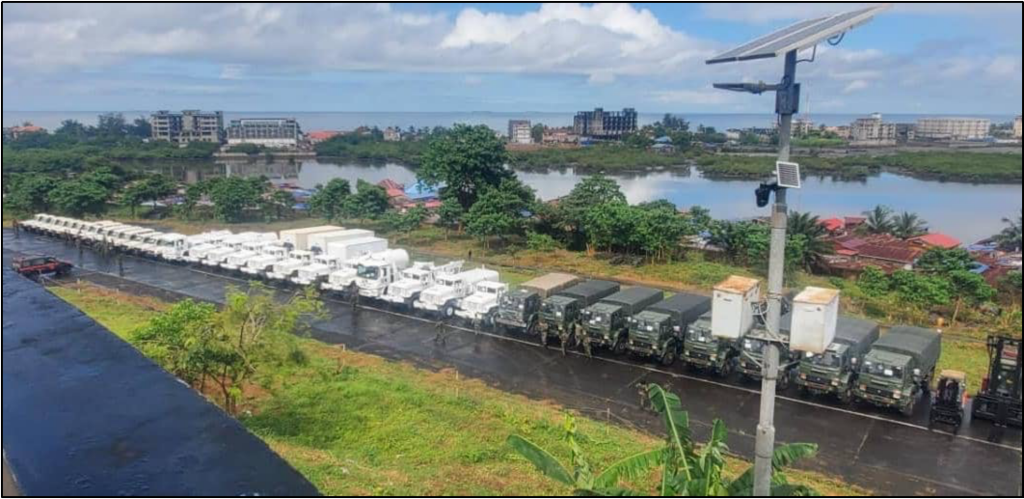
The assessment is part of a larger effort by Sierra Leone’s leadership to restore the country’s contribution to international peacekeeping operations. On Armed Forces Day 2021, President and Commander-in-Chief Brigadier-General Julius Maada Bio (Retired) pledged to return the RSLAF to peacekeeping duties. In pursuit of that pledge, President Bio has purchased peacekeeping equipment for the force through international engagements. Furthermore, the African Union recently donated several items of machinery and equipment to the RSLAF, totalling approximately ten million dollars.
The AU gift package includes armoured infantry carriers, an ambulance, military protective assault vehicles, troop-carrying vehicles, heavy-duty cargo trucks, water and fuel bowsers, sport utility vehicles, combat jeeps, forklifts, and other logistical and mobility assets. According to RSLAF officials, this hardware is intended to improve the force’s ability to meet the logistical, mobility, and protection needs of modern peacekeeping missions.
The Chief of Defence Staff (CDS) will translate equipment and commitments into deployable capability.
Lieutenant General Amara Idara Bangura formed a 200-person peacekeeping contingent and trained them at the Peace Mission Training Centre (PMTC). As the contingent nears completion of training, the CDS requested the UN AAV Team to conduct an on-site assessment to validate their readiness and compliance with UN requirements.
Sierra Leone has a long, albeit intermittent, history of international peacekeeping. Sierra Leone’s first mission was in 1961, when it contributed troops to the United Nations Operation in the Congo (UNOC), the UN’s first major peacekeeping mission in Africa after its founding. Sierra Leone took part in several regional and international operations over the following decades.
Sierra Leone sent its first batch of battalions, known as LEOBATT 1, to Liberia in 1990 as part of the ECOWAS Monitoring Group. The deployment was intended to protect President Samuel Kayan Doe’s Liberian government from rebels led by Charles Ghankay Taylor of the National Patriotic Front of Liberia (NPFL). Charles Ghankay Taylor leads the National Patriotic Front of Liberia (NPFL) rebels. The country’s internal strife and the aftermath of the coup led by Major Johnny Paul Koroma of the Armed Forces Revolutionary Council (AFRC). On May 25, 1997, Koroma overthrew President Alhaji Ahmad Tejan Kabbah and formed a coalition with rebels from the Revolutionary United Front (RUF) led by Corporal Foday Saybana Sankoh. Toppled the AFRC and reinstated President Kabbah.
Sierra Leone’s civil war ended in 2002, and the country resumed its significant participation in Sierra Leone’s civil war ended in 2002, and the country resumed significant participation in the refugee. The Sierra Leone Reconnaissance Company (SRC 1) was the first Sierra Leone unit to deploy there. During the UNAMID mission, Sierra Leone rotated five contingents. The late Brigadier-General Komba Sylvester Mansa-Musa Mondeh served as Sector Commander and Force Commander, making him the first Sierra Leonean to hold such positions in an international peacekeeping theatre. Sierra Leone withdrew its UNAMID contingents in 2013, as the hybrid mission began to reduce troop levels.
Another significant deployment occurred in 2013, when a Sierra Leone battalion, known as LEOBATT 1, was sent to Somalia as part of the African Union Mission in Somalia. The contingent numbered around 850 people and was stationed in the Somali towns of Kismayo, Tabda, and Dobley. Sierra Leone was the first Troop Contributing Country (TCC) from outside East Africa to join AMIS.
The contingent’s operational performance led to an endorsement to command an AMISOM sector, equivalent to brigade level. The late Brigadier-General Tamba Rodnic Allieu was appointed as Sector Commander. The Sierra Leone contingent was about to rotate when the deadly Ebola Viral Disease (EVD) outbreak struck Sierra Leone and neighbouring countries in 2014. As fears of disease spread increased, the Somali government rejected troop rotations from Ebola-affected countries, and Sierra Leone withdrew its forces.
The last Sierra Leone contingent left international theatres ten years ago, following the Ebola outbreak that began in May of 2014. The current assessments and recent acquisition of equipment, combined with targeted training of a new peacekeeping company, indicate a national effort to restore Sierra Leone’s role as a capable troop contributor to regional and UN peacekeeping operations. The UN AAV Team’s findings from its October visit will guide certification decisions and the RSLAF’s return to the peacekeeping theatre.
