
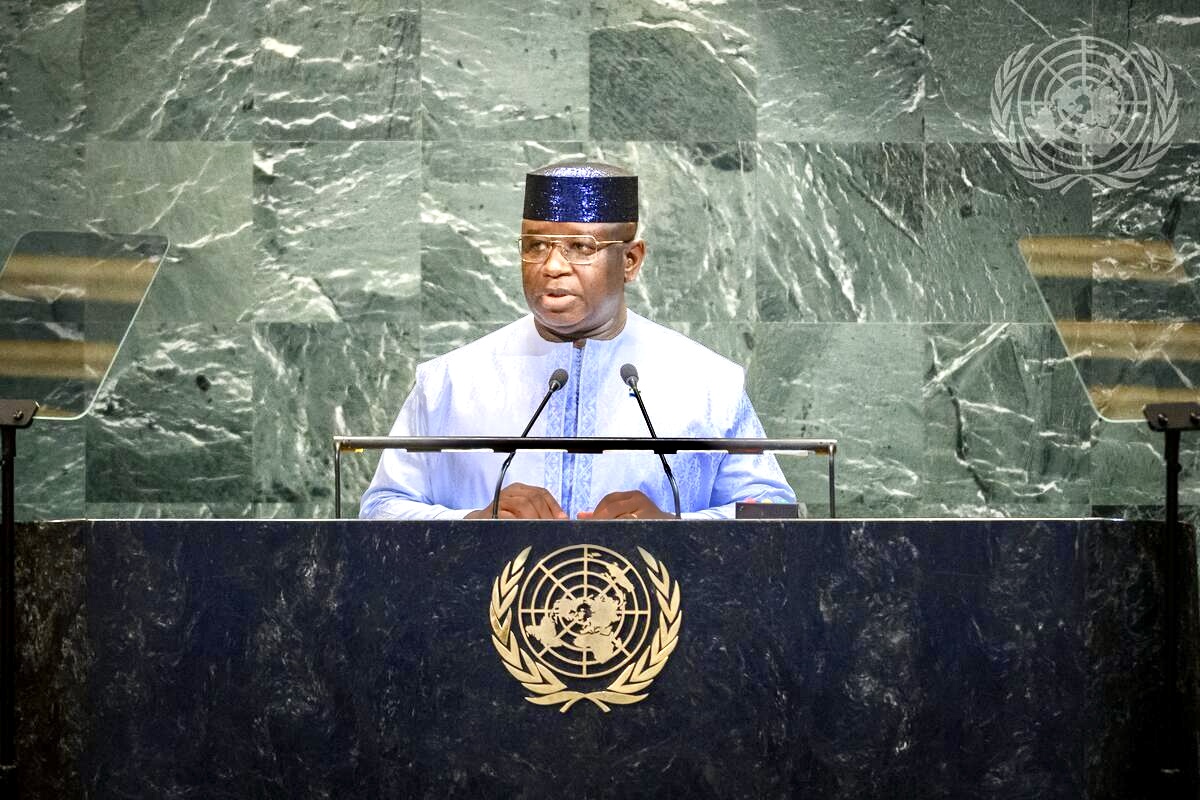
Sierra Leone’s President Julius Maada Bio used his address to the United Nations as part of the UN80 commemorations to call for a fundamental reimagining of multilateralism so that “peace, dignity, and equality are not promises on paper, but realities in people’s lives.” He emphasised that no country can confront today’s global crises alone, citing his country’s participation in both the Economic Community of West African States (ECOWAS) and on the international stage as examples of how collective action can produce results.
Recalling Sierra Leone’s own post-conflict journey, President Bio cited the United Nations’ role in his country’s recovery, as well as the 2014 closure of the United Nations Integrated Peacebuilding Office in Sierra Leone (UNIPSIL), as evidence that sustained international engagement and national ownership can lead to transformation. “Sierra Leone’s story is proof that multilateral solidarity works — when grounded in trust, mutual respect, and genuine investment in national ownership,” he tweeted.
Sierra Leone has made significant contributions to regional and global stabilisation efforts, including supporting stability in the eastern Democratic Republic of the Congo, de-escalating tensions in the Middle East, and providing political support. At the same time, President Bio sharply criticised the United Nations Security Council, claiming that recent conflicts have demonstrated the body’s limitations. At the same time, President Bio sharply criticised the United Nations Security Council, claiming that recent conflicts have demonstrated the body’s limitations. He described the genocide in Gaza as preventable and stated that efforts to achieve a two-state solution have been impeded. “We reiterate our call for a cease-fire in Gaza. There is now a cease-fire in Sudan. “There is a ceasefire in Ukraine now,” he declared. He irritated the Council with a line that emphasised his broader concern about the use of veto power: “A veto should never be a verdict against humanity,” he said, warning that selective adherence to international law has eroded the UN’s credibility.
Aside from immediate security crises, he advocated for a stronger role for regional organisations, urging the United Nations to strengthen its ties with ECOWAS and other regional mechanisms. President Bio praised ECOWAS’ recent efforts to strengthen democracy and stability in Liberia and Gambia, calling the organisation “an African solution to African problems” and urging the UN to recognise and support such regional initiatives. His delegation prioritised increased African representation at the highest levels of the United Nations. According to Bio, Africa’s lack of permanent seats on the Security Council impedes the body’s ability to act in a regional context, resulting in delays that cost lives. He demanded two permanent Council seats for Africa.
Climate change was also a central theme in his remarks. He reminded the assembly that Sierra Leone faces an existential threat from climate change, despite its negligible emissions. The country has mainstreamed climate adaptation efforts, ratified the Biodiversity Beyond National Jurisdiction Treaty (BBNJ), and called on wealthier countries to honour their commitments, including a $100 billion annual climate finance pledge. “Climate justice is not charity.” It is a legal and moral duty. He stated that there is no justice if the poorest people are left to pay the highest climate price.
