

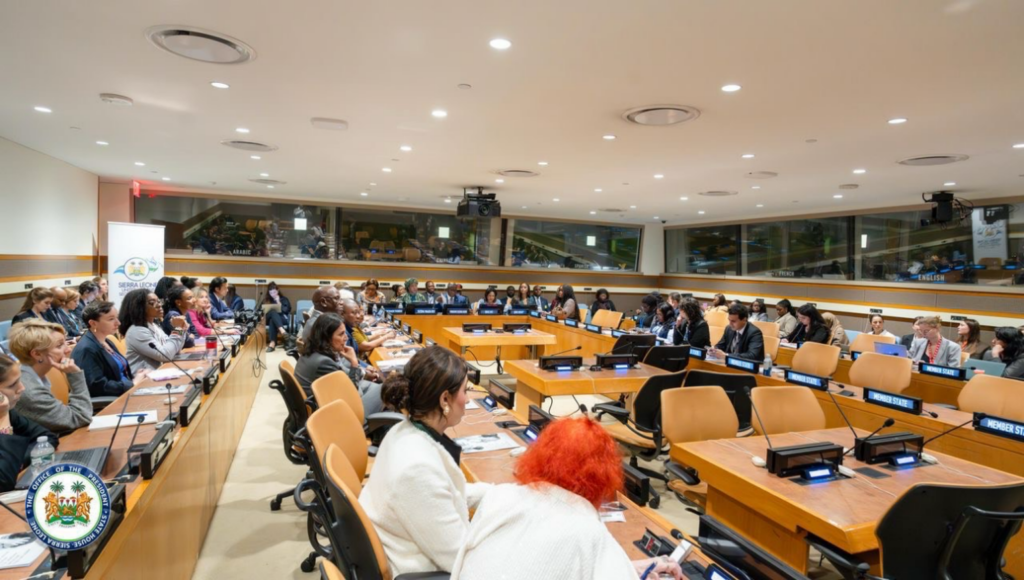
President Julius Maada Bio used a High-Level Event on Pregnancy, Children Born, and Sexual Violence in Conflict to make a strong call for immediate international action to assist survivors and children born from conflict-related sexual violence.
He thanked the First Lady of Sierra Leone and UN Special Representative on Sexual Violence in Conflict Pramila Patten for convening the dialogue, describing it as a necessary confrontation with a “painful reality” — the suffering of women and girls who become pregnant as a result of sexual violence in war, as well as the stigma faced by children born from those assaults. Speaking about Sierra Leone’s recent history, President Bio recalled the brutality of the country’s decade-long civil war, during which an estimated 20,000 children were born as a result of rape and some girls were forced into sexual slavery at the age of 12. “These memories compel us to act,” he said, describing the nation’s history as both a warning and a moral obligation to respond decisively to similar abuses elsewhere.
President Bio detailed a number of national measures Sierra Leone has implemented to combat sexual and gender-based violence. He mentioned that the government declared sexual and gender-based violence a national emergency, set up a dedicated Sexual Offences Court, expanded One-Stop Centers to provide survivors with coordinated services, strengthened protections against early marriage, and advanced its flagship free quality education program.
These steps, he contended, show how states can prioritise prevention, accountability, and long-term recovery for survivors and their children. These steps, he contended, show how states can prioritise prevention, accountability, and long-term recovery for survivors and their children. Violence in conflict is not only a gross violation of human rights, but it also poses a threat to peace and stability. He emphasised Sierra Leone’s role in advancing accountability at the United Nations, including a partnership with Japan in 2022 that helped advance the first UN resolution on remedies for victims of sexual violence. This resolution affirms the rights of survivors to justice, reparations, and rehabilitation.
President Bio called for a shift away from recognition and toward concrete action. He supported the UN Secretary-General’s recommendations to ensure survivor-centred services, to guarantee nationality, legal protections, and full rights for children born of rape, to incorporate survivors into peacebuilding and reconciliation processes, and to provide adequate funding for reparations and reintegration programs. Above all, he urged that survivors’ voices be prioritised in policy and programming, emphasising that those affected must help shape the solutions intended to help them.
The event also included powerful interventions from Sierra Leone’s First Lady Fatima Maada Bio, the Democratic Republic of Congo’s First Lady Denise Nyakeru Tshisekedi, and the UN Secretary-General’s Special Representative on Sexual Violence in Conflict, Pramila Patten. UNFPA Goodwill Ambassador Isha Sesay moderated the high-level discussion and wrapped it up with a summary of the Global Declaration of Principles on the Rights of Children Born of Conflict-Related Rape.
President Bio concluded with a call to solidarity and urgency: the international community must turn words into commitments and actions, creating a world where women’s bodies are never used as battlegrounds and every child has dignity, rights, and hope.
