
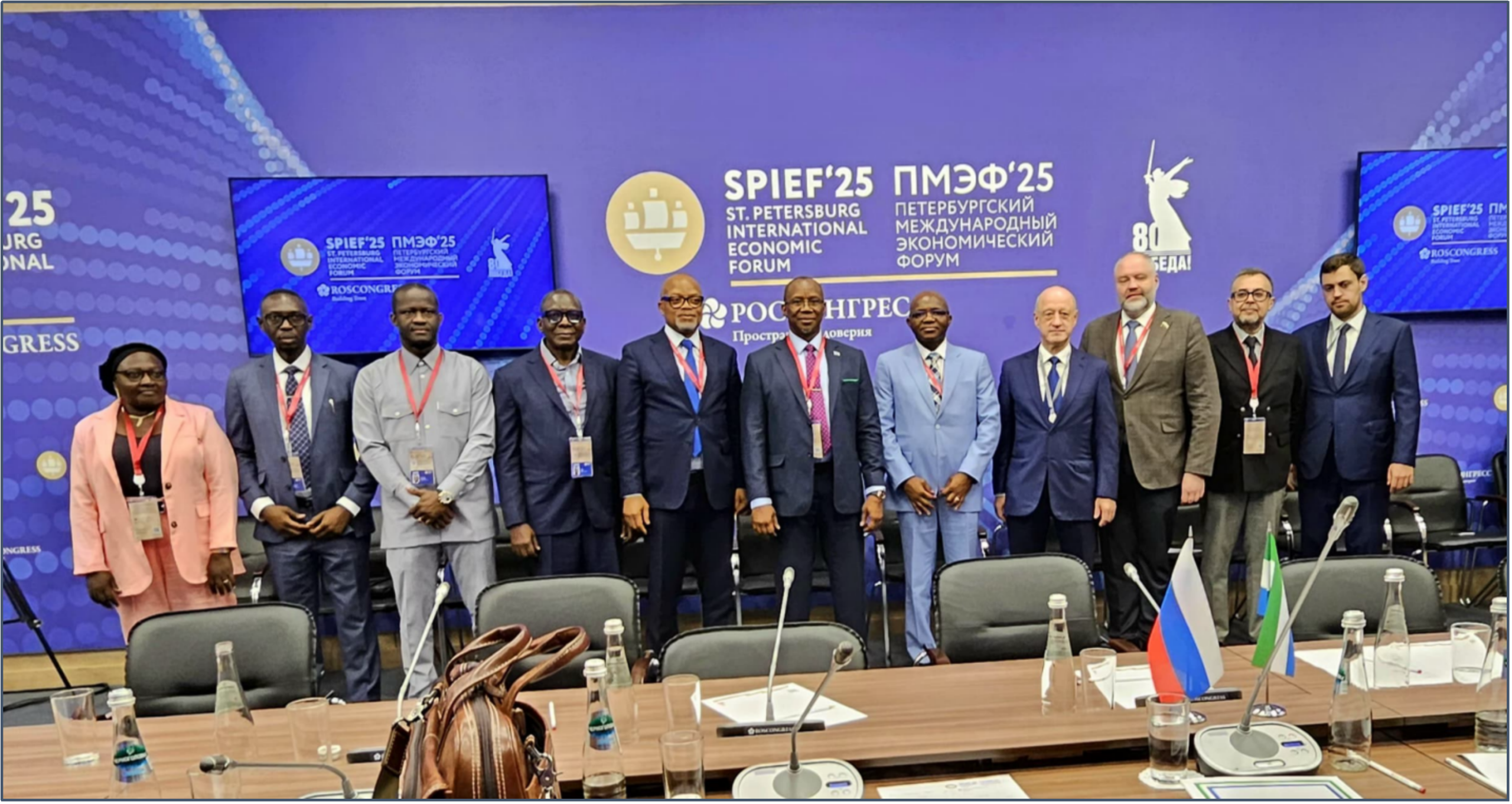
Sierra Leone’s Majority Leader and Leader of Government Business, Hon. Mathew Sahr Nyuma, met with Babakov Alexander Mikhailovich, the Deputy Chairman of the State Duma of the Russian Federation. This high-level meeting, held recently, marks a pivotal moment in the ongoing efforts to bolster inter-parliamentary cooperation and deepen the longstanding relations between Sierra Leone and Russia.
The meeting unfolded in a spirit of collaboration, aimed at enhancing both diplomatic and legislative ties. Historically, the relationship between the two countries has been characterized by mutual respect, political stability, and shared aspirations for economic development. Recognizing the strategic role of parliamentary diplomacy, both parties engaged in discussions aimed at fostering direct dialogue between lawmakers, which is essential for supporting broader government-to-government relations.
Central to the discussions was the proposal for establishing formal mechanisms that would facilitate regular communication and exchanges between the Parliaments of Sierra Leone and Russia. The parties explored the potential benefits of sharing best practices in legislative governance, policymaking, and democratic oversight. Hon. Nyuma articulated the importance of effective parliamentary collaboration as a means to not only deepen bilateral relations but also to contribute to multilateral efforts addressing global challenges.
In his remarks on the topic, “Shaping a Just and Sustainable World Order by Strengthening the Shared Values of the World Majority Countries,” Hon. Nyuma emphasized the historical cordial relations between Sierra Leone and Russia. He noted, “Both nations have demonstrated a commitment to addressing global challenges collaboratively. Parliamentary diplomacy presents a unique avenue to deepen these ties and align legislative efforts for mutual benefit.” His statement underscored the belief that inter-parliamentary cooperation can serve as a vehicle for fostering economic growth and stability in both nations.
The discussions also ventured into the realm of expanding economic collaboration. Hon. Nyuma and Mr. Babakov deliberated on how parliamentary influence can be leveraged to bolster bilateral trade and investment, particularly in strategic sectors such as education, energy, health, agriculture, mining, and information technology. They acknowledged the crucial role that legislative bodies play in crafting enabling legal frameworks that encourage foreign direct investment and facilitate joint ventures between businesses in both countries.
In light of the current global and regional security challenges, the two leaders discussed the role of Parliaments in conflict resolution, peace-building, and the promotion of democratic values. They affirmed that strong legislative institutions are vital for upholding human rights and ensuring political stability. This engagement highlighted the potential of parliamentary diplomacy in addressing pressing issues that affect both nations and the broader international community.
The meeting also addressed urgent global concerns, such as climate change, public health crises, and food insecurity. Hon. Nyuma and Mr. Babakov underscored the need for joint legislative responses to these human security threats, calling for deeper cooperation in multilateral forums like the United Nations. Their discussions reflected a shared commitment to tackling global challenges through collaborative legislative action.
As the meeting drew to a close, both parties reached several key agreements. They committed to developing a roadmap for sustained inter-parliamentary dialogue and cooperation and identified priority areas for legislative collaboration. This framework aims to reinforce mutual support on both domestic and international fronts. To ensure the momentum of their discussions, they agreed to draft and sign a Memorandum of Understanding (MoU) that would formalize their inter-parliamentary partnership. Additionally, they planned to establish a joint working group tasked with overseeing the implementation of initiatives and organizing follow-up meetings to assess progress and refine collaboration strategies.
This renewed focus on legislative diplomacy signals a robust commitment from both Sierra Leone and Russia to not only advance their bilateral relationship but also contribute to addressing shared global challenges through mutual understanding and legislative action.
In a related engagement, Hon. Nyuma concluded his visit to Russia by meeting with His Excellency Mr. Mikhail Bagdanov, the Deputy Minister of Foreign Affairs for Africa and the Middle East. During this meeting, he conveyed warm greetings from President Julius Maada Bio and the people of Sierra Leone. Hon. Nyuma expressed gratitude for Russia’s longstanding support of Sierra Leone, highlighting the assistance provided in various sectors, including education, the donation of 200 dump trucks, and vaccine support during the COVID-19 pandemic.
Mr. Bagdanov reaffirmed Russia’s commitment to reopening its embassy in Freetown, as previously promised by President Vladimir Putin. The two officials discussed various issues pertinent to multilateral cooperation, peace-building, and international collaboration between their two nations.
The Sierra Leone delegation attending this year’s St. Petersburg International Economic Forum included notable figures such as His Excellency Ambassador Mohamed Yongawo, Hon. Minister of Mines and Mineral Resources Mr. Julius Mattai, and Alhaji Hadji Dabo, Director General of the National Minerals Agency (NMA). The presence of these key officials underscores the importance of this diplomatic mission.
In a panel discussion on the theme “Shaping a Just and Sustainable World Order by Strengthening the Shared Values of the World Majority Countries,” Hon. Nyuma reiterated the enduring relationship between Sierra Leone and Russia, which has persisted through various governmental changes. He expressed satisfaction with the assistance rendered by Russia to the people of Sierra Leone and emphasized the essential role of Parliament in nation-building. “Parliaments worldwide have a responsibility to be accountable and transparent to their people,” he stated. He further encouraged his colleagues to adopt strong parliamentary practices to help Sierra Leone advance in governance, transparency, and accountability.
Hon. Nyuma concluded by asserting that when Parliament holds the government accountable, it empowers the people and strengthens democracy within the country. This high-level diplomatic engagement highlights not only the strengthening of bilateral ties between Sierra Leone and Russia but also the potential for collaborative efforts in addressing global challenges through legislative action.
