
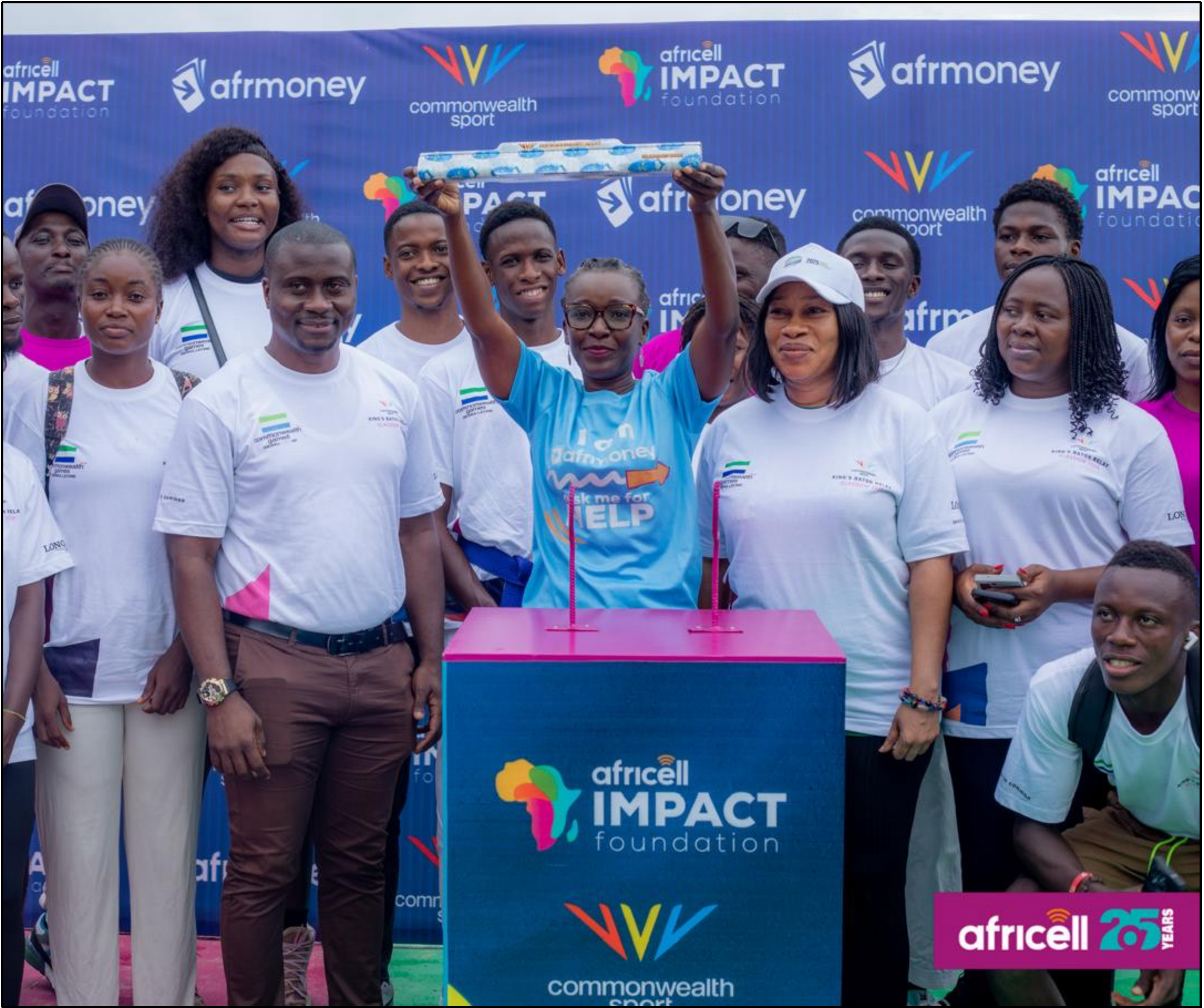
In a powerful demonstration of environmental responsibility and national pride, the Africell Impact Foundation has collaborated with the Commonwealth Games Sierra Leone and the Ministry of Tourism to host the King’s Baton Relay in Freetown, Sierra Leone. This event, which precedes the 2026 Commonwealth Games scheduled to take place in Glasgow, Scotland, served as both a celebration of sports and a rallying cry to combat the pervasive issue of plastic pollution, encapsulated in the slogan “Kip Am Klin.”
The relay took place at the Africell Sports Zone along Lumley Beach Road, a location that underscores the significance of protecting Sierra Leone’s coastal ecosystems. Kippy Debs, who serves as the Director of the Africell Impact Foundation and is also the Customer Relations Manager at Africell Sierra Leone, delivered a stirring address during the ceremony. She highlighted the urgent need for collective action to safeguard the nation’s beaches and oceans from the dangers posed by plastic waste.
“Sierra Leone is at a crossroads—one that determines the health of our beaches, oceans, and future generations,” Debs remarked. She elaborated on the insidious nature of plastic waste, which threatens marine life, pollutes shorelines, and diminishes the natural beauty that the nation takes pride in. Debs emphasized that the beaches of Sierra Leone are not merely recreational sites; they are critical ecosystems that support biodiversity, local livelihoods, and tourism. With millions of tons of plastic entering the oceans worldwide each year, she asserted that the time for mere awareness has passed; it is now time for decisive action.
The Africell Impact Foundation has been at the forefront of grassroots environmental campaigns aimed at promoting recycling, education, and sustainable policy advocacy. Debs stated, “We have empowered communities to reduce, reuse, and recycle—turning awareness into measurable action.” She called upon all Sierra Leoneans to actively participate in the solution, encouraging involvement in beach clean-ups and the adoption of environmentally responsible practices, assuring everyone that every little effort contributes to a cleaner and healthier environment.
In her closing remarks, Debs urged the athletes preparing for the Glasgow Games in 2026 to strive for both trophies and national pride while being mindful of their environmental footprint. “Let’s leave no trace of plastic behind,” she implored.
Prince Sualley, the President of the Commonwealth Games Sierra Leone, praised the Africell Impact Foundation for its unwavering support, referring to the organization as a “permanent fixture within the sporting community.” He elaborated on the significance of the King’s Baton Relay, explaining that it is a cherished tradition that occurs every four years leading up to the Commonwealth Games. Each of the 74 member countries receives a personalized baton, and Sierra Leone’s baton was designed by Foday Dumbuya, a notable designer based in London. It prominently features the national colors—green, white, and blue.
“This isn’t just a symbolic event,” Sualley stated. “It’s a meaningful opportunity to promote unity, sustainability, and national identity. The beach setting and environmental theme reflect the pressing issue of plastic pollution in our oceans.” He also noted the transition from the Queen’s Baton Relay to the King’s Baton Relay, honoring King Charles III, the current monarch of the United Kingdom and head of the Commonwealth.
The event culminated in a community beach clean-up exercise along the Lumley-Aberdeen stretch, reinforcing the “Kip Am Klin” message through tangible action. Participants took to the shoreline, collecting plastic waste and other debris, embodying the spirit of environmental stewardship.
As Sierra Leone prepares for the 2026 Commonwealth Games in Glasgow, the King’s Baton Relay serves as more than just a ceremonial event; it leaves behind a profound reminder of the importance of environmental responsibility and national unity. The collaboration between Africell, the Commonwealth Games Sierra Leone, and the Ministry of Tourism not only highlights the urgency of addressing plastic pollution but also fosters a sense of community and shared purpose among Sierra Leoneans.
